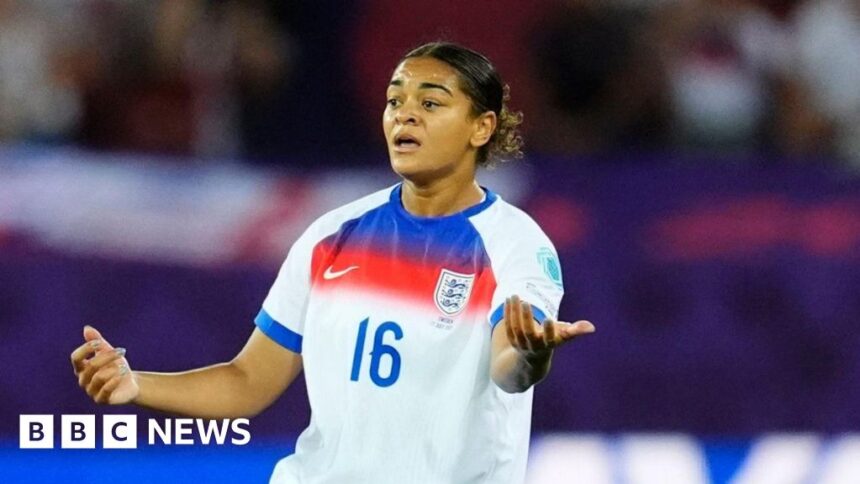
Online Hate Meets the Law: Man Sentenced for Racist Abuse of England’s Jess Carter
The roar of the crowd had barely faded. England’s Lionesses, heroes of a nation once more, were celebrating a historic, back-to-back European Championship victory in the summer of 2025. Yet, while defender Jess Carter was helping to secure glory on the pitch, she was being subjected to a vile torrent of racial hatred online. Today, that abuse has been met with a decisive legal response. Nigel Dewale, a 60-year-old from Lancashire, has been sentenced for sending racially abusive messages to Carter’s TikTok account, a case that underscores the grim intersection of sport, social media, and the long arm of the law.
A Sentence Beyond the Courtroom: Punishment and Deterrence
At Blackburn Magistrates’ Court, Nigel Dewale received a sentence that reflects the serious, multi-faceted nature of his crime. While the six-week prison term was suspended for 12 months, the suite of additional penalties sends a clear message about the consequences of online hate.
The court imposed a four-year football banning order, a significant measure that will prevent him from attending regulated matches. This directly links his online conduct to the world of football he sought to poison. Furthermore, Dewale was given a three-month curfew, ordered to complete 10 days of rehabilitation activity, and fined £239. Crucially, he had previously admitted to sending a malicious message via a public communications network.
This combination of punishments is noteworthy. It moves beyond a simple fine, addressing the offender’s behavior through restriction, rehabilitation, and financial penalty. Legal experts suggest this holistic approach is becoming more common as the justice system grapples with the pervasive harm of online abuse.
- Suspended Prison Sentence: Six weeks, suspended for 12 months.
- Football Banning Order: Four years, barring attendance at matches.
- Curfew: Three months, restricting movement.
- Rehabilitation: 10 days of mandated activity.
- Financial Penalty: £239 fine and court costs.
The Ugly Reality of Abuse in the Beautiful Game
The content of Dewale’s messages, which included a derogatory reference to Carter’s race and falsely suggested people with brown skin were “murderers” and “groomers,” is a stark reminder of the prejudice still festering in the shadows of sport. Jess Carter, a mainstay in the England and Chelsea defense, has been open about the abuse she has faced throughout her career. This incident did not occur in a vacuum; it is part of a sustained pattern targeting Black and minority ethnic players, particularly women.
“What we see here is the weaponization of social media to deliver racist tropes and conspiracy theories directly to a player at the peak of her profession,” says Dr. Anya Patel, a sociologist specializing in sport and discrimination. “The timing is key—during a major tournament, a moment of national pride and personal achievement for Carter. The abuser’s intent is to dehumanize, to undermine that joy, and to remind the player of a hateful worldview that seeks to exclude her. The psychological impact of such targeted abuse cannot be overstated, even for athletes at the elite level.”
The football community, from the Football Association (FA) to clubs and player unions, has intensified efforts to combat this scourge. Reporting protocols are stronger, and partnerships with social media platforms are under constant review. However, this case highlights that while institutional support is vital, ultimate accountability often rests with the criminal justice system.
A Watershed Moment for Online Accountability?
The sentencing of Nigel Dewale may represent a subtle but important shift. The application of a football banning order for online-only abuse is a powerful legal precedent. Traditionally, these orders were used for physical violence or disorder at stadiums. Their extension into the digital realm acknowledges that online hate is not a separate, lesser crime, but a direct attack on the sport and its participants.
“This sentence is a signal,” states Michael Grant, a barrister specializing in cybercrime. “It tells potential offenders that racist abuse hurled from behind a keyboard is not without consequence. The suspended prison sentence hangs as a real threat, the banning order removes a privilege, and the curfew imposes a direct inconvenience. It’s a package designed to deter and to punish meaningfully.”
Predictions for the future suggest a more aggressive legal landscape. We can expect:
- Increased use of existing communications laws to prosecute online hate speech.
- Greater collaboration between police football units and tech platforms to trace offenders.
- More athletes pursuing civil cases against perpetrators for harassment and damages.
- Continued pressure on governments to enact stricter online safety legislation with clearer duties of care for platforms.
The challenge remains immense due to the scale and anonymity of social media. Yet, each successful prosecution builds a blueprint for others to follow.
Strength in the Face of Hatred: The Path Forward
For Jess Carter and her teammates, the focus remains on football. Their resilience in the face of such bile is a testament to their character. The team’s collective stance against all forms of discrimination, often vocal and unified, provides a powerful counter-narrative to the isolated voices of hate.
The true conclusion of this case extends beyond the courtroom. It is a reminder that the fight against racism in football is fought on multiple fronts: on the pitch through excellence, in the stands through allyship, within boardrooms through policy, and now, more firmly, in the courts through law. The sentence handed to Nigel Dewale is not just a punishment for one man; it is a statement of societal values.
It declares that the euphoria of a European Championship victory cannot be marred by bigotry. It affirms that an athlete’s identity is not a weapon to be used against them. And it proves that while the game may be beautiful, the defense of its players from hatred is a serious, and sometimes ugly, business that society is increasingly willing to undertake. The final whistle on online abuse has not blown, but the referees—the courts—are now showing more cards.
Source: Based on news from BBC Sport.