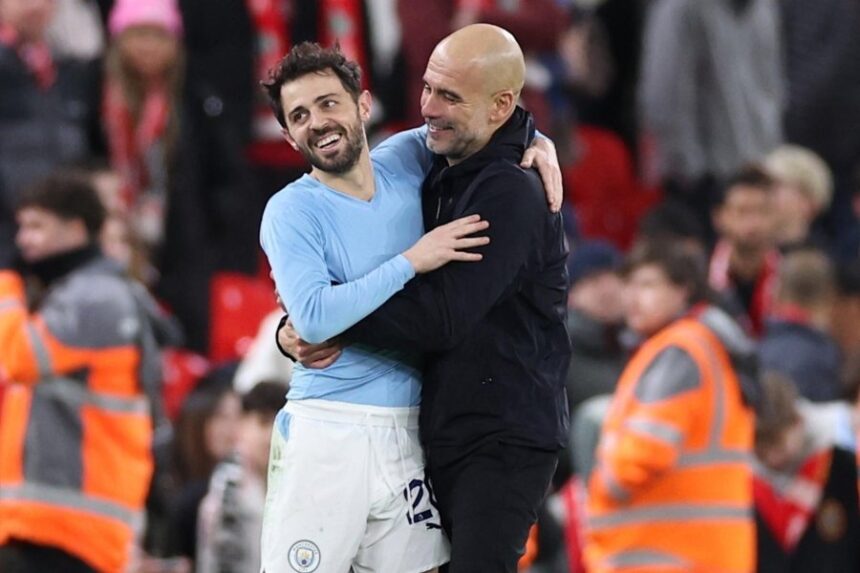
Bernardo Silva’s Manchester City Era Ends: The Architect of an Era Bids Farewell
The news, when it finally arrived, felt both seismic and serene. On a quiet Thursday, Bernardo Silva, the Portuguese magician whose feet painted masterpieces on the Premier League canvas for nearly a decade, confirmed what many had feared and anticipated. In an emotional social media post, the Manchester City midfielder announced his departure from the Etihad this summer, drawing the curtain on one of the most decorated and technically brilliant chapters in the club’s modern history. This isn’t just a transfer; it’s the closing of a defining epoch for both player and club.
The Weight of a Legacy: More Than Trophies
Bernardo Silva’s statement was a masterclass in grace, reflecting the same intelligence he displayed on the pitch. “When I arrived nine years ago, I was following a dream of a little boy,” he wrote, addressing the Cityzens. He acknowledged that the club gave him “much more than I ever hoped for.” His recitation of triumphs—the Centurions, the domestic quadruple, the treble, the four in a row—reads like a timeline of City’s ascent to footballing immortality. With 76 goals and 77 assists in 451 appearances, his statistical contribution is colossal, yet it barely scratches the surface of his true value.
Silva was the embodiment of tactical fluidity and relentless spirit. In an era of superstar signings, he became the ultimate system-enhancer, a player whose role shifted seamlessly from right-wing creator to central midfield metronome, to a false nine, all without a dip in his mesmerizing technical standard. His legacy is etched not just in silverware but in moments of sheer will: the dominant performance against Liverpool in a title-deciding clash, the crucial goals in tight Champions League nights, and the indefatigable pressing that made him, despite his slight frame, a giant in Pep Guardiola’s demanding system.
The Inevitable Speculation: Why Leave and What’s Next?
The speculation surrounding Bernardo Silva’s future had become a perennial subplot, a summer tradition almost as reliable as the transfer window itself. With his contract entering its final year in the 2025-26 season, the writing was on the wall. For a player of his ambition, at 29 years old, this summer represented the last major move of his prime. The reasons are multifaceted:
- New Challenge: After winning every available domestic and European honor, the lure of a different league and culture is a powerful motivator for a footballer of Silva’s curiosity.
- Playing Time Evolution: As City continuously evolves, the competition for places in an already stacked midfield remains fierce, potentially influencing a desire for guaranteed centrality elsewhere.
- Personal Ambition: Reports have long linked him with a move to Spain, with clubs like Barcelona and Paris Saint-Germain historically interested, offering a distinct footballing identity and lifestyle.
His next destination will dominate headlines. A move to La Liga seems a natural fit for his technical prowess, while a project in France or even a lucrative offer from Saudi Arabia cannot be discounted. Wherever he lands, that club will be acquiring one of world football’s most complete and intelligent operators.
The Unfillable Void: What Manchester City Loses
Replacing Bernardo Silva is an impossible task because he was never just one player. He was a multi-tool, a solution to multiple tactical problems, and a unique cultural figure within the squad. His departure leaves a void that transcends the pitch:
Tactical Flexibility: Guardiola loses his ultimate chess piece. Silva’s ability to occupy multiple positions at an elite level gave City an unpredictability and resilience few teams could match. There is no direct replacement on the market who offers that same specific blend of attributes.
Big-Game Temperament: In the highest-pressure matches, Silva’s quality didn’t just remain; it shone brighter. His composure in tight spaces and decision-making under duress were hallmarks of City’s biggest wins.
The “Mentality Monster”: Perhaps his most underrated quality was his tenacity. Coupled with sublime skill was a work rate that set the standard. He was the embodiment of the “noise” he famously dismissed after a crucial victory—a player who answered critics not with words, but with relentless, flawless action.
The club will, of course, move on. The transfer machinery will identify a new superstar, likely younger and with a different skillset. But the specific Bernardo Silva role—that of the humble, world-class, ever-adaptable warrior-artist—may be retired with him.
A Fond Farewell and an Eternal Blueprint
As the summer sun sets on Bernardo Silva’s time in Manchester, the reflection is overwhelmingly positive. He arrived as a promising talent from Monaco and leaves as a certified club legend, a pillar of the greatest period City has ever known. His journey mirrors the club’s own: an ascent to the very pinnacle, achieved through a blend of sublime artistry and unyielding hard work.
For fans, the memories are indelible. The shimmies, the nutmegs, the curled finishes, and the beaming smile after yet another trophy lift. He was a player who connected because his effort was always visible, his love for the craft always apparent. His final message—”it wasn’t all that bad”—will stand as one of football’s great understatements.
The Premier League itself loses one of its great modern characters. In an age of physical giants and explosive athletes, Silva proved that genius, graft, and a low center of gravity could still be the most potent weapons of all. His departure marks the end of an era at the Etihad, but his legacy is permanent. Bernardo Silva wasn’t just a player for Manchester City; he was a defining principle of their golden age. And principles like that never truly leave.
Source: Based on news from Yahoo Sports.