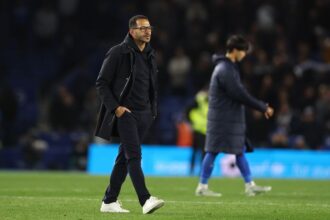



Maresca’s Age-Old Question: Chelsea’s Youth Project Faces Its First Real Test
The Enzo Maresca era at Chelsea was always going to be a fascinating experiment. A disciple of Pep Guardiola, tasked with implementing a complex, possession-based philosophy at a club synonymous with relentless churn and a squad whose average age often resembles a university seminar. The first major tremor in this project, however, may not have come from a defeat, but from the manager’s own pre-match musings. After a chaotic week of speculation linking him back to Leicester City, Maresca arrived at a stormy St James’ Park and, before a ball was kicked, subtly lobbed a philosophical grenade into the heart of Chelsea’s much-debated strategy.
A Chaotic Prelude: Speculation and a Subtle Jab at Strategy
The week leading into Chelsea’s trip to Newcastle was dominated not by tactics, but by tabloid talk. Reports swirled that Maresca was already unsettled, a mere four months into his five-year contract, and that Leicester retained an interest. The Italian batted away the questions with the expected professionalism, insisting it would not distract his squad. Yet, his subsequent comments carried far more weight. When discussing squad building, Maresca ventured into territory that has become almost heretical at Stamford Bridge in the Todd Boehly-Clearlake Capital era: the value of experience.
“Having players who have been through situations, who understand the rhythms of a season, is invaluable,” Maresca hinted, his words a quiet but clear contrast to a recruitment model that has aggressively targeted the world’s most promising under-23 talent. This was not a manager fully at ease with the tools in his kit. He was, in essence, questioning the very foundation of the project he was hired to lead, suggesting the possession-based philosophy he champions might require more seasoned minds to execute under pressure.
St James’ Park Exposes the Raw Nerve
If Maresca’s words were a warning, the first 45 minutes at Newcastle were a brutal validation. Chelsea were not just beaten; they were dismantled, out-thought, and out-fought. The chaotic first half performance was a catalogue of errors that laid bare the manager’s concerns.
- Defensive Fragility: A makeshift backline, missing key figures, was pulled apart with ease, looking uncertain in Maresca’s build-up play and vulnerable in transition.
- Midfield Overrun: The young midfield core was physically and tactically dominated, losing duels and gifting possession in dangerous areas.
- Attacking Impotence: Zero shots on target. A complete failure to establish any offensive rhythm or threat.
The statistics were damning. An Expected Goals (xG) against of 1.97 in the first half was Chelsea’s worst such figure in over two years. It was a period devoid of leadership, game management, or any discernible response to adversity. Nick Woltemade’s two goals were merely the justified reward for Newcastle’s supremacy. This was the nightmare scenario: a young team, trying to play a meticulous system, crumbling in one of the Premier League’s most hostile environments. The absence of experienced heads to steady the ship was glaring.
Analysis: The Core Conflict at Stamford Bridge
Maresca’s post-match analysis likely cut to the quick. The issue isn’t talent; Chelsea’s squad is brimming with it. The issue is game intelligence and resilience—qualities typically forged through seasons of battle, not just academy accolades. The manager’s system demands players who can make constant micro-decisions: when to risk a pass, when to slow the game, how to alter the tactical approach when Plan A is failing. These are not innate skills; they are learned.
Currently, Chelsea’s dressing room lacks a critical mass of players who have that institutional knowledge. The project has been one of potential, not proof. Maresca, a coach deeply invested in tactical detail, is now publicly identifying a gap that data and potential cannot fill: the need for seasoned professionals who can be on-field extensions of his ideas and provide a calming influence when momentum swings violently, as it did at Newcastle.
This creates a direct tension with the club’s business model, which is built on acquiring appreciating assets with long-term resale value. Older players represent depreciation, both financially and in a sporting model obsessed with high energy and pressing. Maresca’s comments suggest he believes the model needs a hybrid approach—a blend of explosive youth and guiding experience to achieve consistent success.
Predictions: How Will Chelsea and Maresca Respond?
The fallout from this chaotic week and dismal performance will define Chelsea’s immediate future. Several paths are now possible.
The January Recalibration: Maresca’s comments will be seen as a direct request to the sporting directors. The January transfer window could become about supplementing youth with targeted, experienced signings—not superstars, but reliable, mid-career professionals who understand the league and can mentor. Think a Mikel Arteta-type figure for his Arsenal, or a James Milner for Liverpool’s recent resurgence.
Internal Solutions & Leadership: The manager must now identify and empower leaders within his existing squad. Who can be his on-pitch lieutenant? This moment pressures the few older players like Raheem Sterling or the captain, Reece James, to step up vocally and performatively. It also asks which of the prodigious talents can accelerate their maturity.
A Philosophical Stalemate: The danger is a growing disconnect between the dugout and the boardroom. If Maresca feels his tools are ill-suited for the job, and the board refuses to adapt its model, the speculation around his future will return with greater force. His £10m move from Leicester was a significant investment; the club will want a return, but not at the cost of abandoning their core strategy.
Conclusion: More Than a Bad Half, a Defining Moment
Chelsea’s 45-minute collapse at Newcastle was more than a poor performance; it was a vivid, real-time case study presented by their own manager. Enzo Maresca didn’t just hint at wanting older heads; he watched his young side deliver a perfect argument for his case. The chaotic week of speculation has now morphed into a profound debate about the club’s identity and the practical requirements of winning at the highest level.
The path forward is fraught with complexity. Can a possession-obsessed coach successfully instill his tactical discipline in a squad of brilliant but raw talents without the steadying influence of veterans? Or will the relentless pressure of the Premier League expose this project as fundamentally unbalanced? Maresca has thrown down the gauntlet, not in defiance, but in diagnosis. How Chelsea’s hierarchy responds will reveal whether this is a true partnership with a shared vision, or merely another chapter in the club’s ongoing period of turbulence. The youth project remains, but after St James’ Park, the call for wisdom has never been louder.
Source: Based on news from BBC Sport.