Ferrari’s Strategic Shift: Hamilton’s Race Engineer Moved to Academy Role After Challenging 2025 Season
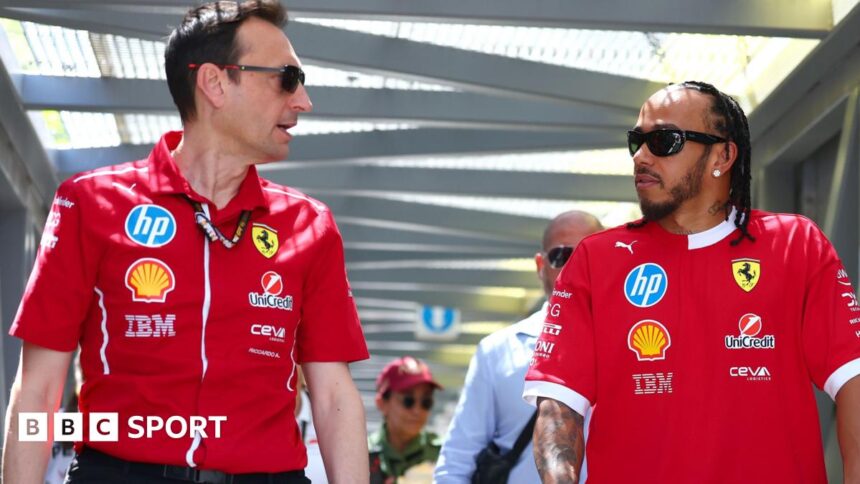
The high-stakes marriage between Formula 1’s most decorated driver and its most storied team has hit its first significant strategic pivot. Ferrari has confirmed that Riccardo Adami, the race engineer for Lewis Hamilton’s tumultuous debut season with the Scuderia, has been reassigned within the organization. This move, following a year punctuated by strained radio exchanges and palpable tension, signals Ferrari’s intent to streamline its most crucial partnership ahead of the 2026 campaign.
Adami, a seasoned Ferrari veteran who previously engineered Kimi Räikkönen and Charles Leclerc, will now helm the prestigious Ferrari Driver Academy and manage the team’s programme for testing previous cars. In a statement notable for its brevity regarding the seven-time champion, Ferrari simply noted: “The appointment of the new race engineer for car number 44 will be announced in due course.” This administrative silence speaks volumes, confirming the widespread speculation that the Hamilton-Adami partnership failed to achieve the synchronicity required to challenge for a title.
A Symphony Out of Tune: Dissecting the 2025 Communication Breakdown
The 2025 season was a narrative of adaptation for Lewis Hamilton, moving from the methodical, data-driven environment of Mercedes to the passionate, fevered atmosphere of Maranello. At the heart of this challenge was the real-time dialogue with his race engineer. Riccardo Adami, while deeply experienced, appeared to clash with Hamilton’s specific communicative style. The awkward radio conversations that became a recurring theme were not merely about unclear messages; they hinted at a deeper misalignment in operational rhythm and strategic intuition.
Hamilton, known for his detailed sensory feedback and constant quest for incremental gains, often requires an engineer who can translate his feelings into immediate chassis or strategy adjustments. The reported problems suggested a disconnect in this translation layer. Moments of frustration, where Hamilton requested quiet or questioned strategic calls, highlighted a partnership still in the “forming” stage long after it needed to be “performing.” In F1, where milliseconds are measured in meters lost on track, a fractional hesitation or misunderstanding in communication can be the difference between a podium and a points finish.
- Strategic Misalignment: Key moments saw Hamilton questioning race strategy calls, suggesting a lack of unified vision during critical Grand Prix phases.
- Feedback Loop Friction: Hamilton’s verbose, sensory-driven feedback seemed to clash with the engineering team’s data-centric processing, causing delays in car adjustment.
- Cultural Integration Hurdle: The move represented more than a team switch; it was a fusion of two distinct F1 cultures, with the engineer-driver relationship as the primary interface.
More Than a Demotion: The Significance of Adami’s New Mission
Framing Adami’s move as a simple demotion would be a misreading of Ferrari’s classic internal maneuvering. The Ferrari Driver Academy is the lifeblood of the team’s future, having nurtured talents like Charles Leclerc, Jules Bianchi, and Mick Schumacher. Placing a man of Adami’s track experience and technical acumen in charge is a powerful statement of intent. It signifies a desire to instill a more rigorous, Grand Prix-ready mentality in its young protégés from the outset.
Furthermore, managing the programme for testing previous cars is a role of increasing importance. With F1’s restrictive testing regulations, maximizing the value of running older specification cars is vital for rookie preparation and general team development. Adami’s deep institutional knowledge of Ferrari’s recent engineering evolution makes him uniquely qualified to oversee this asset. This reshuffle appears less a punitive measure and more a strategic redeployment of a valuable asset to an area where his skills can be maximized, while simultaneously addressing a critical weakness on the main team.
The Forging of a New Alliance: Who Will Step Into the Hot Seat?
The burning question now focuses on the “who.” The selection of Hamilton’s new race engineer is arguably the most important personnel decision Ferrari will make before 2026. The ideal candidate must be a polyglot of sorts: fluent in engineering data, an expert in race strategy, a master of calm communication under fire, and, crucially, a personality capable of earning the trust and respect of a driver with 103 Grand Prix wins.
Several avenues are open to Team Principal Frédéric Vasseur. He could promote from within, perhaps selecting an engineer from Charles Leclerc’s side of the garage who understands the current car and team dynamics intimately. Alternatively, he might look to recruit an experienced engineer from outside, possibly even from the Mercedes sphere, who understands Hamilton’s unique language and methods. The decision will reveal Ferrari’s diagnosis of the 2025 issues: was it primarily a personal chemistry problem, or a deeper methodological gap that requires an external perspective?
Key attributes for the successor will include:
- Unflappable demeanour under extreme pressure.
- Proven ability to assert authority and make decisive calls a driver will trust implicitly.
- A deep strategic mind that can think multiple steps ahead in a rapidly evolving race.
- The diplomatic skill to navigate Ferrari’s complex internal politics while being Hamilton’s sole track-side voice.
Looking Ahead: A Reset for Hamilton’s Ferrari Dream
This engineering change represents a clear line in the sand for the Hamilton-Ferrari project. The romanticism of the move has met the hard reality of F1 competition. For Hamilton, 2025 was a year of acclimatization; 2026, with major regulatory changes on the horizon, must be the year of conquest. A fresh start with a new race engineer is the foundational step toward that goal. It is an admission that the original configuration did not work, and a demonstration of Ferrari’s willingness to adapt its structure to optimize its star signing.
The pressure now shifts. With the communication barrier ostensibly removed, the focus will return purely to performance. The new engineer will be under the microscope from day one, and Hamilton will have the collaborator he needs to fully harness the potential of the Ferrari machine. This move is a gamble, but a necessary one. It shows that both Hamilton and Ferrari are not content with a graceful decline but are ruthlessly, and publicly, pursuing the championship-winning formula that has eluded them since 2008.
In the high-pressure crucible of Formula 1, the driver-engineer relationship is a sacred bond. Ferrari has acknowledged that this bond never properly formed in 2025. By reassigning Riccardo Adami to a critical future-facing role and initiating a search for a new voice on Hamilton’s radio, the Scuderia is not just changing personnel; it is attempting to rewrite the frequency of its entire championship challenge. The success of this recalibration will define whether Lewis Hamilton’s scarlet chapter ends as a fascinating footnote or the glorious final act his legacy demands.
Source: Based on news from BBC Sport.