McIlroy’s Rollercoaster Ride: A Tumultuous Start at the Australian Open
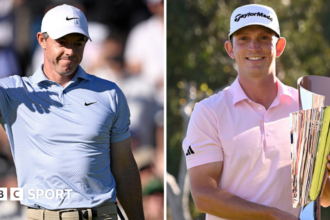
The opening round of the Australian Open at the hallowed Royal Melbourne Composite Course promised a masterclass. It delivered, but not in the way many anticipated for its headline act. Rory McIlroy, the world number two and pre-tournament favorite, authored a round of pure, unadulterated theatre—a one-over par 72 that was less a smooth symphony and more a cacophonous rock opera of brilliance and blunder. While a trio of players sit pretty atop the leaderboard at six-under, the story of the day was McIlroy’s gripping, frustrating, and ultimately resilient battle against both the famed sandbelt layout and his own fluctuating fortunes.
A Jekyll and Hyde Performance on the Sandbelt
McIlroy’s card was a study in stark contrasts, a narrative split cleanly between the sublime and the shaky. He began with a bogey, a warning sign that this would not be a routine procession. The response was pure Rory: a scintillating burst of three consecutive birdies from the fourth hole, reminding everyone of the explosive talent that can overwhelm any golf course. He reached the turn at two-under, seemingly having righted the ship. Then, the rollercoaster plunged.
The back nine was a testament to Royal Melbourne’s relentless examination of patience and precision. Costly bogeys at the 10th, 11th, and 13th holes swiftly erased his progress. A wayward drive here, a missed green there—the margin for error at Royal Melbourne is microscopic, and McIlroy paid the price. A final bogey on the par-3 17th seemed to seal a disappointing day, but characteristically, he finished with a flourish, rolling in a 25-foot birdie putt on the 18th to provide a glimmer of momentum. The round encapsulated the mental resilience required for major championship golf, even if the score was not what he desired.
Leaderboard Analysis: The Pursuit Pack Emerges
While McIlroy wrestled, others flourished in the ideal conditions. The leaderboard presents a fascinating international mix, setting the stage for a wide-open contest.
- Joint Leaders (-6): Australia’s own Smylie delivered a hometown performance, joined by Mexico’s Carlos Ortiz and New Zealand’s Ryan Fox, who all navigated the treacherous layout with six-under rounds of 65.
- Chasing Pack: A group at four-under, including Scotland’s Calum Hill and Denmark’s Rasmus Neergaard-Petersen, lies within striking distance.
- Australian Contingent: The home hopes are strong. Adam Scott (-2) and Min Woo Lee (-2) are positioned menacingly, while Cameron Smith (-1) lurks after a steady start. Their local knowledge of the sandbelt’s nuances is a significant asset.
This diverse leaderboard underscores the global appeal of the event and the unique challenge Royal Melbourne presents—a test that can be deciphered by both local specialists and world-class internationals.
Expert Breakdown: What Went Wrong (and Right) for Rory?
Analyzing McIlroy’s round requires a balanced view. The raw numbers—five bogeys against four birdies—point to inconsistency, but the underlying metrics reveal a more nuanced picture.
Driver volatility was a key factor. On a course where positioning from the tee is paramount, McIlroy’s famed weapon was intermittently offline, leaving him with difficult recovery shots from Royal Melbourne’s dense, penal rough and precarious bunkering. His short game and putting provided both salvation and frustration. The long birdie on 18 was spectacular, but several makeable par saves slipped by earlier in the round, halting any chance of stabilizing his score.
Critically, this performance is not a cause for panic for McIlroy or his team. The ability to score birdies in bunches remains his ultimate weapon. The challenge now is managing the course more conservatively when his ‘A’ game is slightly off. As he often says, it’s about minimizing the damage. Thursday was a lesson in damage limitation that nearly succeeded, thanks to his fighting finish.
Predictions for the Weekend: Can Rory Mount a Charge?
The weekend forecast at Royal Melbourne is now set for compelling drama. For McIlroy, the path is clear but steep. He begins Friday seven shots off the lead, a significant gap but far from insurmountable for a player of his caliber. The immediate goal is a stress-free, bogey-minimizing round in the 60s to safely make the cut and position himself within five shots of the lead heading into the weekend.
History shows McIlroy is one of the sport’s great front-runners, but he is also capable of seismic weekend charges. The pressure now shifts to the leaders, who must sleep on a lead at one of the world’s most intimidating courses. For proven winners like Adam Scott and Cameron Smith, starting within four shots, the tournament is perfectly poised.
Look for McIlroy to:
- Employ a more strategic, position-focused game plan off the tee on Friday.
- Attack the scorable par-fives, which are critical for any low round at Royal Melbourne.
- Lean on his experience to stay patient, knowing a single round does not define a 72-hole tournament.
Conclusion: The Stage is Set for a Classic Sandbelt Showdown
Rory McIlroy’s opening 72 at the Australian Open was a captivating subplot that has only heightened the tournament’s intrigue. It was a raw, human display from a superstar, a reminder that even the greats must grapple with golf’s fickle nature. Far from eliminating him, his rollercoaster round has added a layer of compelling narrative: the chase is on.
Meanwhile, a packed and talented leaderboard promises a fierce battle for the Stonehaven Cup. The blend of rising stars, seasoned international winners, and Australian legends creates a perfect sporting cocktail. Royal Melbourne, with its cunning design and firm, fast conditions, will remain the ultimate arbiter. If McIlroy can smooth out the dramatic peaks and valleys of his game, this rollercoaster start may yet be remembered as the prelude to a spectacular comeback. If not, a new champion is ready to be crowned on one of golf’s most storied stages. The sandbelt drama has only just begun.
Source: Based on news from BBC Sport.
Image: CC licensed via commons.wikimedia.org