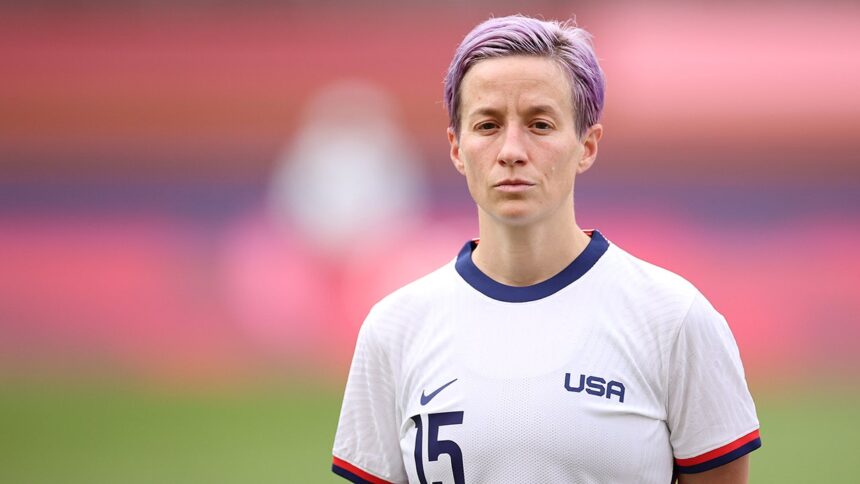
Megan Rapinoe Blasts IOC’s “SRY Gene” Policy, Igniting Global Firestorm Over Women’s Sports
The International Olympic Committee, the guardian of the world’s most storied athletic stage, has plunged headlong into the most contentious debate in modern sports. Its new policy, mandating a one-time SRY gene screening to limit women’s events to “biological females,” has drawn a line in the sand. And one of the most iconic voices in women’s sports, Megan Rapinoe, is drawing her own. The former U.S. soccer star’s fierce condemnation of the rule has transformed a regulatory announcement into a global flashpoint, pitting definitions of fairness against inclusivity and setting the stage for a bruising battle that will extend far beyond the Olympic arena.
The IOC’s Scientific Gambit and the Backlash It Unleashed
At its core, the IOC’s new framework is a dramatic pivot. Moving away from nuanced testosterone-level thresholds, the policy simplifies eligibility with a binary genetic test. The SRY gene, typically found on the Y chromosome, is used as a proxy for biological sex. The IOC cites “fairness and safety” as its paramount concerns, arguing that a clear, biological boundary is necessary to preserve the integrity of the female category. This stance has found powerful allies.
Former Olympian and chair of the IOC Athletes’ Commission, Kirsty Coventry, has publicly backed the move, framing it as a protective measure for female athletes. The sentiment resonates with a significant cohort of sports figures, most notably Caitlyn Jenner, who has long argued for the preservation of biological women’s sports. Jenner recently highlighted a potential “domino effect,” suggesting the IOC’s authority could pressure other leagues and organizations worldwide to adopt similar standards.
Yet, the policy’s purported simplicity is its most contentious flaw. Critics, led by voices like Rapinoe, argue it is a reductive and dangerous oversimplification of both science and humanity.
- Genetic Complexity: The presence of an SRY gene does not universally equate to a male developmental pathway. Conditions like Androgen Insensitivity Syndrome (AIS) result in individuals with XY chromosomes who are biologically female and have always competed as women.
- Targeting Transgender Athletes: While framed as a blanket “biological female” rule, the clear practical impact is the exclusion of transgender women and athletes with Differences of Sex Development (DSD).
- Medicalization of Sport: The mandate introduces compulsory genetic screening, raising ethical questions about bodily autonomy and the precedent of genetic testing for competition.
Rapinoe’s Roar: A Critique of “Fairness” and Legacy
Megan Rapinoe’s response was swift and searing. Having spent her career championing equality—from gender pay gaps to racial justice—she framed the IOC’s policy not as protection, but as exclusion dressed in a lab coat. “This isn’t about science; it’s about fear,” Rapinoe stated in a recent interview. “It’s about using the guise of ‘protecting women’ to systematically exclude a tiny minority of athletes who already face immense discrimination.”
Her argument challenges the very foundation of the IOC’s “fairness” claim. Rapinoe and sports ethicists aligned with her view contend that elite sport is inherently unfair—bolstered by genetic lottery, access to resources, and natural physiological variation. They ask: why is this specific line the immutable one? She also turns the safety argument on its head, questioning why, if safety is a paramount concern, there is not similar scrutiny over vast disparities in size and strength between athletes in sports like boxing or basketball.
Rapinoe’s stance carries the weight of her legacy. As a World Cup winner and Olympic gold medalist, her advocacy forces a critical question: what is the ultimate purpose of women’s sports? Is it solely a protected category for a specific biological class, or is it a platform for empowerment, inclusion, and the celebration of all women’s achievements? Her position asserts the latter, warning that policies like the IOC’s undermine the progressive, community-building spirit she fought to instill.
The American Context: A Political and Personal Powder Keg
This debate does not exist in a vacuum. It erupts amidst a fraught American landscape where transgender rights have become a central political battleground. The image of protesters outside the Supreme Court, as it prepares to hear a landmark case on transgender participation in school sports in 2026, underscores the judicial war to come. The IOC’s policy will undoubtedly be cited as a precedent in those legal arguments.
Simultaneously, the issue intersects with the daily anxieties of Americans. A recent Fox News poll revealing that 46% of Americans feel they are “falling behind financially” amid rising gas prices and inflation adds a complex layer. Cultural debates often intensify when economic pressure mounts, with hot-button issues serving as focal points for broader societal frustration. The fight over women’s sports, therefore, becomes a proxy for deeper conflicts about tradition, change, and equity in an uncertain world.
Predictions: Legal Challenges, Divided Sport, and an Uncertain Future
The path forward is fraught with uncertainty, but several outcomes seem probable.
First, immediate and fierce legal challenges are inevitable. The policy will be contested at the Court of Arbitration for Sport (CAS) on grounds of scientific validity, discrimination, and violation of the Olympic Charter’s principle of non-discrimination. Cases may also proliferate in national courts, particularly in countries with strong transgender rights protections.
Second, global sport will fracture further. While some international federations will fall in line with the IOC, others may resist, creating a patchwork of regulations. Major events could see boycotts or the emergence of alternative, inclusive games. The “domino effect” Jenner predicts may indeed happen, but so will a powerful counter-movement.
Finally, the athlete community will remain deeply divided. For every champion like Coventry, there is a champion like Rapinoe. This schism will play out in press conferences, on social media, and in locker rooms, creating a difficult environment for all competitors. The very women the IOC claims to protect may find themselves torn between personal belief, team solidarity, and the pressure to compete.
Conclusion: More Than a Game, a Defining Struggle
The IOC’s SRY gene policy and Megan Rapinoe’s blistering rebuttal have ignited a conflict that transcends sport. It is a struggle over identity, science, and the meaning of fairness itself. The committee has bet that a clear, biological standard will quell the controversy. Instead, it has poured gasoline on the fire.
As the 2026 Supreme Court case looms and the 2028 Los Angeles Olympics approach, this issue will only intensify. The world will be watching to see if the Olympic ideal of unity can survive a rule that many see as fundamentally divisive. In the end, the legacy of this moment may not be determined by genetic screenings or medal counts, but by how the sports world answers a fundamental human question: who gets to belong? The final whistle on that debate is far from being blown.
Source: Based on news from Fox Sports.