Mehdi Hasan’s All-Star Game Critique of LeBron James Ignites Debate on Athletes and Geopolitics
The NBA All-Star Game is traditionally a spectacle of apolitical celebration, a global showcase of basketball’s brightest stars. Yet, this year, a brief exchange in a pre-game press conference at the Intuit Dome sparked a firestorm that reached far beyond the hardwood, drawing in geopolitical tensions and placing LeBron James squarely in the crosshairs of punditry. The catalyst was a pointed critique from former MSNBC host Mehdi Hasan, who took aim at James’s response to a question about Israel, an incident that unfolded against a backdrop of escalating rhetoric regarding Iran. This confluence of sports, politics, and international conflict reveals the increasingly untenable position for modern global icons who wish to remain neutral.
- The Question and the Non-Answer: LeBron’s All-Star Sidestep
- Hasan’s Broadside: The “Activist-Athlete” Contradiction
- The Broader Geopolitical Backdrop: Keane’s Strike Call and the Unspoken Context
- Expert Analysis: The Impossible Position of the Global Icon
- Predictions: The New Rules of Celebrity Advocacy
- Conclusion: Beyond Dribbling in a Divided World
The Question and the Non-Answer: LeBron’s All-Star Sidestep
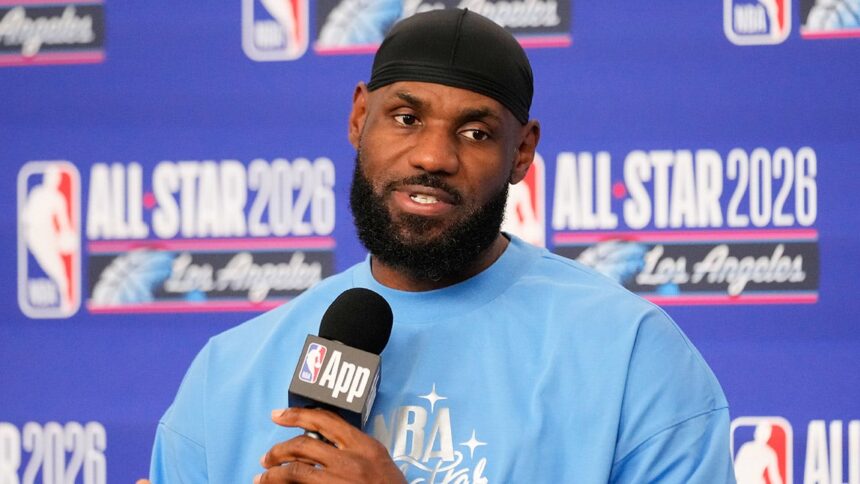
Before taking the court for his record-extending 20th All-Star appearance, LeBron James held a customary media session. Amid questions about his longevity and the game itself, one inquiry stood out. A reporter asked James, “For all the Israeli fans, what message would you like to send to Israel and what do you think about (Portland Trail Blazers All-Star) Deni Avdija.”
James’s response was characteristically cautious and focused on basketball. He praised his fellow All-Star, Deni Avdija, calling him a “great talent” and expressing pride in his growth. On the broader message to Israeli fans, James demurred, stating, “My message to the fans in Israel is: Continue to be strong, continue to be proud. And continue to support the game of basketball. I think that’s a great way to keep your mind at ease in times like this.”
This anodyne, sport-centric reply was precisely what ignited Mehdi Hasan’s criticism. Hasan, known for his direct and often confrontational commentary, interpreted James’s words not as diplomacy but as a calculated evasion of the ongoing humanitarian crisis in Gaza. To Hasan, James’s call for Israelis to find “ease” through basketball, without acknowledging Palestinian suffering, represented a profound moral failure from an athlete who has positioned himself as a social justice advocate.
Hasan’s Broadside: The “Activist-Athlete” Contradiction
In his segment, Mehdi Hasan did not mince words. He framed LeBron James’s response as symptomatic of a selective activism that shies away from complex, internationally divisive issues. Hasan contrasted James’s vocal stances on domestic U.S. issues—such as police brutality and voting rights—with his strategic silence on the Israeli-Palestinian conflict.
“This is the same LeBron James who has told us repeatedly that he won’t ‘shut up and dribble,’ that he is a leader for his community and uses his platform for the voiceless,” Hasan argued. “But when presented with a direct opportunity to acknowledge a profound human tragedy affecting millions, he offered platitudes about basketball. It reveals the limits of his advocacy and the uncomfortable truth that some global crises are deemed too costly for even the world’s most powerful athlete to touch.”
Hasan’s critique taps into a central tension for the modern celebrity activist:
- The Expectation of Consistency: When an athlete builds a brand on social justice, audiences expect a principled stance across issues.
- The Geopolitical Minefield: International conflicts, especially the Israeli-Palestinian issue, carry immense commercial and reputational risk.
- The “Neutrality” Trap: Attempting to remain neutral on a polarized issue is often interpreted as siding with the status quo or the more powerful entity.
James’s response, in this view, was less a message of unity and more a risk-averse corporate statement designed to avoid alienating any segment of his massive global fanbase or corporate partners.
The Broader Geopolitical Backdrop: Keane’s Strike Call and the Unspoken Context
While Hasan focused on Palestine, the reporter’s question to James emerged in a specific and tense geopolitical moment. Just days before the All-Star Game, retired General Jack Keane, a prominent Fox News strategic analyst, made headlines with a stark proposal. Reacting to stalled U.S.-Iran nuclear talks, Keane advocated for a joint U.S.-Israel military strike to dismantle the Iranian regime and its nuclear program, citing internal unrest within Iran.
This hawkish commentary, circulating heavily in U.S. media, forms a crucial part of the context. The question to James was not posed in a vacuum. It was asked at a time when:
- Discourse around Israel was intensely focused on security and existential threats from Iran.
- The humanitarian situation in Gaza, while ongoing, was being framed differently in various media ecosystems.
- The presence of Deni Avdija, an Israeli All-Star, naturally directed basketball media attention toward Israel.
This context makes James’s sidestep even more revealing. He avoided not just the Palestinian issue, but also any entanglement in the aggressive U.S.-Iran debate that Keane’s comments represented. His answer was a masterclass in navigating a media minefield, prioritizing universal, inoffensive themes of sport and fandom over any political alignment.
Expert Analysis: The Impossible Position of the Global Icon
Sports communication experts note that LeBron James is in an almost impossible position. “LeBron James is not a statesman; he is a global brand and an employee of the NBA, which has significant business interests worldwide,” says Dr. Elena Harris, a professor of Sports Media and Society. “His response, while criticized as weak, was arguably the only safe play. To comment substantively on Israel would have drawn immediate and severe backlash from one side or the other, or both. His ‘shut up and dribble’ critics would have pounced, while activists would have dissected every syllable.”
The incident underscores a new reality: in the age of social media and 24/7 news, every microphone is a potential crisis. The question itself, seemingly innocuous, was a loaded geopolitical probe. James’s team likely anticipated such questions, and his reply was a rehearsed strategy of deflection—praise the player, praise the sport, express generic goodwill.
Mehdi Hasan’s role in this drama is equally significant. As a journalist moving to new platforms, his critique of a figure like James generates attention and defines his own brand as one willing to challenge powerful voices from the left and the right. His takedown was as much about holding James accountable as it was about asserting a specific narrative on Palestine into a mainstream sports conversation.
Predictions: The New Rules of Celebrity Advocacy
This episode is a harbinger of conflicts to come for athlete-activists. We can predict several evolving trends:
- Increased Media Traps: Reporters will continue to ask global stars about international conflicts, knowing the answers—or non-answers—are newsworthy.
- The Rise of “Bland Diplomacy”: More athletes will adopt the James model: expressing generic support for “all people” and “peace” while fervently redirecting to their sport.
- Brand Fragmentation: Athletes may be forced to choose between being a purely domestic activist or a truly global one, as maintaining both stances becomes increasingly contradictory and commercially hazardous.
- Backlash from All Sides: As seen here, neutrality satisfies no one. It draws fire from activists who demand courage and from critics who believe athletes should have no voice at all.
The era of the uncontroversial global sports icon is over. The LeBron James paradox—the demand to speak out and the punishment for doing so—is now the defining challenge.
Conclusion: Beyond Dribbling in a Divided World
The clash between Mehdi Hasan and LeBron James was more than a media spat. It was a vivid case study in the pressures facing public figures in a fractured world. James, perhaps the most scrutinized athlete on the planet, attempted the corporate playbook: say nothing of substance. Hasan, a polemicist by trade, called him on it, highlighting the gap between James’s activist persona and his action on this issue.
This incident proves that there is no longer a sidelines in global politics for those of James’s stature. Silence is a statement. A non-answer is an answer. Whether one views Hasan’s critique as justified or unfair, it successfully exposed the inherent contradictions in modern celebrity advocacy. As geopolitical tensions like those surrounding Iran and Israel continue to simmer, the microphone at the All-Star Game will remain as potent a weapon as any three-pointer, and the pressure on athletes to define their voices—or consciously limit them—will only intensify. The final score in this game extends far beyond basketball.
Source: Based on news from Fox Sports.