Miami Hurricanes’ Marcus Allen Out for Season After Non-Hodgkin Lymphoma Diagnosis
The Miami Hurricanes basketball program, poised for another competitive season in the ACC, has received devastating news that transcends the sport. Sophomore forward Marcus Allen, a Miami native who returned home to play for the Hurricanes, has been diagnosed with non-Hodgkin lymphoma and will miss the remainder of the season. The diagnosis, revealed during routine medical tests earlier this month, shifts the focus from wins and losses to health, resilience, and the power of community support.
In an emotional announcement on Friday, the university shared the news, highlighting not just the loss of a rotational player but the beginning of a profound fight for a young man cherished by his team. The Hurricanes’ locker room, once a hub of strategic chatter and competitive fire, now stands unified in a different battle—rallying behind their teammate as he prepares for the most significant challenge of his life.
A Shocking Diagnosis and a Program’s Unified Response
The nature of Marcus Allen’s diagnosis—discovered during routine medical tests—underscores the unpredictable and indiscriminate reality of illness. One moment, Allen was a 6-foot-7, 231-pound athlete contributing energy off the bench; the next, he was facing a life-altering health crisis. For Coach Jai Lucas and the entire Hurricanes staff, the basketball season instantly became secondary.
Coach Lucas’s statement was a powerful testament to the person beyond the player. “Marcus is an incredible person and teammate, and we will do everything we can to support him and his amazing family during this difficult time,” Lucas said. He specifically highlighted Allen’s toughness and selflessness, qualities honed on the court that now become foundational pillars for his fight ahead. This shift in focus from player development to holistic, human support defines how modern athletic programs must function in times of crisis.
The team’s role now extends far beyond the hardwood. Their support system will be crucial, involving everything from managing his academic load to simply being present. This situation is a stark reminder that within the framework of high-stakes college athletics, the well-being of the student-athlete is the ultimate priority.
Marcus Allen’s Journey and On-Court Impact
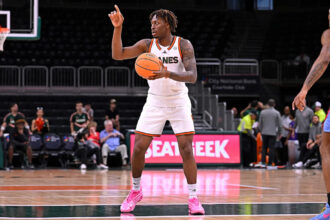
Marcus Allen’s basketball path has been one of homecoming. After beginning his college career at Missouri, the Miami native transferred to the Hurricanes prior to this season, fulfilling a dream of representing his hometown university. In his eight games off the bench this season, Allen was still carving out his role, averaging 5.3 points and 3.1 rebounds in 18.9 minutes per game. His contributions, however, were often of the intangible variety—energy, defensive effort, and a team-first mentality.
His potential was clear, and his physical profile suggested a player who could develop into a key two-way contributor in the ACC. Now, that potential is on pause. Analysts looking at Miami’s season must now recalculate not just the rotation, but the emotional tenor of the team. The loss of Allen depletes their frontcourt depth, but more significantly, it removes a beloved locker room presence whose spirit defined the team’s culture.
- Key Stats: 5.3 PPG, 3.1 RPG, 18.9 MPG in 8 games.
- Background: Miami native, transfer from Missouri.
- Playing Style: Energetic forward valued for defensive versatility and team-oriented play.
The Road Ahead: Treatment, Team Dynamics, and Season Outlook
The immediate future for Marcus Allen involves beginning treatment for non-Hodgkin lymphoma, a cancer that begins in the lymphatic system. The statement from his family was anchored in profound faith and resilience. “We thank God for his continued Grace, Mercy and Favor. We wait in anticipation for the miracle healing to take place. We are standing on FAITH,” they said. This public declaration of faith will undoubtedly resonate and mobilize the extended Hurricanes family and the broader college basketball community.
For the Miami Hurricanes on the court, the season continues, but it will be played with a heavy heart and a new purpose. Coach Lucas faces the difficult task of redistributing Allen’s minutes while managing the emotional weight his players will carry. This kind of event can sometimes forge an unbreakable bond within a team, playing with a “for Marcus” mentality that unlocks a different level of grit and determination.
Expert analysis suggests the Hurricanes will likely turn to a combination of players to fill the gap, including increased minutes for other bench forwards and potentially small-ball lineups. However, the X’s and O’s are trivial compared to the human element. The team’s performance will now be a barometer of their collective character and ability to channel their concern for their teammate into focused play.
A Community Stands on Faith: The Bigger Picture
The story of Marcus Allen is no longer a sports transaction report. It is a human story that highlights the vulnerability of even the most elite athletes. It’s a narrative about health, the strength of family, and the power of a community—from the University of Miami to the entire NCAA—rallying around one of its own. Social media has already seen an outpouring of support from rival programs, a show of solidarity that sports makes uniquely possible.
This journey will be followed closely, with every update on Allen’s health holding more significance than any game result. The basketball community has witnessed inspiring stories of athletes overcoming cancer, such as former NBA coach Monty Williams’s family’s story or the recovery of various players, which offer hope and a roadmap for support.
Predictions for the outcome of Miami’s season are now inherently tied to their ability to process this adversity. They have the talent to remain competitive, but their ultimate success may be measured in how they honor their teammate through unity, effort, and perspective—understanding that some fights are far more important than basketball.
Conclusion: The Ultimate Assist
Marcus Allen’s diagnosis is a heartbreaking development, but the response defines the true spirit of team sports. The Miami Hurricanes, their fans, and the wider college basketball world now have a single, unified goal: to provide Marcus Allen and his family with the strongest possible support system. His battle with non-Hodgkin lymphoma will require the same discipline, courage, and resilience he displayed on the court, amplified a thousandfold.
As the Hurricanes take the floor in the games to come, Marcus Allen’s presence will be felt in every defensive stop, every hustle play, and every moment of camaraderie. His journey reminds us that beyond the rankings and the tournaments, the sports world is a human community capable of profound compassion. The entire college basketball landscape now has the opportunity to offer the ultimate assist—not a pass leading to a basket, but a wave of love, prayers, and positive energy leading toward healing. The season’s outcome for Miami is uncertain, but the hope for Marcus Allen’s full recovery is the only victory that truly matters.
Source: Based on news from Deadspin.
Image: CC licensed via commons.wikimedia.org