Michigan’s 2026 National Title: A Statistical Blueprint of Dominance
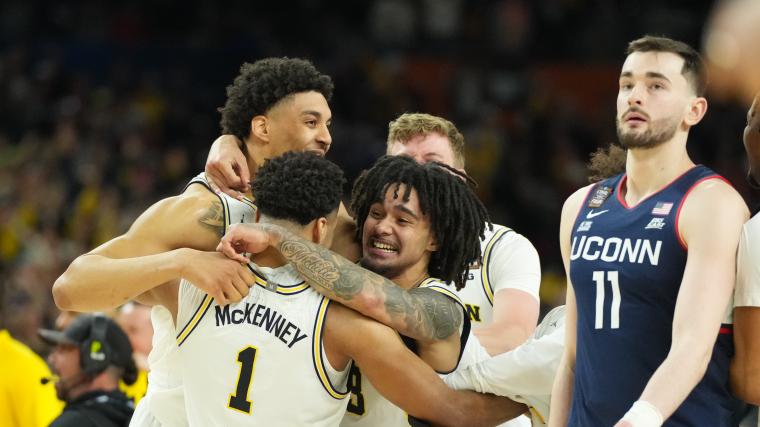
The confetti has settled in Glendale, and the narrative is cemented in college basketball history. The 2026 NCAA National Championship belongs to the Michigan Wolverines. In a climactic battle that tested their resolve, Coach Dusty May’s top-seeded Wolverines outlasted the defending champion UConn Huskies 69-63, completing a season-long journey defined not by flash, but by an overwhelming, systematic dominance. While the final score suggests a tense affair, Michigan’s overall campaign was a masterclass in modern team construction and execution. Their path to the title wasn’t just victorious; it was a statistical demolition. Let’s break down the numbers that tell the true story of a Wolverine squad that left an indelible mark on the sport.
The Foundation: Regular Season Supremacy
Before a single bracket was printed, Michigan established itself as the nation’s premier unit. This wasn’t a team that caught fire in March; they were a controlled burn that lasted an entire season. Their identity was built on a devastating combination of size, unselfishness, and defensive discipline, creating a margin for error that few opponents could overcome.
Key Regular Season Metrics:
- Record and Rankings: Michigan finished the regular season at 31-2, capturing both the Big Ten regular-season and tournament titles. They spent a nation-leading 12 weeks at No. 1 in the AP Poll.
- Historic Efficiency: The Wolverines became the first team in over a decade to finish the season ranked in the top three nationally in both adjusted offensive and defensive efficiency, per KenPom. This two-way prowess was the bedrock of their success.
- The Assist Tells the Story: Averaging 20.1 assists per game, Michigan led the Power 5. Their assist rate (percentage of made baskets assisted) of 68.5% wasn’t just good—it was a philosophy. It highlighted a roster devoid of ego, where ball movement and the “extra pass” were non-negotiable tenets.
- Defensive Juggernaut: Leveraging their exceptional length, Michigan held opponents to just 39.1% shooting from two-point range (2nd nationally) and a paltry 28.5% from three. Their defensive effective field goal percentage was the best in the country.
The March to Glory: A Tournament of Statements
If the regular season was a warning, the NCAA Tournament was the execution. Michigan’s six-game run to the title was characterized by a series of decisive, often demoralizing, victories. They didn’t just win games; they dismantled game plans.
Tournament by the Numbers:
- Average Margin of Victory: +18.8 points per game through the first five rounds. This includes a staggering 42-point thrashing in the second round and a 22-point Elite Eight victory over a fellow No. 1 seed.
- Defensive Lockdown: Tournament opponents shot a combined 37.8% from the field against the Wolverines. In the national semifinal, they held a potent offensive team to under 60 points.
- Sharing the Wealth: The unselfish play scaled up under pressure. Michigan averaged 21.5 assists per tournament game, with their star player, point guard Elijah Collins, famously recording more assists (43) than field goal attempts (41) through the first five games.
- Depth on Display: The Wolverines’ bench outscored opponents’ benches by an average of 15.2 points per game in the tournament. This wasn’t a seven-man rotation; it was a ten-man wave of interchangeable, high-IQ players that wore teams down.
The Championship Final: Winning Ugly, Winning Smart
The clash with UConn presented a unique challenge: a battle-tested champion with the pedigree to match Michigan’s physicality. For the first time all tournament, the Wolverines’ offense sputtered, and their normally reliable three-point shot abandoned them (4-for-18). Yet, the numbers reveal how they adapted and conquered.
Michigan won this game not with aesthetic beauty, but with gritty, statistical advantages that underscored their versatility:
- Ownership of the Paint: Despite UConn’s strong frontcourt, Michigan outscored the Huskies 38-24 in the paint, a testament to their disciplined shot selection and relentless driving.
- Second-Chance Salvation: On a poor shooting night, the Wolverines secured 14 offensive rebounds, leading to a crucial 17-6 advantage in second-chance points. This effort was epitomized by forward Alex Johnson’s 6 offensive boards.
- Free Throw Fortitude: In a tight, physical game, Michigan got to the line and converted, shooting 21-of-25 (84%) from the stripe. UConn attempted only 12 free throws.
- Limiting the Huskies’ Arsenal: UConn, known for its offensive explosions, was held to just 8 fast-break points and shot 40% from the field. Michigan’s transition defense and half-court structure never broke.
This game proved Michigan was more than a statistical marvel; they were a team with the championship IQ to win in multiple ways.
Legacy and Looking Ahead: Can the Wolverines Repeat?
Where does this title run rank historically? By advanced metrics, the 2025-26 Michigan Wolverines will be discussed among the most complete teams of the modern era. Their combination of elite efficiency on both ends, historic ball movement, and deep, cohesive roster places them in rarefied air.
Expert Analysis & Prediction: The immediate question shifts to the future. With the potential return of several key contributors and another top-3 recruiting class headed to Ann Arbor, Michigan will undoubtedly enter the 2026-27 season as the preseason No. 1. However, history is brutal to repeat champions. The target will be enormous, and the hunger of every opponent will be palpable.
Coach Dusty May’s system, which emphasizes versatility and collective intelligence over reliance on a single superstar, is uniquely built for sustainability. The prediction here is that Michigan will not suffer a “championship hangover” in the traditional sense. They are built to dominate the regular season again. But the randomness of March is the great equalizer. While they will be the favorites, the quest for a repeat will be their greatest test yet—a test of maintaining that razor-sharp edge when everyone is gunning for you.
Conclusion
The 2026 Michigan Wolverines didn’t just win a national championship; they authored a blueprint for dominance in the contemporary game. Their title was a victory for substance over style, for the collective over the individual. The numbers—from their historic regular-season efficiency to their overwhelming tournament margins and their gritty, adaptive championship performance—tell an unambiguous story. This was a team built from the ground up to not just compete, but to control. They leave behind a legacy defined by a simple, powerful truth: in an era often celebrating individual brilliance, Michigan proved that the whole can be exponentially greater than the sum of its parts. The title is headed to Ann Arbor, backed by a statistical argument that may be debated for years to come.
Source: Based on news from Yahoo Sports.