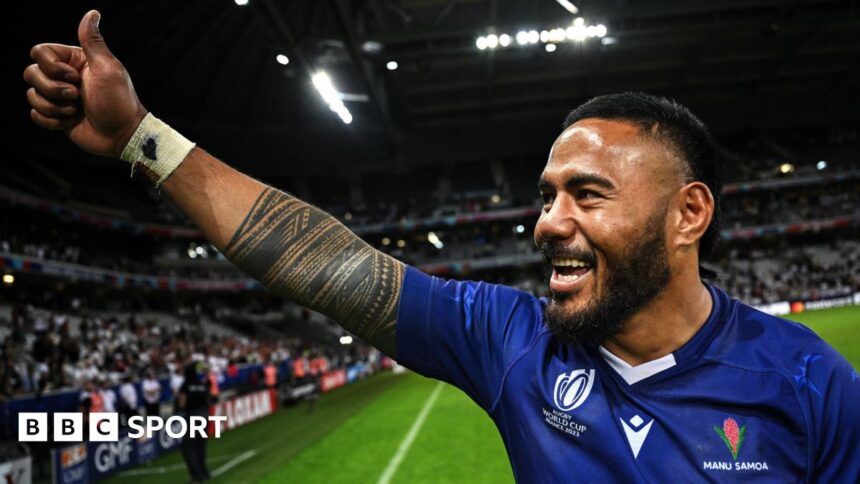
‘My brothers might force me’ – The Emotional Allure of a Tuilagi Swan Song in Blue and Samoa
The roar of Twickenham, the crunching tackles on Australian soil, the white rose of England emblazoned on his chest—for over a decade, Manu Tuilagi has been a defining force in English rugby. But now, as the twilight of his illustrious career approaches, a different rhythm is calling. It’s the beat of the Siva Tau, the call of the Manu Samoa, and the powerful, persuasive voices of his own family. In a revelation that tugs at the very heartstrings of international rugby’s complex allegiance rules, the powerhouse centre has opened the door to a storybook ending: representing the land of his birth.
The Birthright Rule and a Closing Window
Manu Tuilagi’s international career with England, spanning 60 caps and three World Cups, was built on a foundation of devastating power and game-breaking line breaks. His move to Bayonne in France, however, signaled the end of his England chapter under the current selection policy. Yet, World Rugby’s regulations have created a fascinating new possibility. The birthright rule allows a player to switch nations once, provided three years have passed since their last cap for their previous country and they hold the correct passport.
For Tuilagi, the math is poignant:
- Last England Cap: Potentially in 2024, finalizing his move to France.
- Eligibility Date: March 2027, three years after that last England appearance.
- The Prize: The 2027 Rugby World Cup in Australia.
This timeline presents a race against the clock for the 34-year-old. The tournament kicks off in October 2027, meaning Tuilagi would be 36 years old, navigating a young man’s game with a veteran’s body. His own words to Rugby Union Weekly underscore this reality: “It depends if I’m still able to compete at that level.” The ambition is there, but the physical demands are the ultimate gatekeeper.
More Than a Jersey: The Pull of Family and Fa’a Samoa
While the rule makes it technically feasible, the true motivation lies deeper. Tuilagi’s comment, “My brothers might force me,” is more than a throwaway line; it’s a window into the profound cultural and familial ties that bind the Tuilagi clan. Born in Fogapoa, Samoa, and moving to the UK at 13, Manu was the last of the famed rugby-playing brothers to leave the islands.
His siblings—Freddie, Henry, Alesana, and Anitelea—all wore the blue of Samoa with immense pride. Manu’s journey with England, while glorious, always existed in a different orbit. A switch would not just be a personal milestone; it would be a homecoming, a completion of the family legacy. It’s about aligning his international swan song with the fa’a Samoa—the Samoan way—a cultural fabric woven with respect for family, community, and heritage.
This potential move resonates with the broader narrative of Pacific Island rugby. Players from Samoa, Fiji, and Tonga have long been the lifeblood of the global game, often leaving their homes to pursue professional careers abroad. The chance for one of the most famous sons of Samoa to return, to don the jersey his brothers wore, would be a moment of immense symbolic power for the nation and its diaspora.
The State of Manu Samoa and the 2027 Challenge
The context of Samoa’s recent qualification adds another layer of drama to this potential fairytale. Samoa scraped into the 2027 World Cup after a nerve-shredding play-off victory over Belgium, a result that highlighted both the team’s resilience and the precarious nature of Tier 2 rugby. They are a team on the rise, boasting more talent than ever in top leagues, but consistency remains elusive.
The inclusion of a figure like Tuilagi, even in his mid-30s, would be transformative. His value would extend far beyond the 80 minutes on the pitch:
- Mentorship: Guiding a new generation of Samoan midfielders.
- Big-Game Temperament: Imparting wisdom from countless high-pressure Tests for England and the British and Irish Lions.
- Cultural Bridge: Embodying the connection between the islands and the global rugby community.
His presence alone would elevate the team’s profile and instill a belief that they can compete with the world’s best on the sport’s biggest stage.
Expert Analysis: A Calculated Risk or a Fitting Finale?
From a tactical standpoint, the question is one of physical longevity. Can Tuilagi’s body withstand the rigors of international rugby at 36? The modern game is faster and more collision-based than ever. However, his role could be strategically managed. He wouldn’t need to be the week-in, week-out battering ram of his youth. Instead, he could be deployed as a impact player, a tactical weapon to be unleashed in critical pool games or knockout matches where his experience and unique skill set could prove the difference.
His time in the French Top 14 with Bayonne will be crucial. The slightly less frenetic pace compared to the English Premiership, coupled with a focus on power and set-piece, could help preserve his body, extending his career by those precious extra months needed for a 2027 swan song.
The risk of a diminished performance is real, but the potential reward—for both Tuilagi and Samoa—is immeasurable. For the player, it’s a chance to close his international career on his own terms, wrapped in the flag of his homeland and alongside the culture that forged him. For Samoa, it’s about adding a legendary figure to their ranks, a move that would capture the imagination of the rugby world and galvanize a nation.
Conclusion: A Legacy Waiting to be Written
The image of Manu Tuilagi, face etched with concentration, performing the Siva Tau before a World Cup match in Australia is a powerful one. It’s a narrative of completion, of coming full circle. While the physical hurdles are significant, the emotional and cultural pull is undeniable. This is not merely a transaction under a regulatory loophole; it is a story of family, identity, and the enduring call of home.
The final decision rests on the condition of his body and the relentless march of time. But if the brothers have their way, and if the fire still burns within, the 2027 Rugby World Cup could witness one of the most poignant and celebrated international switches in the sport’s history. The man who once shattered defenses for England may yet find his final, most meaningful chapter wearing the blue of Samoa, not by force, but by the powerful, irresistible call of blood and heritage.
Source: Based on news from BBC Sport.
Image: Source – Original Article