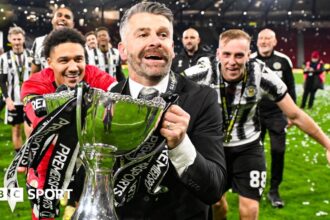
‘My wife said I’d mess it up’ – How Martin O’Neill Became Celtic’s Steady Hand
The phone call from Dermot Desmond was unexpected. The mission was monumental. And the confidence of his own wife was, by her own admission, non-existent. When Martin O’Neill, 73 years old and six years removed from the dugout, agreed to return to Celtic as interim manager, he wasn’t just taking a job; he was answering a distress call from a club he loved, a club that was, quite literally, sinking.
A Club Adrift and a Legend’s Return
It is exactly one month since that pivotal moment. The landscape O’Neill inherited was one of pure chaos. Brendan Rodgers’ abrupt and acrimonious exit had ripped the heart out of the squad. On the pitch, a disjointed Celtic side had just been dismantled 3-1 by Hearts at Tynecastle, a result that left them a staggering eight points adrift at the top of the Scottish Premiership. The ship was taking on water, and fast.
Off the pitch, the situation was even more volatile. The fan protests against the Celtic board were in full swing, with green and white scarves littering the pitch in a powerful display of discontent. The air around Parkhead was thick with animosity, a far cry from the unifying force the club typically represents. This was the “choppy water” O’Neill was asked to navigate. And as he later revealed with a wry smile, his biggest critic was waiting for him at home.
“My wife said I’d mess it up,” O’Neill confessed, a comment that speaks volumes about the perceived risk of his return. He was stepping back into a pressure cooker, with the expectations of a nation on his shoulders and the skepticism of his nearest and dearest in his ears.
Quieting the Noise: The O’Neill Effect in Numbers
One month on, the only thing being “messed up” are the plans of Celtic’s rivals. The transformation under O’Neill has been both swift and profound. The interim manager’s record is a testament to his immediate impact:
- Five wins from six matches in all competitions.
- A dramatic reduction in the points deficit, turning an eight-point chasm into a tightly-contested title race.
- A restored sense of defensive solidity and attacking purpose.
- Crucial victories in the cauldron of the Edinburgh derby and under the Parkhead lights.
So, how has a man who had been out of the game for so long engineered such a rapid turnaround? The answer lies not in complex tactical overhauls, but in the restoration of core principles. O’Neill’s success is built on a foundation of simplifying the message and restoring belief. He hasn’t reinvented the wheel; he has simply reminded everyone how to make it turn efficiently.
The off-field animosity towards the board hasn’t vanished, but O’Neill has created a firewall, protecting his players and ensuring the focus on the pitch remains laser-sharp. He has absorbed the external pressure, allowing his squad to play with a freedom that had evaporated in the final days of the previous regime.
More Than Tactics: The Psychology of a Rescue Mission
O’Neill’s genius in this interim period has been psychological. He understands the Celtic psyche better than most. He knows that wearing the famous green and white hoops is as much about mentality as it is about ability. His approach has been a masterclass in man-management.
He has reinstalled a siege mentality, a classic O’Neill trait. By referencing his wife’s humorous doubt, he created an “us against the world” narrative, even if that world included his own household. It’s a unifying tool, a way to bond the squad together under a shared cause. The players aren’t just playing for a manager; they are playing to prove a point for him.
Furthermore, O’Neill’s legendary status at the club grants him an immediate and unquestioned authority. When a figure of his stature speaks, players listen. There is no need for a lengthy “bedding-in” period or a struggle for respect. His presence in the dressing room commands attention and, more importantly, demands application. He has stripped the game back to its basics: passion, organization, and a relentless will to win.
Navigating the Final Stretch: Predictions for the Title Race
The question now shifts from “Can he steady the ship?” to “Can he pilot it to the title?” The Scottish Premiership race is now wide open, and Celtic, written off just four weeks ago, are firmly back in the driving seat. The momentum is with them, and in football, momentum is often the most powerful weapon.
Looking ahead, the key factors will be:
- Squad Management: Can O’Neill keep key players fit and motivated through the final, grueling fixtures?
- Handling Pressure: The pressure is now on Celtic as the hunters have become the hunted. O’Neill’s experience in title run-ins is invaluable.
- The Rangers Factor: The Old Firm derby looms large, a match that could ultimately decide the destination of the trophy.
Based on the evidence of the last month, it would be foolish to bet against O’Neill. He has instilled a resilience that was previously missing. The predictions for Celtic’s season have been completely rewritten. From a potential also-ran, they are now favorites to clinch a league title that seemed lost, a turnaround as dramatic as any in the club’s recent history.
Conclusion: A Steady Hand When It Was Needed Most
Martin O’Neill’s return to Celtic was a gamble, a romantic notion that many feared was rooted in nostalgia rather than modern footballing reality. His wife’s playful jab, “I’d mess it up,” encapsulated the quiet fears of an entire support. But one month and five wins later, the joke has been well and truly on the doubters.
O’Neill has not messed it up. He has, instead, provided a masterful lesson in crisis management. He has not sought to be a hero, but a steady hand on the tiller, guiding Celtic away from the rocks and back into clear, competitive waters. He has reminded everyone what it means to play for Celtic—the pride, the passion, the unyielding demand for victory.
The final chapter of this season is yet to be written, and the long-term future of the manager’s position remains unclear. But Martin O’Neill’s legacy, already secure, has been burnished with a new, brilliant layer. In a moment of profound need, the legend returned, silenced the critics—including the one at his breakfast table—and, with a quiet and assured dignity, reminded Celtic what it means to be Celtic.
Source: Based on news from BBC Sport.
Image: CC licensed via www.hippopx.com