Puka Nacua’s Blunt Charge: Are NFL Refs Playing for the Camera?
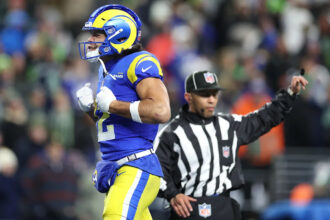
The NFL’s officiating discourse, a perennial sidebar to the action on the field, has been jolted by a fresh, unfiltered voice. This time, it’s not a seasoned coach or a veteran quarterback sounding off in a post-game press conference. It’s a rising star, speaking candidly on a livestream, who has lobbed a grenade into the league’s lap. Los Angeles Rams wide receiver Puka Nacua, in a moment of striking candor, suggested that some NFL referees make calls with one eye on the game and the other on their television close-up.
The Livestream Lightning Bolt: Nacua’s Unvarnished Take
During a Tuesday night Twitch stream, while playing the video game “Call of Duty,” Nacua was asked by a viewer about the toughest part of the NFL transition. His answer veered from the physical grind to the mental gymnastics of dealing with officials. “I think the refs are the worst part of the game,” Nacua stated. He elaborated, pointing a finger at what he perceives as a motive beyond rule enforcement. “I feel like they make calls just so they can get shown on TV sometimes.”
This isn’t the standard complaint about a missed holding call or a dubious pass interference. Nacua’s accusation strikes at the integrity and intent of officiating, suggesting a performative element. He painted a picture of officials inserting themselves into the narrative of the game for personal visibility. In the social media age, where soundbites travel at light speed, Nacua’s comments immediately transcended the gaming stream, becoming a major point of discussion across sports talk shows and digital platforms.
Expert Analysis: The Psychology of the Striped Spotlight
Nacua’s claim, while explosive, taps into a long-simmering fan sentiment. To analyze it, we must separate the emotional reaction from the structural realities of NFL officiating.
First, the scrutiny on NFL officials has never been higher. With ultra-high-definition slow-motion replays from a dozen angles, broadcasters and fans dissect every decision in microscopic detail. Officials are mic’d up, and their conversations are broadcast. This environment inherently places them “on TV” constantly. The question Nacua raises is whether this visibility influences their decision-making process.
Sports psychologists point to the concept of “decision fatigue” and unconscious bias. In a split-second, high-pressure environment, an official’s brain is processing countless variables. Could the desire to “make the correct, game-defining call” be subconsciously conflated with “making the *noticeable* call”? It’s a thin, blurry line. Former officials and rules analysts often note that the best officiating is often the quietest—games that flow without a barrage of flags. Nacua’s comment suggests some officials may be drifting from that ideal.
Furthermore, the league’s own emphasis on certain points of emphasis each season—be it roughing the passer, defensive holding, or taunting—can create a environment where officials are incentivized to throw flags in those specific areas to demonstrate league mandates are being enforced, which inevitably draws broadcast attention.
- Unconscious Bias: The pressure to be “right” in the spotlight could subconsciously influence tight calls.
- League Directives: Yearly points of emphasis can lead to a ticky-tack flood of flags on specific rules.
- The “TV Official” Theory: While no evidence suggests active malfeasance, the performative pressure of modern broadcasting is a real factor.
- Player Frustration: Nacua’s outburst reflects a growing, palpable frustration with game-to-game consistency.
Predictions: Fallout and the Future of Officiating Transparency
So, what happens next? Nacua’s comments are unlikely to result in a fine from the league, as they were not made in an official NFL setting. However, they will undoubtedly be a topic in the next Rams team meeting about media (and livestream) diplomacy.
More broadly, this incident adds fuel to several ongoing fires:
1. The Full-Time Official Debate: Critics will use Nacua’s comments to renew calls for full-time NFL referees. The argument is that professionals dedicated solely to craft, training, and review, without off-season careers in law or finance, would be less susceptible to external pressures and more consistent.
2. Expanded Replay and Technology: The push for a sky judge or expanded replay system will gain more vocal support. If players distrust the human element on the field, the solution appears to be augmenting it with a more robust, technologically-assisted booth. Expect the NFL Competition Committee to continue exploring this, though progress is often slow.
3. The Player-Official Relationship: This public airing of distrust widens the perceived gap between those playing the game and those officiating it. The NFL may look for ways to improve dialogue and understanding, perhaps through more offseason engagement or simplified rule explanations.
Conclusion: More Than Just a Hot Mic Moment
Puka Nacua’s livestream comments are far more significant than a simple venting session. They are a stark, modern articulation of a classic sports conflict, amplified by the new media landscape. He has channeled the silent suspicion of millions of fans and, presumably, many players, into a direct and provocative thesis: that the allure of the television spotlight may be a corrupting influence on the game’s arbiters.
Whether one agrees with Nacua or views his take as the frustrated hyperbole of a competitor, it cannot be dismissed. It strikes at the heart of sports integrity and fairness. In a league where a single penalty can alter a drive, a game, a season, and millions of dollars in outcomes, the motivation behind a yellow flag must be unimpeachable. The NFL’s challenge is no longer just about getting calls right via replay. It’s about managing perception, ensuring transparency, and rebuilding a foundation of trust with its players. If a rising star like Puka Nacua feels comfortable stating on an open stream that refs are “the worst” and playing for the camera, the league has a significant, non-football problem to address. The whistle has been blown on the issue; now we wait to see if the league calls a penalty on itself or lets the play continue.
Source: Based on news from ESPN.
Image: CC licensed via www.pickpik.com