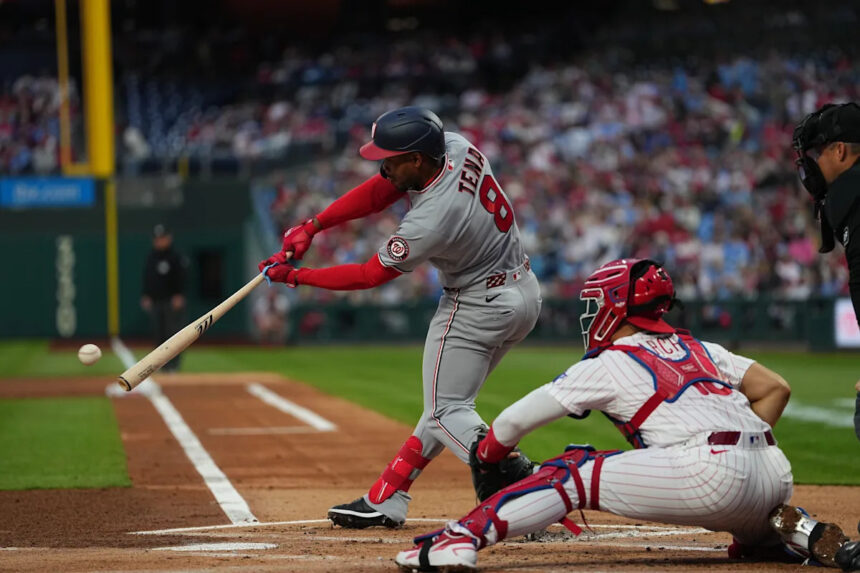
Nationals Unleash 17-Hit Barrage, Wiemer Ties Historic Record in Rout of Phillies
PHILADELPHIA — On a chilly Monday night at Citizens Bank Park, the Washington Nationals didn’t just beat the Philadelphia Phillies. They authored a masterclass in relentless, contact-heavy offense, punctuated by a young player etching his name alongside a baseball legend. In a stunning 13-2 victory, the Nationals’ bats were a constant hum, collecting 17 hits, while outfielder Joey Wiemer tied a 22-year-old Major League record, creating a narrative far richer than a simple April win.
A Record Born from Hustle and Controversy
The story of the night centered on Joey Wiemer. The Nationals’ sparkplug entered the game having reached base safely in his first eight plate appearances of the young season. The baseball world held its collective breath as he stepped in during the first inning. Wiemer chopped a slow roller to third, dug in with explosive speed, and appeared to be called out on a tight play at first by umpire Marvin Hudson. The Nationals immediately challenged.
As replay officials reviewed the call, chaos ensued. Believing the inning was over on the out call, the Phillies had casually thrown the ball home, where catcher Rafael Marchán tagged a scurrying Drew Millas. Nationals manager Dave Martinez argued that if Wiemer was safe, Millas’s run should count, as the play was never technically dead. A furious Rob Thomson, the Phillies’ skipper, contended the opposite. When the replay overturned the call, ruling Wiemer safe, the run was awarded. Thomson’s vehement argument led to his ejection by Hudson, a fiery sidebar to the main event: Wiemer’s record-tying ninth consecutive reach.
The record became reality in the fourth. Wiemer laced a clean single up the middle, tying the mark set by Toronto Blue Jays slugger Carlos Delgado in 2002. “It’s surreal to see your name next to a guy like that,” Wiemer said after the game. “I’m just trying to have good at-bats, see the ball, and put it in play. The rest is history, I guess.” The magical streak would end in the fifth on a groundout, but the tone for Washington was irrevocably set.
The Anatomy of an Offensive Onslaught
While Wiemer’s record provided the headline, the Nationals’ offensive performance was a symphony of disciplined, team-wide execution. Seven different batters recorded at least two hits, a testament to the lineup’s depth and approach. This was not a display of raw power. According to StatCast data, the Nationals’ attack was a lesson in precision over force:
- 17 total hits, with only three going for doubles.
- Zero hits with an exit velocity exceeding 100 mph.
- A barrage of well-placed dink-and-dunk singles and strategic line drives.
- Relentless pressure applied by consistently putting the ball in play.
“That’s our identity,” said veteran hitter Joey Meneses, who contributed three hits. “We’re not waiting for the three-run homer. We’re going to grind out at-bats, use the whole field, and make the defense work. When you string together hits like that, it’s demoralizing for the other side.” The Nationals exploited every gap and hole in the Phillies’ shifting defense, turning the ballpark into a pinball machine. This approach neutralized Philadelphia’s pitching plan and showcased a sustainable, contact-first philosophy that can travel well.
Expert Analysis: What Wiemer’s Streak and the Hit Parade Reveal
From a tactical standpoint, Monday’s game offers a fascinating case study. Wiemer’s record is more than a quirky stat; it’s a signal of a player locked in at an elite level. “A start like this is about pitch recognition and zone control,” said ESPN analyst and former All-Star Mark DeRosa. “Wiemer isn’t chasing. He’s forcing pitchers into the zone and winning the battle before he even swings. That confidence radiates through a lineup.”
The Nationals’ collective approach—prioritizing contact over catastrophic power—is a deliberate counter to modern pitching trends. In an era of high-velocity fastballs and elite spin rates, a team that consistently puts the ball in play can create havoc. The Phillies’ defense, often positioned for pull-heavy power hitters, was repeatedly caught out of alignment by Washington’s opposite-field focus. This game plan requires immense discipline, but as demonstrated, it can lead to explosive innings without a single home run.
Furthermore, the early-season ejection of Rob Thomson highlights the pressure on a Phillies team with World Series aspirations. Facing a division rival expected to be in a rebuild phase, such a lopsided loss and a controversial call can create internal frustration. How Philadelphia responds to this kind of “small-ball” humiliation will be telling for their season-long resilience.
Predictions and the Road Ahead
For the Washington Nationals, this victory is a potent early-season statement. It proves their young core, led by emerging players like Wiemer, can execute a sophisticated game plan against a playoff contender. The key will be sustainability. Can they maintain this level of plate discipline against top-tier pitching rotations? The record run by Joey Wiemer will inevitably end, but the approach that fueled it must not.
Look for opposing teams to quickly adjust their defensive alignments against Washington, potentially playing more straight-up to cut off the angles for those bloop and bleed singles. The Nationals’ counter-adjustment—perhaps incorporating more bunting or hit-and-runs—will be the next chapter in this evolving strategy.
For the Philadelphia Phillies, this game is a stark wake-up call. Their pitching staff was picked apart, and their offense was silenced. The path forward involves a return to fundamentals: sharper command from their starters, more aggressive early-count swings to put pressure back on the Nationals, and cleaner defensive execution. The NL East is a gauntlet, and there is no room for lethargic performances, even in April.
Conclusion: More Than Just an April Win
The final score of 13-2 will fade into the season’s ledger, but the implications of Monday night’s game in Philadelphia will linger. The Washington Nationals announced themselves not as a team of the future, but as a present-day nuisance with a clear, disruptive identity. They did it through a historic individual achievement from Joey Wiemer, a record built on hustle that ignited a team-wide inferno of contact.
This was a victory of philosophy. In an age obsessed with exit velocity and launch angle, the Nationals crafted a 17-hit masterpiece with the subtlety of a painter, not the brute force of a sculptor. They served notice that they will be a tough out, a team that extends innings, exhausts pitchers, and capitalizes on every opportunity. For the Phillies, it’s a reminder that in baseball, the slow, constant drip of singles can be as devastating as the thunderous crash of a home run. The season is long, but the Nationals have already provided one of its most compelling blueprints for success.
Source: Based on news from Yahoo Sports.