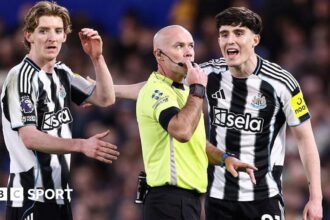
Neville: Disallowed West Ham Goal the Biggest Moment in VAR History
In the high-stakes cauldron of a Premier League title race, every decision feels magnified. But when Gary Neville, a man who has seen the beautiful game from every angle—player, pundit, and owner—declares a single moment as the “biggest in VAR history,” the football world is forced to stop and listen. That moment arrived at the London Stadium on a tense Sunday afternoon, as West Ham United saw a 95th-minute equaliser against Arsenal controversially disallowed. The decision didn’t just deny the Hammers a point; it ignited a firestorm of debate about the very soul of modern officiating. This is not just another VAR controversy. According to Neville, this is the watershed moment that will define how we view technology in football for years to come.
The Anatomy of a Controversy: What Actually Happened?
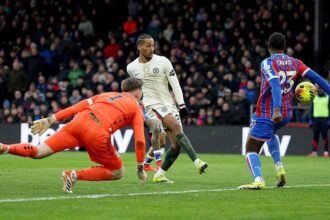
To understand the magnitude of Neville’s claim, we must first dissect the incident itself. With Arsenal clinging to a 1-0 lead deep into stoppage time, West Ham launched a desperate final assault. A cross into the box was met by a header, which deflected off Arsenal defender Jakub Kiwior and fell perfectly for West Ham’s Jarrod Bowen. Bowen, with the composure of a seasoned finisher, swept the ball past David Raya. The stadium erupted. The comeback was on. But the joy was short-lived.
VAR official Michael Oliver intervened, instructing referee Craig Pawson to review the monitor. The check was for a potential offside in the build-up. The key frame? Tomas Soucek, standing in an offside position, appeared to make a slight motion—a duck of the head—as the initial header came in. The argument was that Soucek, though not touching the ball, was impacting the goalkeeper’s ability to play the ball. After a lengthy review, Pawson overturned his on-field decision. No goal. The Hammers were left heartbroken.
- The Offside Ruling: Soucek was in an offside position when the ball was played.
- The “Active” Debate: Did Soucek’s movement constitute “interfering with an opponent”?
- The Goalkeeper Factor: Arsenal argued that Raya was distracted by Soucek’s proximity.
- The Reversal: The on-field goal was overturned, a rare and dramatic VAR intervention.
For Neville, speaking on his podcast, this wasn’t a marginal call. It was a fundamental failure of interpretation. “We’ve seen offsides by a toenail, handballs that defy physics, but this? This is the biggest moment in VAR history because it sets a precedent that a player can be penalised for breathing near a goalkeeper,” Neville stated emphatically.
Why Neville Calls This the ‘Biggest Moment in VAR History’
Neville’s declaration is not hyperbole for the sake of a headline. He has been a consistent critic of VAR’s implementation, but he has rarely used such definitive language. So, what makes this specific incident so historically significant?
1. The Precedent of ‘Intent’ vs. ‘Impact’
The core of the controversy lies in the interpretation of Law 11. Soucek did not touch the ball. He did not block the goalkeeper’s path. He made a natural, instinctive motion to avoid being hit by the ball. Yet, VAR decided that his presence—and his slight head movement—distracted David Raya. Neville argues this opens a Pandora’s box. “If that is a foul, then every corner kick, every free-kick, every cross into the box becomes a minefield,” he said. “You are now asking attackers to stand completely still like statues. It’s not football.”
2. The Timing and the Title Race Context
This wasn’t a mid-table clash. Arsenal are in a fierce battle for the Premier League title. Dropping two points here could have been catastrophic for Mikel Arteta’s side. Conversely, West Ham, fighting for European places, felt robbed of a deserved point. Neville highlighted that VAR decisions in title races carry exponential weight. “This moment could define the title. If Arsenal win the league by one or two points, every single person will point back to this goal that wasn’t. That’s the weight of history.”
3. The Erosion of the ‘Clear and Obvious’ Standard
The original mandate for VAR was to correct “clear and obvious errors.” The on-field referee, Craig Pawson, had a perfect view of the play and saw no infringement. He allowed the goal. For VAR to intervene, the error must be blatant. Neville believes this was not a clear error. “It was a subjective interpretation. The referees are now micro-managing the game. They are looking for reasons to disallow goals, not to allow them. That is a fundamental corruption of the spirit of the game.”
Expert Analysis: The Fallout for Players, Managers, and Fans
The immediate aftermath was predictable. West Ham manager David Moyes, usually measured in his post-match comments, was visibly furious. “It’s a nonsense. The goalkeeper has been beaten by a deflection. The idea that a player ducking is a foul is a new rule that nobody told me about,” Moyes fumed. On the other side, Arsenal’s Mikel Arteta was pragmatic, acknowledging the win but admitting the decision was “very tight.”
But the real damage is to the trust between fans and the game. Stadiums across the country are now filled with a sense of dread when a goal is scored. The spontaneous joy has been replaced by a nervous glance at the referee’s watch, waiting for the VAR check. Neville’s point is that this incident has accelerated that distrust to breaking point.
- For West Ham: A devastating psychological blow. Hard-fought momentum stolen by a technicality.
- For Arsenal: A massive result, but one tainted by controversy. They know the narrative will follow them.
- For the Premier League: Another black eye. The product is being damaged by its own technology.
- For the PGMOL (Referees’ body): A crisis of confidence. They must now explain how a non-contact, non-blocking movement became a decisive factor.
Neville’s analysis cuts to the bone. “We are losing the essence of what makes football special. It’s a contact sport with chaos and beauty. VAR is trying to sanitise it into a spreadsheet. This West Ham decision is the moment where the technology officially became more important than the game itself.”
What Happens Next? Predictions for the Future of VAR
If Gary Neville is right, and this is the “biggest moment in VAR history,” then what comes next? The football community is at a crossroads. We have seen incremental changes to VAR before—the introduction of thicker lines for offside, the “referee’s call” protocol—but nothing has truly solved the problem.
Prediction 1: A Formal Challenge to the Interpretation
West Ham may not win a formal appeal (the Premier League rarely overturns VAR decisions), but the club’s legal and administrative teams will likely push for clarity. Expect a Premier League managers’ meeting where this specific “ducking” incident is discussed. A new directive will almost certainly be issued, clarifying that such minor movements should not be penalised. But the damage is done.
Prediction 2: The Rise of ‘Challenge’ Systems
Neville has long advocated for a system similar to tennis or cricket, where managers get one or two challenges per game. This incident strengthens that argument. If Moyes could have challenged the VAR intervention itself, the game might have continued with the goal standing. Expect this debate to become a central topic in the next Premier League shareholders’ meeting.
Prediction 3: A Shift in Attacking Play
Forwards and attacking midfielders will now be coached to avoid any movement near a goalkeeper during set pieces. This will lead to more static, less dynamic attacking play. The art of the “nuisance” striker—the player who makes subtle runs to disrupt the keeper—may become extinct. That is a loss for the sport’s tactical richness.
Prediction 4: Increased Public Pressure on Referees
The PGMOL will face unprecedented scrutiny. The referee in question, Craig Pawson, and VAR Michael Oliver are two of England’s most respected officials. If they can get a call of this magnitude wrong (in Neville’s view), then no decision is safe. The public trust, already fragile, will be further eroded.
Conclusion: A Line in the Sand
Gary Neville’s assertion that the disallowed West Ham goal is the “biggest moment in VAR history” is a powerful statement. It is not just about one game or one point. It is about the philosophical direction of football. Are we building a game that is perfectly fair but sterile and joyless? Or are we willing to accept a degree of human error in exchange for the raw, unfiltered emotion that makes the sport the world’s greatest?
Neville’s argument is that this West Ham incident has drawn a line in the sand. We have now entered an era where the technology dictates the narrative, not the players. When a player cannot duck out of the way of a ball without fear of having a goal disallowed, the rules have gone too far. The beautiful game is in danger of becoming a legalistic nightmare. As the title race heats up and the season reaches its climax, one thing is certain: the ghost of that disallowed goal at the London Stadium will haunt every decision, every celebration, and every conversation about VAR until the technology is fundamentally reformed. Gary Neville has, once again, proven he is not just a pundit; he is the conscience of the modern game.
Source: Based on news from Sky Sports.