Newcastle v The System: Is the Saudi 2030 Vision Already Unrealistic?
The roar that greeted Newcastle United’s Saudi-backed takeover in October 2021 wasn’t just one of relief at Mike Ashley’s departure. It was a sonic boom of ambition, a belief that the sleeping giant of the north-east had been handed a key to football’s ultimate kingdom. Fast forward to a desolate January 2024, and the sound at St. James’ Park was the stunned silence following a 2-1 FA Cup defeat to arch-rivals Sunderland. The result was a brutal metaphor, exposing a gulf not just in passion but in Premier League position. It has forced a stark, urgent question: is the grand Saudi 2030 vision for Newcastle United already colliding with an unyielding reality?
The Bold Promise: From North-East to the World’s Summit
The project’s blueprint is no secret. The Saudi Public Investment Fund (PIF), with its near-infinite wealth, didn’t buy a football club merely to compete. The acquisition is a cornerstone of the nation’s “Vision 2030,” a sweeping economic and social diversification strategy where sport is a primary vehicle for global influence. For Newcastle, the timeline was publicly accelerated by the club’s own leadership.
Arriving as Chief Executive at the end of 2023, David Hopkinson was remarkably bullish. He didn’t speak of gradual progress or top-four aspirations. He declared an intent to put Newcastle United “in the debate about being the top club in the world” by 2030. This wasn’t fanfare; it was a corporate target, aligning the club’s trajectory directly with the Kingdom’s national project. The early signs were promising: a Champions League qualification in 2022/23 suggested the rocket was on the launchpad.
The Cold Shower: The System Pushes Back
Football, however, operates within a complex and restrictive ecosystem—”the system” of financial, sporting, and human constraints. Newcastle’s current season is a masterclass in how this system can throttle even the best-funded projects.
- Financial Fair Play (FFP) & Profit and Sustainability Rules (PSR): The so-called “untold wealth” of PIF is rendered almost theoretical by the Premier League’s spending regulations. Newcastle cannot simply buy their way to the top; they must grow commercial revenue organically to spend big, a slow process in a crowded market.
- The Injury Crisis: This isn’t bad luck; it’s a structural consequence. A thin squad, stretched by Champions League demands, buckled. The system tests depth, and Newcastle’s, limited by FFP, was found catastrophically wanting.
- Competitive Saturation: The “top club” debate Hopkinson referenced includes state-backed Manchester City, commercially monstrous Manchester United, and strategically brilliant clubs like Liverpool and Arsenal. All are accelerating while Newcastle hits its first major speed bump.
- The Sunderland Barometer: The recent defeat was symbolic. As Eddie Howe noted, being not even the top club in the north east in the current table is a painful reality check. The vision is global, but the foundations must be local, and they currently look shaky.
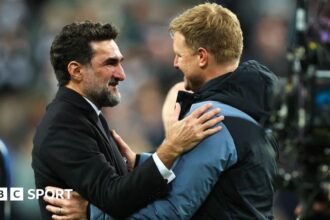
In his press conference after the derby defeat, a visibly strained Eddie Howe, under pressure for the first time in his tenure, faced the direct question: was the Saudi Public Investment Fund (PIF) project running out of steam? His answer, focusing on the need for “resources” and “help,” was a tacit admission that the current model is straining against its limits.
Expert Analysis: Vision vs. Viability
The central tension is between geopolitical timescales and football’s relentless cycle. Saudi Arabia’s Vision 2030 is a decade-long national transformation. Football fandom, and particularly the Premier League, operates in a hysterical, week-to-week news cycle. The project demands patience, but the ecosystem—from pundits to fans—is inherently impatient.
Furthermore, Newcastle’s rise is scrutinized under a unique ethical and political lens. Every transfer is viewed through the prism of sportswashing, every setback gleefully highlighted by critics. This adds a layer of pressure and distraction not faced by other clubs.
The January transfer window is a litmus test. Will PIF find creative, rule-compliant ways to inject vitality into the squad, or will FFP force another month of austerity? The club’s ability to navigate this system—not just their bank balance—will define the next phase. Hopkinson’s bullishness must now translate into off-field commercial genius to expand the financial headroom for his on-field ambitions.
Predictions: A Recalibration, Not a Retreat
So, is the 2030 vision dead? A more nuanced forecast is likely.
The “Top Club” rhetoric will soften. The target will likely be reframed around sustainable Champions League qualification and domestic trophy wins, rather than outright global primacy by 2030. The timescale will stretch.
Infrastructure will become the priority. The real signs of the project’s health won’t just be marquee signings, but shovels in the ground for training ground upgrades and stadium expansion. This is the slow, unglamorous work of empire-building.
Howe’s future hinges on this season’s finish. A top-seven finish and a deep European run next season could reset the narrative. A bottom-half finish may force PIF into a brutal, identity-shifting decision, despite Howe’s monumental prior work.
The system will force smarter strategy. Newcastle’s recruitment must become flawless—finding value, developing youth, and avoiding expensive mistakes. They must out-think, not just out-spend, their rivals.
Conclusion: The Long Game in a Short-Term World
The defeat to Sunderland was not a death knell for the Saudi project at Newcastle United, but it was a piercing alarm. It revealed that the path from a passionate, wounded giant to a global superclub is not a straight, funded line. It is a brutal obstacle course of financial regulations, sporting misfortune, and fierce competition.
The Saudi 2030 vision for Newcastle is not necessarily unrealistic, but it is undoubtedly naive in its original, stated timeline. The project is not running out of steam, but it has conclusively run into the system. The sovereign wealth meets sovereign rules. The coming years are no longer about a triumphant march; they are about a complex, often frustrating, negotiation with reality. The world-class debate David Hopkinson craves will be earned not by declaration, but by decades of shrewd, resilient, and system-proof building. The true test of the vision is no longer ambition, but adaptability.
Source: Based on news from BBC Sport.