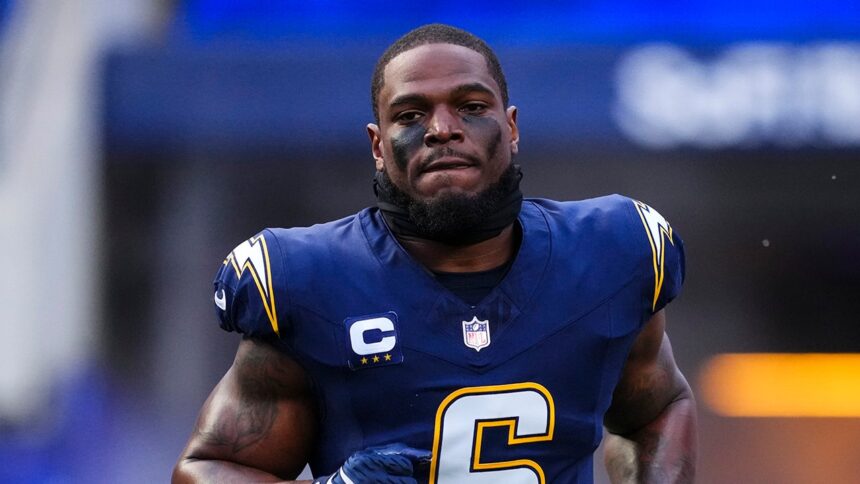
NFL Suspends Chargers’ Denzel Perryman 2 Games for ‘Repeated Violations’ After Scary Hit on Cowboys Receiver
The NFL’s ongoing battle to legislate dangerous hits out of the game found its latest flashpoint in a late-season clash between the Los Angeles Chargers and Dallas Cowboys. In the wake of the Chargers’ 34-17 Week 16 victory, the league has levied a significant punishment, suspending veteran linebacker Denzel Perryman two games without pay for a helmet-to-helmet hit on Cowboys rookie receiver Ryan Flournoy. The suspension, citing “repeated violations,” underscores the league’s fraught and often controversial mission to prioritize player safety in a sport built on violent collision.
A Hit That Crossed the Line: Dissecting the Play
With the game well in hand late in the fourth quarter, Cowboys quarterback Trey Lance targeted rookie wideout Ryan Flournoy on a short crossing route. Flournoy caught the pass and was immediately wrapped up by Chargers defender Deane Leonard, driving him to the ground. As Flournoy was falling, already in the grasp of the defender, Denzel Perryman entered the frame at full speed.
Launching himself forward, Perryman delivered a forceful blow with the crown of his helmet directly to the side of Flournoy’s helmet. The violent collision drew an immediate flag for unnecessary roughness and left Flournoy down on the turf, requiring medical attention. He was later evaluated for a concussion.
The NFL’s vice president of football operations, Jon Runyan, was unequivocal in his suspension letter, stating Perryman “used your helmet to make forcible contact” to a defenseless player’s head. The league specifically pointed to Rule 12, Section 2, Article 10, which prohibits “using any part of the helmet or facemask to butt or make forcible contact to an opponent’s head or neck area.”
Not an Isolated Incident: The Weight of “Repeated Violations”
The key phrase in the NFL’s announcement—and the likely reason for a suspension rather than just a fine—is “repeated violations of playing rules intended to protect the health and safety of players.” This was not Perryman’s first offense in 2023, or even his second.
- In Week 2, while playing for the Houston Texans, Perryman was fined for a helmet-to-helmet hit on Indianapolis Colts quarterback Anthony Richardson.
- In Week 12, now with the Chargers, he was fined again for unnecessary roughness on Baltimore Ravens tight end Isaiah Likely.
- The hit on Flournoy represented a third strike, prompting the league to move beyond financial penalties to a playing-time sanction.
This history paints a picture of a player whose aggressive style has repeatedly crossed into illegal and dangerous territory. The NFL’s disciplinary system, often criticized for inconsistency, is designed to escalate punishment for repeat offenders. Perryman’s suspension is a textbook application of that policy, signaling that the league is monitoring individual player trends in dangerous play.
Expert Analysis: The Fine Line Between Aggressive and Reckless
The play sparked immediate reaction from the broadcast booth. Play-by-play announcer Adam Amin called it “a bad hit” in real time, emphasizing that Flournoy was “already going down.” Analyst and Hall of Fame quarterback Drew Brees, known for his offensive perspective, offered a nuanced take that highlights the core tension in the modern NFL.
“You appreciate the physicality, you appreciate the effort,” Brees said during the broadcast. “But that is exactly the type of hit that the league is trying to get out of the game.” This dichotomy—appreciating hard-nosed football while condemning its most hazardous manifestations—is at the heart of the safety debate. Perryman, a 2015 draft pick known as a hard hitter, represents an old-school mentality that is increasingly being phased out by rule changes and enforcement.
Football purists often lament the “softening” of the game, but medical research on Chronic Traumatic Encephalopathy (CTE) and the long-term effects of concussions has forced the league’s hand. Hits like Perryman’s, where a player launches and uses his helmet as a weapon, carry an exceptionally high risk for both the deliverer and the recipient. The suspension is a clear message to all players: adjust your tackling technique, or face escalating consequences.
Implications and Predictions: What Happens Next?
Perryman has appealed the suspension, a standard procedure in such cases. The appeal will be heard and decided by either Derrick Brooks or James Thrash, the former players jointly appointed by the NFL and NFLPA to handle on-field discipline appeals. Given the clear video evidence and Perryman’s recent history, a reduction or overturning of the suspension seems unlikely.
The two-game ban means Perryman will miss the Chargers’ final two games of the season against the Denver Broncos and Kansas City Chiefs. For a team already eliminated from playoff contention, the suspension is more about a personal consequence for Perryman than a competitive blow to the Chargers. However, it directly impacts his wallet and his future.
Looking ahead, this incident will factor into Perryman’s free agency this offseason. While his tackling production is valued, teams will now have to weigh his on-field aggression against his growing disciplinary file. In an era where penalties can swing games and suspensions cripple a roster’s depth, a label as a “repeat offender” carries significant weight in front offices.
Furthermore, this case will be added to the league’s internal catalog of examples used for player education. The NFL will likely point to the Perryman suspension during the next offseason’s safety tutorials, showing players the tangible repercussions of non-compliance.
Conclusion: An Unending Evolution for Player Safety
The suspension of Denzel Perryman is more than a two-game headline; it is a microcosm of the NFL’s complex and often painful evolution. It involves a veteran player struggling to adapt his game, a rookie suffering a scary injury, and a league office attempting to enforce standards that are, by nature, difficult to apply in split-second moments of high-speed contact.
The league’s ultimate goal—to preserve the essential physicality of football while mitigating its most catastrophic risks—remains a work in progress. Punishments like this one are a necessary tool in that effort, aiming to deter behavior that endangers careers and long-term health. As the game continues to change, players like Perryman face a clear mandate: evolve your approach, or face the consequences. The hit on Ryan Flournoy was deemed unacceptable, and the NFL’s response, citing a pattern of behavior, sends a stark message as the league moves forward into an increasingly safety-conscious future.
Source: Based on news from Fox Sports.