The Unseen Architect: How JT Toppin’s “Hockey Assists” Fueled Texas Tech’s Record-Setting Three-Point Barrage
WACO, Texas — The box score from Texas Tech’s commanding 92-73 victory over Baylor on Tuesday night tells a story of incendiary shooting. It screams the headlines: Christian Anderson’s career-high eight threes. Donovan Atwell’s seven first-half triples. The Red Raiders, for the third time this season, matching a program record with 17 made 3-pointers. But buried in that stat sheet, between the gaudy point totals and the long-range makes, lies a subtle, two-line entry for JT Toppin: 2 assists. To the untrained eye, it’s a footnote. To head coach Grant McCasland, it’s a statistical lie, the hidden blueprint to an offensive masterpiece. The real story of this record-tying night wasn’t just the flame; it was the fuse, and his name is JT Toppin.
The Catalyst in the Paint: Toppin’s Decisive Touch
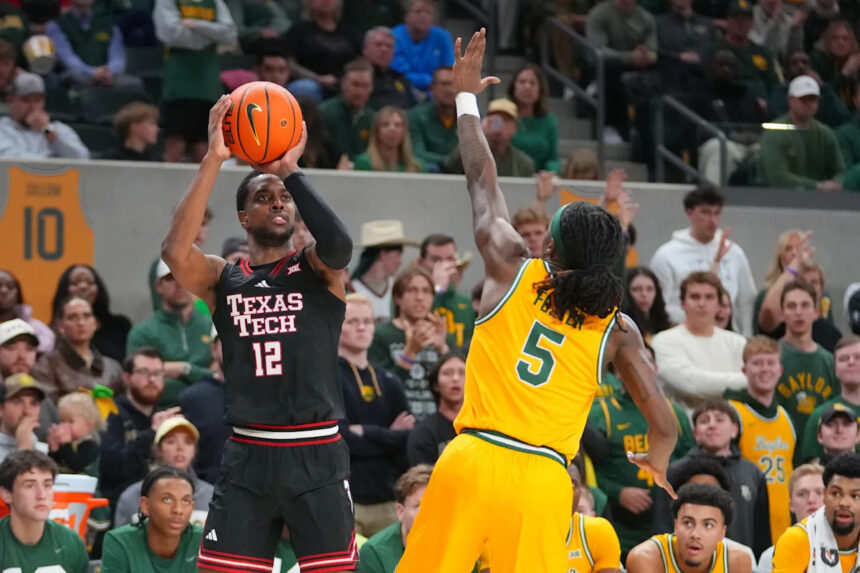
Just 21 seconds into the contest, the game’s defining pattern was set. Baylor, wary of Toppin’s interior prowess, immediately double-teamed the 6-foot-9 forward in the post. Instead of forcing a contested shot, Toppin made a sharp, decisive pass out to the perimeter. The ball found Christian Anderson, who immediately swung it to a wide-open Donovan Atwell. Swish. Three points. Assist: Anderson. But the play was engineered by Toppin’s poise and vision.
This was not an isolated incident. It was a systematic dismantling. “We threw it to him, I don’t know, maybe 10 times early in the game, and he just makes the right play over and over and over again,” McCasland revealed postgame. In an era obsessed with primary statistics, Toppin excelled at the hockey assist—the pass that leads directly to the assist. His presence in the high or low post acted as a gravitational force, bending Baylor’s defense inward and creating pristine driving and passing lanes for Tech’s guards.
McCasland’s analysis cut to the heart of Toppin’s impact: “You look at the stat sheet and (Toppin) has got two assists. But I mean nine of those 3s are Christian passing to (Atwell) from JT, and LeJuan (Watts) getting it from JT.” This unofficial stat line transforms the narrative. Toppin wasn’t just a contributor; he was the primary catalyst, directly influencing over half of the Red Raiders’ record-matching three-point output through sheer, unselfish basketball IQ.
Anatomy of an Offensive Symphony
Texas Tech’s offensive performance was a symphony in three movements, with Toppin conducting from the block.
- Movement 1: The Post Entry & Collapse. Every time Toppin caught the ball, Baylor’s defense was compelled to react. Their double-teams were a sign of respect, but also a trap.
- Movement 2: The Quick Kick-Out. Toppin’s ability to read the double-team and immediately find the open man on the perimeter was flawless. His passes weren’t just accurate; they were timely and crisp, allowing shooters to catch in rhythm.
- Movement 3: The Extra Pass & Fire. This is where Anderson and Atwell thrived. With the defense now in frantic rotation after Toppin’s initial pass, the closeouts were late and disjointed. The Red Raiders’ guards, trusting the system, often made the extra pass, turning a good look into a great one.
This system created a perfect storm. Atwell’s 21 points, all before halftime, were a product of this relentless ball movement originating from Toppin’s touches. Anderson’s 26 points and eight threes were not just a display of hot shooting, but of a point guard perfectly executing within an offense designed to create chaos via inside-out play.
Strategic Implications for the Postseason
This victory, and the manner in which it was achieved, sends a powerful message as the calendar flips toward March. The No. 12 Red Raiders have demonstrated an offensive versatility that makes them a nightmare matchup. They are no longer a team that can be beaten by taking away one option.
Key Takeaways for Future Opponents:
- The Toppin Dilemma: Do you single-cover him and risk him scoring efficiently inside, or double him and unleash the nation’s 11th-ranked three-point shooting team (entering the game)? Baylor chose the latter and was burned.
- Shooting Depth: With multiple players capable of historic shooting nights (Anderson, Atwell, Pop Isaacs, etc.), shutting down one shooter is futile. The ball will find the open man.
- System Over Stars: McCasland has instilled an offense built on trust and quick decisions. It’s a system that maximizes every player’s strength, from Toppin’s vision to Atwell’s catch-and-shoot prowess.
For Texas Tech, the blueprint for a deep NCAA Tournament run is now clear. When they play through Toppin as a decision-making hub, their offensive ceiling is astronomical. He is the engine that makes the high-octane, three-point shooting machine run at peak efficiency.
Looking Ahead: A New Standard in Lubbock
Matching a school record once is notable. Doing it three times in a single season is a paradigm shift. It signals an intentional, systemic commitment to a modern, space-and-pace offensive identity. However, what makes this iteration of Texas Tech basketball uniquely dangerous is its duality. They are not just a finesse, jump-shooting team. They are a physical, defensive-minded squad (ranked 21st in adjusted defensive efficiency, per KenPom) that now possesses an elite, multi-faceted offense.
The emergence of JT Toppin as an elite facilitator from the post is the final piece of the puzzle. He allows Texas Tech to control tempo, punish mismatches, and exploit defensive schemes in a way that pure guard-driven teams cannot. His “hockey assists” are more than just a fun anecdote; they are the hallmark of a sophisticated, unselfish, and brutally effective offense.
Prediction: If Texas Tech continues to leverage Toppin’s unique playmaking ability, they will not only shatter the three-point record they’ve now matched three times, but they will also position themselves as a legitimate threat to cut down the nets in April. Their performance in Waco wasn’t a fluke; it was a declaration. The Red Raiders have found their offensive identity, and it flows through the hands of their big man, creating waves of three-pointers that can drown any opponent in the country.
In the end, the story of Texas Tech’s season will be written in the wins and losses, the seeds and the brackets. But for those who understand the game’s nuances, the story of their potential will be found in the sequences that don’t make the highlight reel—the quick pass from the post, the extra swing, and the wide-open three that started with the unselfish vision of a player whose greatest contribution will never fully show up in the stat sheet. JT Toppin isn’t just scoring or rebounding; he’s architecting an offense, one hockey assist at a time.
Source: Based on news from Yahoo Sports.