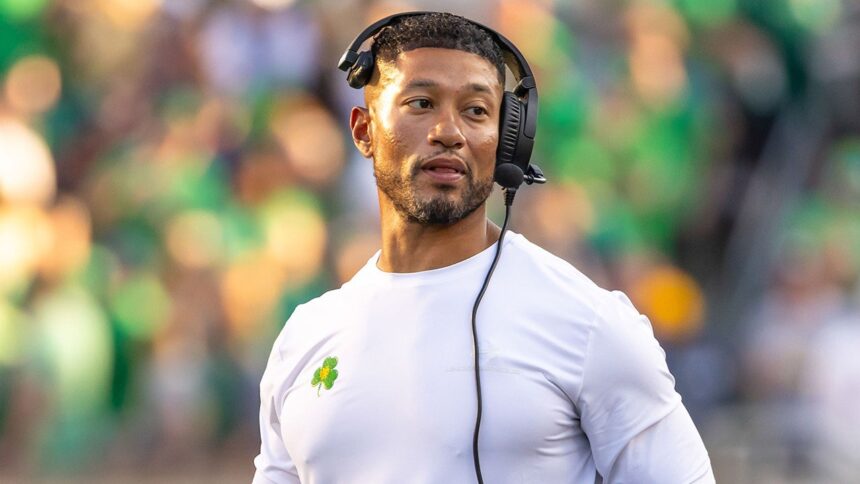
Notre Dame’s Marcus Freeman Faces Battery Allegation: A Coach Under Scrutiny Amid Bowl Game Fallout
The University of Notre Dame football program finds itself navigating turbulent off-field waters, as head coach Marcus Freeman faces a serious personal allegation while his team grapples with the competitive disappointment of missing the College Football Playoff. In a one-two punch of adversity, a police report alleging battery against Freeman has surfaced, casting a shadow just as his players, including standout running back Jeremiyah Love, explain their collective decision to opt out of a postseason bowl game. This confluence of events presents a critical test of leadership and institutional stability for one of college football’s most storied programs.
The Alleged Incident: A Father’s Passion or a Coach’s Misstep?
According to a report from the South Bend Tribune, the allegation stems from an incident earlier this month at the prestigious Al Smith Wrestling Invitational in Mishawaka, Indiana. Freeman was in attendance not as the face of Fighting Irish football, but as a father supporting his son, Vinny, a wrestler for Penn High School. The situation reportedly escalated after Vinny Freeman lost his bout.
The police filing, made by New Prairie High School assistant wrestling coach Chris Fleeger, claims a physical altercation occurred between the two men. Specific details of the contact remain undisclosed, but the battery allegation indicates Fleeger believed the contact was offensive or provoking. This scenario instantly transforms the narrative from a private parental moment to a very public legal and reputational matter for Freeman and, by extension, Notre Dame.
Key Context of the Allegation:
- Setting: A high school wrestling tournament, far from the bright lights of Notre Dame Stadium.
- Role: Freeman was present purely in a parental capacity.
- Accuser: Chris Fleeger, a fellow coach in the competitive Indiana high school wrestling scene.
- Potential Impact: While a minor legal matter, the court of public opinion and NCAA expectations for coach conduct are immediate concerns.
Team Turmoil: Jeremiyah Love and the Bowl Game Opt-Out
Simultaneously, Freeman is managing a significant football decision that has sparked debate across the sport. In an exclusive conversation with Fox News Digital, Notre Dame running back Jeremiyah Love articulated the team’s rationale for declining a bowl invitation following their exclusion from the 12-team College Football Playoff.
Love’s comments provide a rare, player-driven insight into the modern athlete’s mindset. “As a team, we looked at our goals for the season, and competing for a national championship was at the top,” Love explained. “When that path ended, we made a unified decision that a different bowl game didn’t align with where we wanted to be. It’s about protecting our health, preparing for the next step, and supporting each other in that choice.”
This decision, while increasingly common in the era of the expanded playoff and player empowerment, places Freeman in a delicate position. He must publicly support his players’ collective agency while privately managing the fallout from athletic directors and bowl partners who depend on Notre Dame’s massive draw. It is a leadership tightrope walk, complicated exponentially by the personal allegation now facing him.
Expert Analysis: Navigating the Dual Crises
To understand the magnitude of this moment, one must view both issues through the lenses of public relations, team psychology, and NCAA governance.
“This is a classic case of crisis convergence,” says Dr. Evelyn Marsh, a sports sociologist specializing in leadership. “Freeman is now the protagonist in two separate but parallel stories: one about the evolving power dynamics between players and institutions, and another about the intense, often blurred line between a coach’s personal life and his professional persona. How Notre Dame’s administration handles the legal allegation will send a powerful message about their tolerance for off-field conduct, even in a personal setting.”
From a team dynamics perspective, the bowl opt-out could have a silver lining. A unified player decision can galvanize a locker room, fostering a “us-against-the-world” mentality. However, this cohesion is fragile. “The battery allegation introduces an unpredictable variable,” notes former college coach and analyst Ben Carter. “Players look to their head coach for stability and moral authority. Any whiff of hypocrisy or distraction can erode that trust quickly, especially when the season has already ended on a note of disappointment. Freeman’s ability to address this head-on with his team, with absolute transparency, will be crucial for maintaining the culture he’s built.”
Predictions and Potential Outcomes for Notre Dame Football
The immediate and long-term ramifications of these twin events will unfold on several tracks.
For the Legal Allegation:
- The most likely outcome is a swift, private settlement or dismissal, given the relatively minor nature of most battery cases stemming from heated sporting events. The greater damage is to Freeman’s reputation.
- Notre Dame will likely conduct its own internal review. A public statement of support for Freeman, coupled with a “letting the legal process play out” caveat, is expected.
- Recruiting impact may be minimal if resolved quickly, but rival coaches will undoubtedly use the incident to question Freeman’s composure.
For the Program’s Direction:
- The bowl opt-out signals a program with a “Playoff or bust” mentality. This raises stakes enormously for the 2025 season.
- Expect Freeman to lean heavily on veteran leaders like Jeremiyah Love to maintain offseason focus and unity.
- The administration may face pressure to more aggressively utilize the Transfer Portal and NIL resources to ensure the team is a definitive Playoff contender next year, justifying the bold bowl decision.
Conclusion: A Defining Offseason for Marcus Freeman
Marcus Freeman arrived at Notre Dame as the vibrant, next-generation leader tasked with restoring the program to the pinnacle of college football. This offseason, however, presents challenges no playbook can adequately cover. The battery allegation, however minor it may prove legally, is a personal test of his judgment and character under fire. The team’s bowl game decision, articulated by Jeremiyah Love, is a professional test of his ability to guide a program through the new, player-centric realities of the sport.
Ultimately, Freeman’s tenure may be defined by how he navigates this fraught period. Can he personally resolve the allegation with dignity and transparency? Can he channel his team’s collective disappointment and unified stand into a fiercer, more focused pursuit of a national championship in 2025? The answers will determine whether this winter is remembered as a stumbling block or the crucible that forged a stronger, more resilient Notre Dame football program. The spotlight, for all the wrong and right reasons, is fixed firmly on South Bend.
Source: Based on news from Fox Sports.