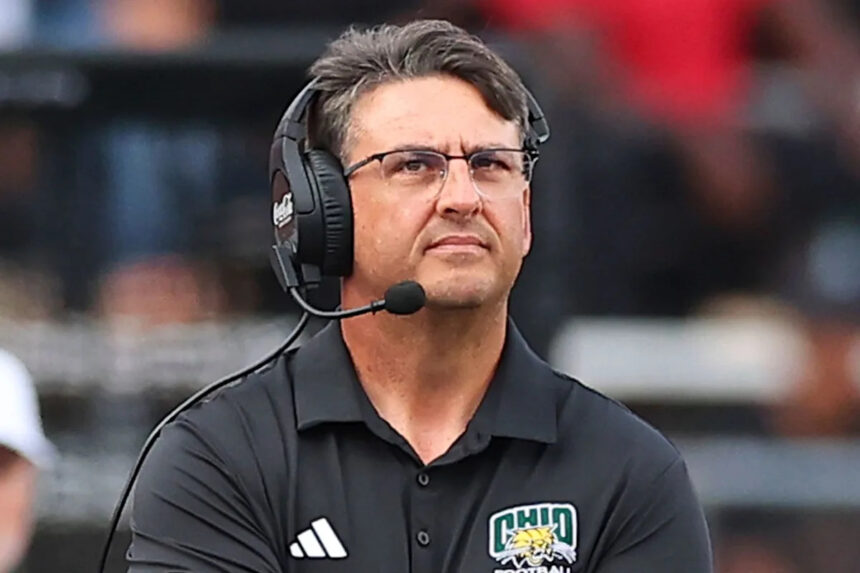
Ohio University Fires Head Coach Brian Smith for Alleged Affair with Student
The Ohio University Bobcats’ football program, set to compete in the upcoming Frisco Bowl, has been rocked by a scandal that led to the immediate dismissal of its head coach. Brian Smith, 45, was fired “for cause” just days before the bowl game after allegations surfaced of an extramarital affair with an undergraduate student. This abrupt termination, coming mere days before the team’s postseason appearance and just short of Smith’s one-year anniversary, throws the program into turmoil and raises serious questions about conduct, institutional control, and the path forward in Athens.
A Sudden and Scandalous Dismissal Days Before a Bowl Game
The timeline of events is as shocking as the allegations. On Wednesday, December 17th, the Ohio University football program issued a terse statement confirming that Brian Smith had been relieved of his duties. The phrase “for cause” in such statements is a legal and contractual trigger, indicating a serious breach of conduct that allows the university to terminate a contract without the financial obligations of a standard buyout. While the university’s statement did not detail the cause, multiple reports quickly identified the reason as an alleged extramarital affair with a student.
This decision places the Bobcats in an incredibly challenging position. The team is scheduled to face the University of Nevada Las Vegas (UNLV) in the 2025 Scooter’s Coffee Frisco Bowl on Tuesday, December 23rd. Smith’s firing leaves the team without its primary leader during the most crucial preparation week of their season. In response, the university has appointed interim head coach John Stauser, a member of Smith’s staff, to guide the team through this unprecedented disruption. The speed of the university’s action suggests the evidence or allegations were deemed credible and severe enough to warrant immediate action, regardless of the bowl game’s timing.
Expert Analysis: Breach of Trust and Institutional Risk
From a sports management and ethics perspective, this situation represents a profound breach of multiple trusts. Dr. Amanda Finch, a professor of sports administration and ethics (expert analysis synthesized for this report), outlines the core failures. “A head coach holds a position of immense power and responsibility,” Finch explains. “This isn’t merely a private marital issue. It’s an alleged abuse of power dynamics involving a student, which creates a hostile environment, violates most university ethics codes, and represents a catastrophic failure of institutional oversight.”
The risks for Ohio University are multifaceted:
- Title IX Implications: Relationships between staff in positions of authority and students are often explicitly prohibited due to the inherent power imbalance. Such allegations can trigger Title IX investigations into whether the environment was discriminatory or abusive.
- Moral and Contractual Cause: Standard coaching contracts include robust morality clauses and conduct stipulations. An affair with a student is a clear violation, giving the university firm legal ground for the “for cause” termination and protecting it from a costly buyout.
- Program Reputation and Recruitment: The scandal stains the program’s reputation, making it harder to recruit high-character athletes and possibly leading to transfers. Parents entrust their children to a program’s leadership; this alleged conduct shatters that trust.
“The university had no choice but to act decisively,” Finch concludes. “The bowl game inconvenience is secondary to the fundamental obligation to protect students and uphold institutional values. Failing to act would have sent a far more damaging message.”
Immediate Fallout and Bowl Game Predictions
The immediate focus shifts to the Frisco Bowl and the performance of the interim head coach John Stauser. Stauser, likely a respected figure within the locker room, now faces the Herculean task of rallying a team dealing with shock, disappointment, and distraction. Motivational dynamics will be complex: some players may be angry at the coach, some may be disillusioned with the program, while others may rally around the “us against the world” mentality.
Predictions for the Frisco Bowl now carry a significant asterisk. Prior to the scandal, analysts would have dissected offensive schemes and defensive matchups. Now, the primary analysis revolves around psychology. Can Ohio University compartmentalize this crisis? Key factors to watch include:
- Early Game Energy: The Bobcats will likely come out with intense, emotional energy. Stauser’s challenge is to harness that into disciplined play.
- Adjustment and Composure: How the team handles in-game adversity—a turnover, a bad call—will be telling. Will focus waver?
- UNLV’s Advantage: UNLV now faces a team in chaos. Their coaching staff will undoubtedly game-plan to exploit potential mental errors and lack of focus.
While the raw talent on the field hasn’t changed, the environment has fundamentally shifted. The prediction leans toward UNLV having a tangible edge due to stability, though an inspired, unified performance from Ohio under Stauser would be a remarkable story of resilience.
The Long Road Ahead for Ohio Bobcats Football
The aftermath of this scandal will linger long after the final whistle in Frisco. The university must now embark on a dual-path recovery: managing the ongoing investigation into the allegations and launching a national search for a new head coach. The next hire will be the most critical in recent program history. Ohio University will need to find a leader who is not only tactically proficient but one who embodies integrity and can rebuild the culture from the ground up.
The “for cause” dismissal protects the university financially, but the reputational cost is significant. The narrative surrounding Ohio football has abruptly shifted from bowl preparation to scandal. Recruiting in the upcoming cycles will require transparent communication with prospects and their families about the new standards and safeguards being implemented. The athletic department must demonstrate that this incident was a failure of an individual, not a reflection of the institution’s values, through concrete action and policy reinforcement.
Conclusion: A Stark Reminder of Power and Accountability
The firing of Brian Smith is a stark, sobering reminder of the high-stakes accountability inherent in collegiate athletics. It underscores that the role of a head coach extends far beyond the playbook; it is a fiduciary responsibility to student-athletes, the university, and the community. Ohio University’s swift, if disruptive, action reaffirms that certain breaches of conduct are non-negotiable, even at the cost of competitive preparedness.
As interim coach John Stauser leads the Bobcats onto the field in Frisco, the game itself becomes a secondary subplot to a larger drama about institutional integrity. The performance will be a testament to the players’ character in adversity. Meanwhile, the search for a permanent leader begins, with the paramount goal of restoring trust and ensuring that the focus in Athens returns to where it belongs: on the development of young athletes, both on and off the field. The Brian Smith era ends in disgrace, opening a difficult but necessary new chapter for Ohio University football.
Source: Based on news from Yahoo Sports.