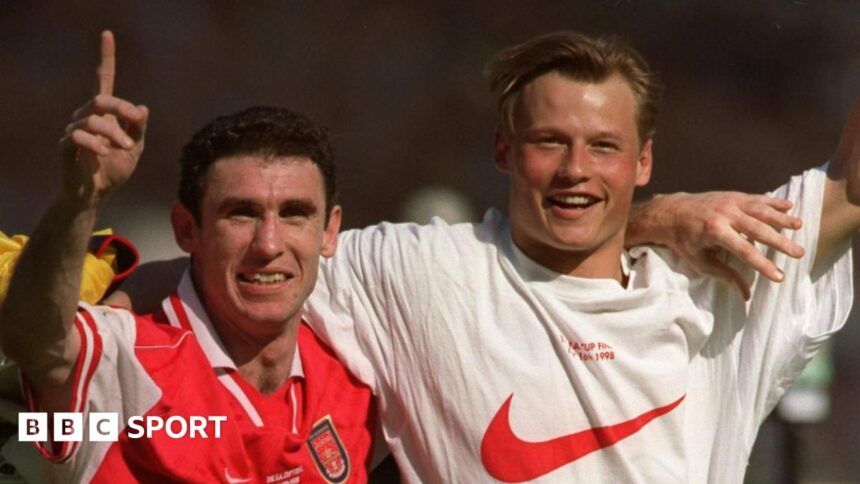
Keown’s Embrace: The Unforgettable Energy of Arsenal’s Unsung Hero Alex Manninger
The archives of football are filled with moments frozen in time. For the fan, they are highlights of glory; for the player, they are portals. A grainy clip can be a stranger’s memory, or it can be a lightning bolt to the soul, transporting you back with such visceral force you can still feel the sweat, the adrenaline, the pure, unadulterated joy. For Martin Keown, one such clip became a heartbreaking tribute this week. It wasn’t of a title-winning goal or a trophy lift, but of an embrace. An embrace with a man who lifted him, both literally and figuratively: the late, great Alex Manninger.
A Celebration That Lifted a Legend
Following the tragic news of Alex Manninger’s passing, Martin Keown took to social media with a specific memory. It was from February 1998, after an epic FA Cup fourth-round replay against West Ham United. Arsenal, the Double-chasing giants, had been pushed to the limit, eventually prevailing 4-3 on penalties. The footage shows Keown, the embodiment of Arsenal’s defensive grit, moving to congratulate his goalkeeper. What happens next is telling.
“I can still feel the energy of that embrace to this day,” Keown recalled. The video shows him going in for a bear hug, but it is Manninger—the penalty hero—who ends up lifting the formidable centre-half clean off the ground. “It is him who ends up lifting me off the ground.” This single, powerful image encapsulates Manninger’s role at Arsenal: a supportive force with unexpected strength, capable of uplifting the entire squad at a crucial moment.
That season, Manninger was performing the most difficult job in football: deputizing for a legend. With David Seaman injured, the young Austrian stepped into the breach during the run-in for the Premier League and FA Cup Double. His contribution was not just capable; it was title-defining.
- Seven consecutive clean sheets in the Premier League during a critical spring period.
- A crucial, man-of-the-match performance in a 1-0 win at Old Trafford in March.
- Steely reliability in the FA Cup run, culminating in that penalty save against West Ham.
He wasn’t just keeping the seat warm; he was fortifying the foundation. As Keown and other former colleagues process the news, that shared memory of the embrace speaks volumes. It was the recognition, in real time, of an unsung hero’s vital contribution.
The Quiet Architect of The Double
To understand Alex Manninger’s impact, one must dismiss the modern obsession with constant spotlight. His was the art of seamless integration. In a squad bristling with personalities like Adams, Vieira, Bergkamp, and Overmars, Manninger provided a calm, competent assurance. His run in the team wasn’t a subplot; it was a masterclass in readiness and mental fortitude.
“The news is still sinking in for all of us,” Keown noted, speaking for a generation of Invincibles-in-waiting. Manninger’s performances ensured the machine kept humming. The defensive unit, built on trust, never had to downgrade its expectations. He played with the confidence of a number one, which in turn gave confidence to the back four. This psychological stability is an intangible, rarely captured in statistics, but felt profoundly by teammates. It’s what allowed Keown to attack his defensive duties without a second thought, knowing the last line was impregnable.
His heroics at Old Trafford were the pinnacle. In a tight, tense match decided by Marc Overmars’ goal, Manninger was a wall. Saving from Cole, Scholes, and Sheringham, he delivered a performance that screamed not “deputy,” but “leader.” It was a statement that Arsenal’s title challenge would not falter on the altar of injury. For a team cultivating a winning mentality, having a capable understudy who performed like a star was a secret weapon.
The Legacy of the Understudy: A Dying Art?
Reflecting on Manninger’s role prompts a broader analysis of the modern game. The era of the long-serving, cup-competition goalkeeper who can step up for a prolonged league campaign seems to be fading. Today’s squads often have two “number ones,” or a clear hierarchy that sees a backup player rarely tested in consecutive high-stakes matches.
Manninger’s 1998 run represents a different model: depth built on patience and preparation. He wasn’t bought for £30 million to create competition; he was a shrewd signing who learned, waited, and delivered with elite precision when called upon. This speaks to a specific culture within that Arsenal dressing room, fostered by Arsène Wenger, where every player felt invested and ready.
Could a similar story unfold today? The financial stakes are higher, and patience is thinner. However, the success of squad players in long campaigns—think of Stefan Ortega at Manchester City or Joselu at Real Madrid—proves the archetype still exists. The true test is mental. Manninger’s legacy is a blueprint: total professionalism, daily competitiveness in training, and an unwavering belief that your moment will come. When it did, he grasped it with both hands and lifted a club—and a centre-half—to new heights.
A Memory Forged in Feeling
For Keown, the tragedy brings a specific poignancy to memory. He distinguishes between forgotten games and those moments that remain etched in the senses. The embrace with Manninger is in the latter category. “I can see a brief clip and I am taken right back to that time and place, and the memory is so vivid I can still feel it,” he said. That feeling is the ultimate tribute to a teammate.
It wasn’t just a hug; it was a transfer of energy, a release of pressure, and a shared understanding of a job brilliantly done. In that spontaneous lift, we see the respect the defensive stalwart had for his goalkeeper. We see the joy of a collective mission surviving a huge scare. And we see the human connection that underpins all great teams.
Alex Manninger’s name might not headline the histories of Arsenal’s 1998 Double, but his imprint is all over it. He was the unsung hero whose excellence ensured a legendary team didn’t miss a beat. For his teammates, his memory is not stored in statistics or trophy rolls, but in a feeling—a vivid, powerful sensation of being lifted up, both on the Wembley turf after the final and in the crucible of a penalty shootout at Upton Park. His legacy is that energy, that reliability, and the undeniable truth that the strongest foundations are built on trust, and sometimes, the quietest voices shout the loudest in the hearts of champions.
Source: Based on news from BBC Sport.