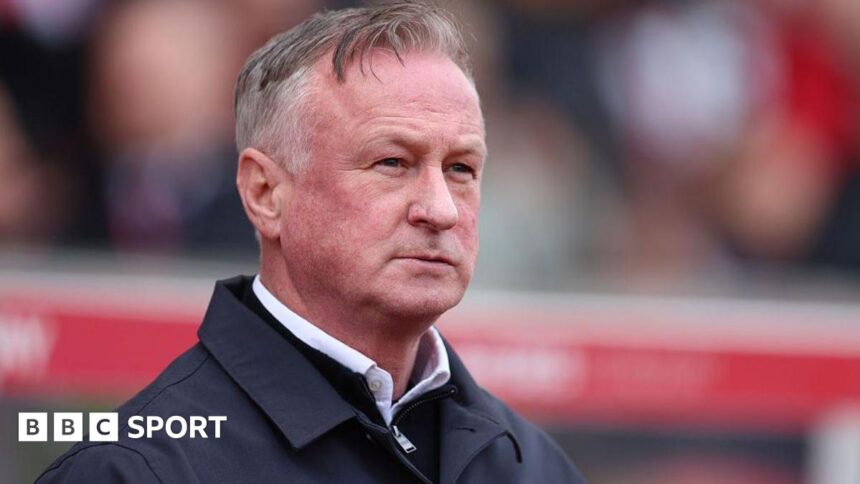
O’Neill Turns Down Blackburn Job: The Green and White Army’s Gain is Ewood Park’s Loss
In a decision that will send a seismic wave of relief across Northern Ireland, and perhaps a pang of regret through Lancashire, Michael O’Neill has officially ruled himself out of the running for the permanent managerial position at Blackburn Rovers. The 56-year-old, who masterfully juggled two high-pressure jobs for the final months of the season, has chosen to remain solely at the helm of the Northern Ireland national team. It is a verdict that feels inevitable in hindsight, yet it carries the weight of a major transfer saga.
For Blackburn, it signals the end of a brief, promising, and ultimately unfulfilled romance. For the Green and White Army, it is a validation of loyalty and a stabilising force ahead of a crucial UEFA Nations League campaign. O’Neill’s tenure at Ewood Park was a short, intense, and statistically fascinating chapter. He took over a sinking ship in February, steadied the vessel, and guided it to the safe harbour of Championship survival. But the siren call of Windsor Park proved too strong.
The Balancing Act: A Season of Dual Duty
When Michael O’Neill was appointed interim manager of Blackburn Rovers in February of the 2025-26 season, the football world raised an eyebrow. Could a man already tasked with rebuilding the pride of Northern Ireland truly split his focus? The answer, it turned out, was a resounding yes—but only as a temporary measure. O’Neill’s brief was simple: keep Rovers in the Championship. He did exactly that, but the job share was always a ticking clock.
During his 15 games in interim charge, O’Neill produced a record that was the very definition of mid-table mediocrity, yet it was the most valuable kind of mediocrity: survival. The numbers tell a tale of grit rather than glamour:
- Games Managed: 15
- Wins: 5
- Draws: 5
- Losses: 5
- Final League Position: 20th (securing Championship status)
To the casual observer, a 20th-place finish is nothing to write home about. But for a club that was flirting with the relegation zone when he arrived, this was a masterclass in crisis management. O’Neill instilled a defensive solidity and a never-say-die attitude that had been sorely lacking. He did not transform Blackburn into a free-scoring, swashbuckling outfit. Instead, he made them horrible to play against. He made them resilient. He made them survivors.
Yet, throughout this period, O’Neill was remarkably transparent. He repeatedly stated that a permanent dual role was not viable. “I would be unable to do both roles permanently,” he said. “I would have to choose one or the other.” This was not a man hedging his bets; it was a professional laying out the logical limits of human endurance. The commute between Belfast and Blackburn, the split scouting reports, the divided loyalties—it was a temporary fix, not a long-term solution.
Why O’Neill Chose Northern Ireland Over Blackburn
The decision, while difficult, was rooted in a deep-seated sense of unfinished business and emotional connection. For Michael O’Neill, the Northern Ireland job is not just a job; it is a calling. He is the architect of the nation’s greatest modern footballing era, leading them to the Round of 16 at Euro 2016 and crafting a squad that punches far above its weight. Leaving that legacy for a gruelling Championship relegation battle was never going to be a simple swap.
There are several key factors that tilted the scales in favour of Windsor Park:
- Legacy and Loyalty: O’Neill is synonymous with Northern Ireland’s golden generation. Walking away now, with a new generation of talent emerging—players like Trai Hume, Shea Charles, and Isaac Price—would have felt like abandoning a project he started.
- The Nations League Opportunity: Northern Ireland have a genuine chance to secure promotion in the UEFA Nations League. O’Neill sees this as a platform to build momentum for the next World Cup qualifying cycle. Blackburn, by contrast, offers only the grim prospect of another relegation scrap.
- Control vs. Chaos: At Blackburn, O’Neill was an interim manager inheriting a squad he didn’t build. At Northern Ireland, he has total control over the playing philosophy, the staff, and the long-term development plan. That autonomy is precious.
- Personal Wellbeing: The strain of commuting and managing two dressing rooms is immense. O’Neill is 56. He has nothing left to prove in terms of his work rate. Choosing the role that offers more stability and less travel was a smart, human decision.
Expert Analysis: This was not a rejection of Blackburn Rovers as a club. It was a rejection of the chaos that comes with a Championship firefighting job. O’Neill looked at Ewood Park and saw a high-risk, high-reward scenario with a low ceiling for glory. He looked at Windsor Park and saw a legacy, a family, and a realistic path to another major tournament. The choice was clear.
What This Means for Blackburn Rovers’ Future
For Blackburn Rovers, the O’Neill era will be remembered as a brief, effective, but ultimately transitional period. The club now faces a critical summer. They must find a permanent manager who can build on the foundations O’Neill laid, but who also understands the financial realities of the Championship.
The immediate implications for Rovers are stark:
- Instability Returns: The club must now conduct a full managerial search. Any momentum gained under O’Neill’s steady hand threatens to evaporate if the wrong appointment is made.
- Squad Uncertainty: O’Neill kept players motivated through sheer force of personality. The new manager will have to win the dressing room from scratch.
- Transfer Window Pressure: With no permanent boss in place, summer recruitment could be delayed. Rovers cannot afford to enter the 2026-27 season with a squad that only just survived.
- A Template for Survival: O’Neill proved that this squad is capable of staying up. The new manager has a blueprint: be organised, be difficult to beat, and grind out results.
Prediction for Blackburn: Expect a pragmatic appointment. The owners will likely target a manager with Championship experience, possibly a veteran of the lower leagues who can replicate O’Neill’s defensive organisation. The goal for next season will be the same: avoid relegation. The dream of pushing for the playoffs is likely another year away.
Northern Ireland’s Bright Future Under O’Neill
While Blackburn lick their wounds, Northern Ireland can celebrate. Keeping Michael O’Neill is arguably the most important transfer window signing they could make. He is the stable hand that guides the ship through the storm. With the European Championship qualifiers on the distant horizon, his presence ensures continuity.
The strategic advantages for Northern Ireland are immense:
- Uninterrupted Development: O’Neill can now fully focus on integrating young talents like Conor Bradley and Shea Charles into his system without distractions.
- Tactical Consistency: The players know his system inside out. There will be no “new manager bounce” to worry about—only the steady evolution of his tactics.
- Nations League Momentum: With a full pre-season and undivided attention, O’Neill can target promotion. This is a realistic goal that would set up a World Cup qualifying campaign perfectly.
- Psychological Boost: The players know their manager chose them over a lucrative club job. That loyalty breeds a powerful team spirit.
Expert Prediction for Northern Ireland: I foresee a strong Nations League campaign, potentially resulting in promotion to League B. O’Neill will use this platform to blood one or two more young players, building a squad that is not just competitive, but dangerous. The long-term goal is qualification for the 2028 European Championship, and this decision keeps that dream firmly on track.
Conclusion: A Victory for National Pride
In the end, Michael O’Neill’s decision to turn down Blackburn Rovers is a victory for romanticism in a cynical sport. It proves that national pride, legacy, and a sense of belonging can still compete with the financial lure of club football. For Blackburn, it is a frustrating but respectful parting of ways. They got exactly what they asked for: a manager who kept them in the Championship. They simply could not keep the manager.
For Northern Ireland, the summer just got a whole lot brighter. The man who orchestrated the greatest nights in the nation’s football history is staying put. He is not a man chasing a payday; he is a man chasing a dream. And as he prepares for the next chapter with the Green and White Army, one thing is certain: Michael O’Neill is exactly where he belongs. The only question now is how far he can take them next.
Source: Based on news from BBC Sport.