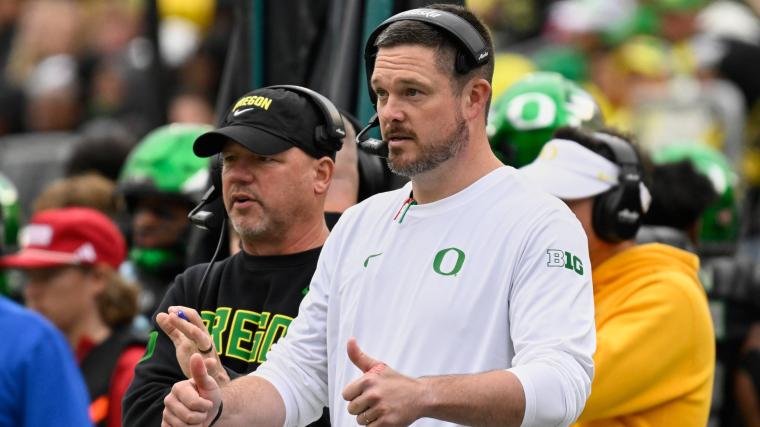
Oregon’s Dan Lanning Unleashes Blistering Critique of College Football Playoff, Demands Overhaul
The College Football Playoff is designed to crown a national champion, but according to one of the sport’s brightest coaching minds, its current structure is failing the very teams it seeks to elevate. In a candid press conference ahead of Oregon’s Orange Bowl clash with Texas Tech, Ducks head coach Dan Lanning didn’t just tinker around the edges of playoff discourse. He delivered a full-throated, systemic indictment of the CFP format, calling for radical changes to scheduling, site selection, and the very rhythm of the postseason. His comments, sharp and solution-oriented, have ignited a crucial debate about the future of the sport’s premier event.
Beyond the Bye Week: Lanning’s Core Philosophical Gripe
On the surface, Lanning’s timing seems curious. His Oregon Ducks are preparing for a College Football Playoff quarterfinal on New Year’s Eve, having just played a game this past Saturday. Their opponent, Texas Tech, hasn’t taken the field since the Big 12 Championship on December 7th, creating a rest disparity of over three weeks. Yet, Lanning swiftly dismissed the notion that this is a simple complaint about an opponent’s extended bye.
“I don’t think it’s an advantage or disadvantage,” Lanning stated, redirecting the conversation. His issue is foundational. He argues that the elongated, irregular gaps between games—a hallmark of the expanded 12-team playoff—disrupt the essential cadence of football. “We’re creatures of habit,” Lanning explained. “Our players are used to playing on a Saturday, recovering on a Sunday, implementing a game plan Monday through Friday, and then playing again.”
This playoff format disruption, he contends, forces teams out of their successful seasonal rhythms and into an artificial, stretched-out timeline that benefits no one. It’s a player-centric argument that challenges the television-driven scheduling of the current model, suggesting the sport has sacrificed its competitive integrity for broadcast windows.
A Blueprint for Change: Neutral Sites, Seeding, and the “Next Saturday” Model
Lanning didn’t stop at identifying problems; he presented a clear, three-point blueprint for a reformed playoff system. His vision is strikingly simple and mirrors the urgency of the regular season.
- Respect the Seed with Home Games: Lanning’s most pointed remark concerned site selection. “In my opinion, this game should be played at Texas Tech,” he said of the upcoming Orange Bowl. “They’re the higher seeded team.” He advocates for true home-field advantage for higher seeds in the early rounds, moving away from predetermined neutral-site bowls for all but the final game. This rewards regular-season performance with a tangible, intimidating benefit and engages local fanbases directly.
- Embrace a Consecutive-Weekend Rhythm: His second pillar is scheduling consistency. “The next playoff game should be the next Saturday, then the next Saturday, then a championship game,” Lanning asserted. This “win-and-advance” model would maintain competitive sharpness, reduce the logistical burden of extended travel and hotel stays, and keep the playoff narrative moving with relentless momentum.
- Mirror the Regular Season: Underpinning both points is a philosophy that the postseason should be a continuation of, not a departure from, the season. Shorter turnarounds and hostile road environments are what define September through November. Lanning asks: why should January be any different?
Expert Analysis: The Practicality and Politics of Lanning’s Vision
Lanning’s critique, while compelling, runs headlong into the entrenched financial and political machinery of college football. As a college football analyst, it’s clear his model has significant merit for competitive purity but faces monumental hurdles.
The Bowl Alliance Problem: The current system is deeply intertwined with historic bowl games and their host committees. The Orange, Sugar, Rose, and Peach Bowls have multimillion-dollar payouts and contractual expectations. Replacing these neutral-site games with campus stadiums would be a seismic financial shift, redistracting revenue from bowl organizations to individual schools and conferences. The political will to dismantle this ecosystem is currently low.
Logistical Realities: A “next Saturday” model is elegant but complex. It allows minimal time for ticket sales, travel planning for visiting fans, and stadium operations for host schools. While the NCAA basketball tournament manages it, the scale and travel involved in football are vastly different. Television networks, which bankroll the playoff, also prefer spaced-out, primetime standalone games to maximize viewership over consecutive weekends of overlapping contests.
However, Lanning’s status as a premier coach at a college football powerhouse gives his voice unusual weight. He is not an outsider lobbying for change; he is a successful participant highlighting the system’s flaws from within. His perspective echoes growing sentiment among coaches and players who feel the expanded playoff, while more inclusive, has created an unnecessarily cumbersome and disjointed climax to the season.
Predictions: Will the Playoff Heed the Call?
The CFP expansion to 12 teams was a massive first step, but Lanning’s comments prove the evolution is far from over. Predicting immediate, wholesale adoption of his model is unrealistic for the next contract cycle. However, we can anticipate incremental shifts influenced by this kind of coaching advocacy.
- Short-Term (Next 2-3 years): Expect the CFP committee to tinker with playoff scheduling. The gaps may be shortened, and the calendar compacted where possible. The first round (on-campus games) is already a concession to Lanning’s home-field advantage argument.
- Medium-Term (Next CFP Contract): The 2026 contract negotiations will be a battleground. The influence of coaches like Lanning, along with player feedback, will push for more on-campus games, potentially through the quarterfinals. The “rhythm” argument may lead to a more standardized one-week preparation model for all teams after the first round.
- Long-Term Vision: The ultimate endpoint may be a hybrid model: true home sites for the first two rounds, followed by a “final four” at neutral sites, all played on consecutive weekends. This balances competitive fairness, fan experience, and the economic interests of major bowls.
Conclusion: A Coach Shaping the Sport’s Future
Dan Lanning’s press conference was more than pre-game bowl preparation; it was a manifesto. By shifting focus from a single game’s logistics to the playoff’s foundational philosophy, he elevated the conversation. His call for a postseason structure that prioritizes competitive integrity, player rhythm, and rewarding regular-season success resonates because it is rooted in the fundamental appeal of the sport: consistent competition in challenging environments.
While the forces of tradition and television revenue are formidable, the voice of a coach who has navigated the playoff in back-to-back seasons is impossible to ignore. Lanning may not get his wish for a game in Lubbock this year, but his bold critique has undoubtedly accelerated the clock on the next great debate in college football. The expanded playoff was the answer to the question of access. Now, Dan Lanning has forcefully posed the next question: at what cost does that access come, and how can we make it better? The search for answers, thanks to his clarity and conviction, has already begun.
Source: Based on news from Yahoo Sports.