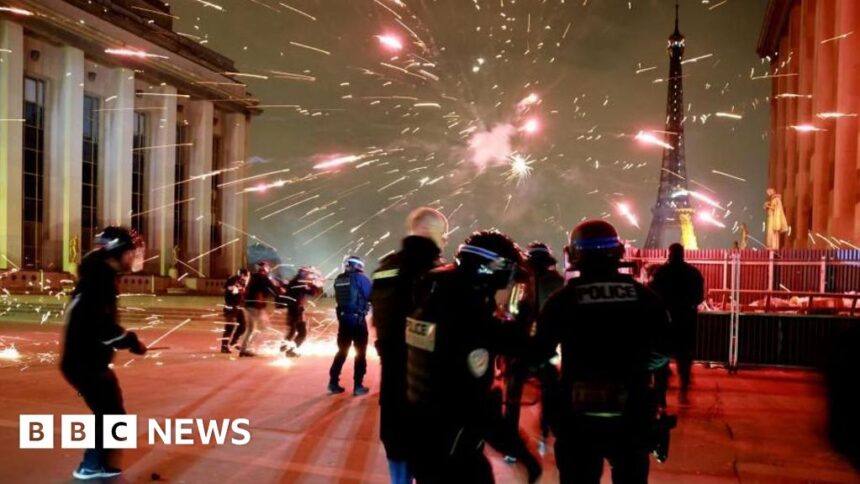
Paris Disturbances and 127 Arrests Mar PSG’s Champions League Win
Paris Saint-Germain secured a hard-fought place in the UEFA Champions League final on Wednesday night, drawing 1-1 with Bayern Munich to progress 3-2 on aggregate. Yet, the celebrations on the streets of Paris quickly turned sour. Instead of a night of unbridled joy, the French capital witnessed a series of violent disturbances that led to 127 arrests and left multiple people injured. France’s Interior Minister, Laurent Nuñez, condemned the chaos, calling it “unacceptable” and a stain on what should have been a historic sporting achievement.
For PSG fans, the result was a dream come true. A second consecutive Champions League final appearance—this time against either Real Madrid or Borussia Dortmund in Budapest on 30 May—was cause for euphoria. However, the ugly undercurrent of hooliganism and opportunistic violence has once again raised serious questions about public safety and fan behavior in major European cities.
The Night of Celebration Turns Dark: 127 Arrests in Paris Region
According to Interior Minister Laurent Nuñez, speaking to French radio on Thursday morning, the disturbances were concentrated in the broader Paris region. “We have recorded 127 arrests across the Île-de-France area,” Nuñez stated. “Of those, 107 were made in the capital itself.” The minister emphasized that while the majority of the 20,000-plus fans who took to the streets celebrated peacefully, a “significant minority” engaged in acts of vandalism, theft, and violence.
The numbers paint a grim picture: 23 police officers sustained minor injuries while attempting to disperse unruly crowds. Eleven civilians were hurt, with one individual in serious condition. Authorities deployed over 1,000 police officers and gendarmes to monitor the hotspots, including the Champs-Élysées, the Parc des Princes area, and the Trocadéro. Despite this heavy presence, pockets of chaos erupted.
Witnesses reported scenes of fans throwing bottles, setting off fireworks at police lines, and looting nearby shops. One video circulating on social media showed a group of masked individuals smashing the windows of a luxury boutique near the Arc de Triomphe. “It was supposed to be a party,” said one local resident, who asked not to be named. “Instead, it felt like a war zone for about an hour.”
Nuñez did not mince words in his condemnation. “These acts of violence are a disgrace to the sport and to the city of Paris,” he said. “We will not tolerate such behavior. Those responsible will face the full force of the law.” The minister confirmed that investigations are underway, with authorities reviewing CCTV footage to identify the perpetrators.
Inside the Match: PSG’s Gritty Qualification
While the off-field events dominated headlines, it is worth remembering the football that sparked the celebrations. PSG entered the Allianz Arena needing to protect a 1-0 lead from the first leg in Paris. Bayern Munich, desperate to overturn the deficit, pressed from the first whistle. The German giants took the lead through a stunning strike from Joshua Kimmich in the 38th minute, leveling the tie on aggregate.
But PSG showed their resilience. A tactical masterstroke from manager Luis Enrique saw his team absorb pressure and hit on the counter. The equalizer came in the 58th minute when Kylian Mbappé latched onto a through ball from Ousmane Dembélé and slotted past Manuel Neuer. The goal not only restored PSG’s aggregate lead but also silenced the home crowd. The final 30 minutes were a defensive masterclass, with goalkeeper Gianluigi Donnarumma making several crucial saves.
This performance was a testament to PSG’s growth under Enrique. Last season, they crumbled under pressure in the knockout stages. This year, they showed tactical discipline and mental fortitude. The question now is whether they can carry this form into the final.
Expert Analysis: Why Violence Erupted and What It Means for the Final
As a sports journalist who has covered European football for over a decade, I can say that the Paris disturbances are not an isolated incident. They reflect a broader trend of post-match violence that has plagued cities like Rome, London, and Marseille. The factors are complex: a mix of alcohol, tribal passion, and the presence of organized groups looking for confrontation.
In Paris, the problem is exacerbated by the city’s geography. The Champs-Élysées is a natural gathering point, but its wide boulevards and high-end stores make it a target for looters. Police tactics have improved—the use of drones and rapid intervention units helped contain the worst of the violence—but they cannot be everywhere at once.
“The issue is not the fans,” said Dr. Antoine Lefèvre, a sociologist specializing in football culture at the University of Paris. “It’s the small number of individuals who use the cover of celebration to commit crimes. They are not fans; they are opportunists.” This distinction is critical. The vast majority of PSG supporters behaved responsibly. The 107 arrests in Paris represent less than 0.5% of those who celebrated.
Looking ahead to the final in Budapest on 30 May, the authorities must prepare for a repeat. Budapest’s Puskás Aréna will host a single-leg final, and PSG fans are expected to travel in large numbers. Security measures will need to be ramped up, including strict alcohol bans in fan zones and enhanced coordination between French and Hungarian police. The UEFA has already stated that it will “closely monitor the situation” and may impose sanctions if violence continues.
Predictions: Can PSG Lift the Trophy Despite the Chaos?
On the pitch, PSG look like genuine contenders. Their defensive solidity, combined with the attacking brilliance of Mbappé and Dembélé, makes them a nightmare for any opponent. If they face Real Madrid, the narrative will be about revenge for last season’s collapse. If it’s Dortmund, it will be about favoritism and pressure. Either way, PSG have the tools to win.
But the off-field chaos could be a distraction. Player morale can be affected by negative headlines. Coach Luis Enrique will need to shield his squad from the noise. “We focus on what we can control,” he said after the match. “The fans have every right to celebrate, but violence is never acceptable. We are with the people of Paris.”
My prediction: PSG will win the Champions League. They have the experience, the talent, and the tactical flexibility. However, the victory will be bittersweet if the streets of Paris continue to burn. The club and the city must work together to ensure that the final is remembered for the football, not the fighting.
Strong Conclusion: A Night of Mixed Emotions
The 127 arrests and injuries are a stark reminder that sport and society are inseparable. PSG’s qualification for the Champions League final is a monumental achievement—a testament to years of investment, planning, and sheer talent. Yet, the disturbances in Paris show that success on the pitch does not automatically translate to peace off it.
Interior Minister Nuñez has promised a crackdown. The police will review their tactics. The club will issue statements. But the real change must come from the fans themselves. Celebrating a win should never mean destroying your own city. As the team prepares for Budapest, Paris must heal its wounds and remember that the beautiful game is just that—beautiful.
Let the final be about Mbappé’s speed, Donnarumma’s saves, and the roar of the crowd. Let it not be about arrests and injuries. For PSG, the dream is alive. For Paris, the work is just beginning.
Source: Based on news from BBC Sport.