Paul vs. Joshua Fallout: A Broken Jaw, Earned Respect, and the Heavyweight Landscape Shifts
In the high-stakes theater of heavyweight boxing, where narratives are written in sweat and consequence, Friday night delivered a story with a clear victor but surprisingly complex aftermath. Jake Paul, the social media maestro turned pugilistic provocateur, finally stepped into the deep end against a shark. Facing Anthony Joshua—a former unified champion and one of the sport’s most formidable physical specimens—Paul gambled everything. The result was a predictable knockout, but the journey there, and the fallout since, has reshaped perceptions and set the stage for a seismic shift in the sport’s glamour division.
The Calculated Risk and Its Painful Price
On paper, the mismatch was almost comical. Anthony Joshua, at 6’6″ and roughly 250 pounds of sculpted muscle, carried a 30-pound weight advantage, a five-inch height reach, and, most importantly, a lifetime of elite-level boxing pedigree over the 6’1″, 220-pound Paul. The Cleveland native, despite an impressive and shrewdly crafted professional record, was venturing into uncharted territory against a man who has shared the ring with the very best of this era.
For the first half of the fight, Paul’s strategy was both intelligent and survival-based. Utilizing constant movement, a high guard, and sporadic counters, he aimed to frustrate Joshua and bank rounds. It was a game plan born of necessity, and for a while, it worked better than many anticipated. Anthony Joshua showed clear signs of ring rust after a 15-month layoff, struggling to cut off the ring and land his signature power shots cleanly.
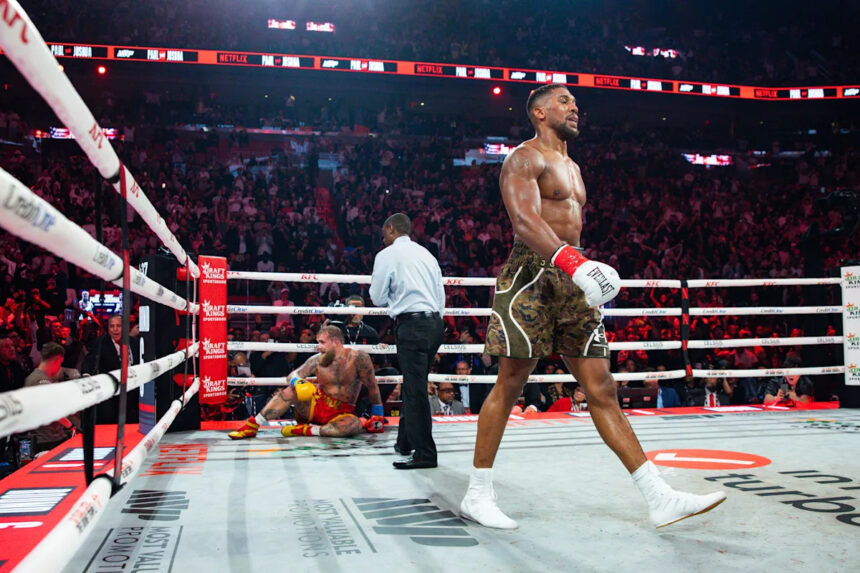
However, the tide of a heavyweight fight can turn on a single punch. By the middle rounds, Joshua found his timing and range. What followed was a demonstration of systematic breakdown. Paul was knocked down four times, displaying a resilience that became the night’s secondary headline. He rose each time, until a final, concussive right hand in the sixth round left him unable to continue, handing him the first knockout loss of his career.
The true cost of that resilience was revealed hours after the final bell. In his post-fight interview, a swollen and dazed Paul mumbled a prediction that he had likely broken his jaw. Medical scans confirmed a grim reality: Jake Paul broke his jaw in two places. The injury, far worse than initial speculation, underscores the brutal physics at play when a heavyweight of Joshua’s caliber connects. It is a sobering reminder of the very real dangers Paul willingly accepted and will now require significant recovery time.
Earned Respect and the Changing Narrative
Beyond the medical report, the most significant outcome for Jake Paul may be the shift in how he is perceived within the sport. For years, his critics have labeled him a sideshow, a savvy businessman exploiting the sweet science. While his entrepreneurial acumen is undeniable, Friday night was about sport, not spectacle. By surviving longer than expected and repeatedly climbing off the canvas, Paul earned a currency that cannot be bought: respect from the inner sanctum.
Anthony Joshua himself acknowledged it. “He’s a tough man. You have to give him credit,” Joshua stated in the post-fight press conference. “He took the fight seriously, came in shape, and showed a lot of heart. That’s all you can ask for.” This sentiment, echoed by many in the boxing community, marks a pivotal moment. The narrative is no longer solely about whether Jake Paul can fight; it’s now about where he goes from here after sharing a ring with an A-list heavyweight.
Key takeaways from the Paul-Joshua fallout include:
- Legitimacy Through Adversity: While he lost decisively, Paul’s performance against an elite opponent moves him beyond the “celebrity boxer” label into a more serious, albeit still developing, professional.
- The Heart Factor: His ability to withstand punishment and continue answered questions about his toughness, a critical attribute in boxing’s credibility hierarchy.
- Strategic Crossroads: The fight exposed clear technical gaps but also proved Paul belongs in the ring with serious, world-ranked fighters, just not the very top tier.
The Ripple Effect: Latest on Joshua vs. Fury and the Heavyweight Title Picture
While Jake Paul licks his wounds, Anthony Joshua’s victory does more than just add another win to his column. It firmly re-establishes him as the division’s most dangerous looming threat. The knockout win served its dual purpose: shaking off the rust and sending a violent message to the rest of the division, particularly to the man holding the lineal crown, Tyson Fury.
The long-awaited, all-British super fight between Anthony Joshua and Tyson Fury has been the “white whale” of heavyweight boxing for nearly half a decade. Negotiations have collapsed multiple times, leaving fans in perpetual frustration. However, Joshua’s dominant performance against Paul has reignited the conversation. With Fury currently without a scheduled opponent following his contentious win over Oleksandr Usyk, the path is clearer than it has been in years.
Insider analysis suggests the following developments:
- Joshua as Mandatory: His position as the IBF’s top contender could force a mandatory shot at the winner of the upcoming Usyk-Fury rematch, creating a straightforward path to the fight.
- Fury’s Motivation: The “Gypsy King” thrives on mega-events. A stadium fight in the UK against a revitalized Joshua is arguably the biggest financial and legacy fight available in all of sports.
- Timeline: Promoters are already hinting at a potential late 2024 or early 2025 showdown, assuming Fury navigates his rematch with Usyk. Joshua’s clean win and good health position him perfectly for a fall camp.
The heavyweight landscape, once stagnant, is now buzzing with definitive direction. Joshua is back in the title conversation, Fury has a clear rival to target, and the division’s ultimate dream fight feels tantalizingly close to reality.
Predictions and the Road Ahead
Looking forward, the trajectories for both men are starkly different but equally compelling.
For Jake Paul, the road is one of rehabilitation and recalibration. The broken jaw will sideline him for months, during which his team will need to make a crucial decision. Does he return to the influencer-boxer circuit for a lucrative but less risky affair, or does he continue to pursue respect against seasoned veterans? His showing against Joshua may have earned him the leverage to secure fights with big-name MMA stars or borderline top-20 boxers who now see him as a viable, marketable opponent. His next move will define whether this fight was a one-off curiosity or a genuine step in a continued boxing journey.
For Anthony Joshua, the path leads directly to the summit. The prediction here is clear: Joshua vs. Fury will be signed for 2025. The financial imperative, fan demand, and current alignment of titles and rankings make it inevitable. Joshua, under the guidance of trainer Ben Davison, looked focused and patient against Paul. If he carries that refined approach into a fight with Fury, we could witness a tactical battle for the ages. While Fury remains the betting favorite due to his unique style and ring IQ, a disciplined, powerful Joshua represents his most dangerous test to date.
The fallout from Paul vs. Joshua has delivered more than just a highlight-reel knockout. It provided a brutal lesson in levels, a surprising dose of earned respect, and, most importantly, a catalyst that finally seems to be propelling the heavyweight division toward its long-promised, blockbuster future. The jaw may have broken in two places, but the narrative of heavyweight boxing has been firmly reset.
Source: Based on news from Yahoo Sports.