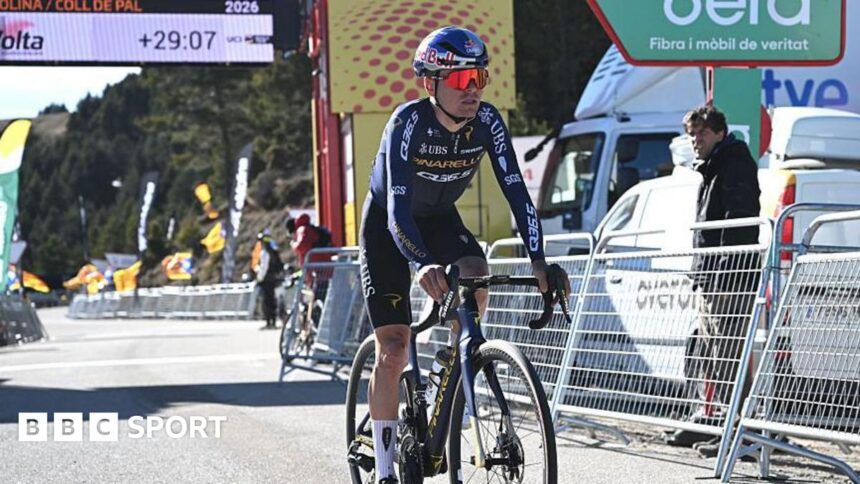
Pidcock’s Catalunya Campaign Ends in Ravine ‘Horror’ as Vingegaard Tightens Grip
The thin line between calculated risk and catastrophe was starkly illustrated on the serpentine roads of the Volta a Catalunya Friday, as one of cycling’s most audacious talents saw his race end not in a sprint for glory, but in a harrowing plunge off the tarmac. British superstar Tom Pidcock, the Olympic Mountain Bike champion known for his fearless descending, is out of the week-long WorldTour race following what he himself termed a “horror” crash, a dramatic incident that overshadows the continuing dominance of Jonas Vingegaard.
A Descent into Disaster: Reconstructing the Crash
The drama unfolded on the penultimate descent of stage five, a 167.3km trek from Altafulla to Viladecans. On a technical corner, Pidcock’s razor-sharp instincts, which have delivered iconic wins on the cobbles of Roubaix and the mud of Tokyo, betrayed him. Misjudging his line, the Pinarello-Q36.5 rider speared off the road, disappearing into a ravine. The shocking visual of a rider vanishing over the edge sent a immediate wave of concern through the peloton and watching fans.
Incredibly, Pidcock remounted and completed the stage, a testament to his renowned resilience. He crossed the line in Viladecans a staggering 29 minutes and 44 seconds behind stage winner Jonas Vingegaard, his kit torn and his body battered. While his determination to finish was characteristic, it belied the severity of the impact. Subsequent medical checks revealed the unavoidable: the accumulated trauma from the fall meant he could not safely continue. His team confirmed his withdrawal, ending a race where he was sitting 15th overall and showing promising climbing form.
Expert Analysis: The Psychology and Physiology of a Crash
This incident opens a fascinating, if concerning, window into the high-stakes world of professional cycling. Pidcock is universally lauded as one of the most technically gifted bike handlers in the world. His crash was not a result of a slippery surface or another rider’s error, but a pure misjudgment.
Sports psychologists often speak of the fine margin between aggressive confidence and over-extension. After a demanding week of racing, fatigue can dull the millisecond reactions required for descending at 80km/h. “A rider of Pidcock’s caliber operates on the absolute limit of grip and speed,” notes a former team directeur sportif. “One percent of lost concentration, a tiny misreading of the camber, and the margin for error evaporates. The ravine, in this case, was a brutally unforgiving consequence.”
Physiologically, the decision to withdraw is prudent. Beyond visible wounds, a crash of that violence subjects the body to immense soft tissue trauma and systemic shock. Starting a mountainous 150km stage the next day could exacerbate injuries, leading to compensatory riding styles that risk further accidents or long-term issues. The priority now shifts to recovery and assessment for his major spring goals.
- Immediate Impact: Loss of a GC top-15 and a stage-hunting threat for Pinarello-Q36.5.
- Physical Toll: Widespread bruising, abrasions, and potential musculoskeletal strain requiring careful management.
- Psychological Factor: Rebuilding the instinctive confidence on descents, a cornerstone of Pidcock’s racing identity.
Ripple Effects: Vingegaard’s Path and Pidcock’s Season
While Pidcock’s exit is the headline, the race for the overall victory has crystallized into a seemingly inevitable conclusion. Jonas Vingegaard’s commanding stage win, where he decimated the remnants of the breakaway with a blistering late attack, extended his overall lead. The Visma-Lease a Bike leader appears untouchable, his form suggesting his horrific crash last year is firmly in the past. Pidcock’s absence removes one of the few riders willing and able to attack unpredictably in the mountains, potentially simplifying Vingegaard’s defensive calculus for the final stages.
For Pidcock, the calendar provides a small buffer. His next major target is likely the Ardennes Classics – Amstel Gold Race, La Flèche Wallonne, and Liège-Bastogne-Liège – in mid-April. The coming weeks will be a race against time for healing and rebuilding form.
Key questions now loom for his team:
- Can he return to full training within 7-10 days to be competitive for the Ardennes?
- Does this incident prompt a subconscious recalibration of his descending style?
- How will this affect his preparation for a targeted Tour de France and his Paris Olympic mountain bike title defense?
Conclusion: A Stark Reminder of Cycling’s Ever-Present Peril
Tom Pidcock’s “horror” crash in Catalunya is more than a simple race abandonment. It is a visceral reminder of the inherent danger that underpins the beauty of professional cycling. It demonstrates that no amount of skill is an absolute shield against misfortune, and that the pursuit of victory is a constant negotiation with risk. As Jonas Vingegaard marches towards a likely overall victory, his narrative one of triumphant return, Pidcock’s story in this race becomes one of sobering resilience. His ability to walk away from a ravine fall is a victory in itself. The cycling world will now watch closely, hoping the rider famed for his breathtaking bravado can swiftly and fully recover, his talent undimmed by the shadows of a Catalan ravine. The road back begins now, with the hope that this horror story is merely a dramatic interlude in another spectacular season.
Source: Based on news from BBC Sport.