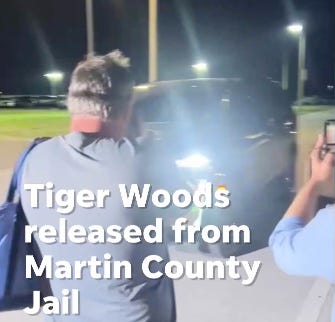
Tiger Woods Released from Jail Following DUI Arrest After Jupiter Island Crash
The world of sports was rocked once again as golf legend Tiger Woods was released from the Martin County Jail late Friday night, just hours after his arrest on suspicion of driving under the influence. The incident, stemming from a two-car crash on the exclusive enclave of Jupiter Island, Florida, marks another tumultuous chapter in the career of the 15-time major champion, raising immediate questions about his health, legacy, and future both on and off the course.
The Incident: A Rolled-Over Vehicle and a Solemn Arrest
According to Martin County Sheriff John Budensiek, the chain of events began just after 2 p.m. on Friday, March 27. Authorities responded to a report of a two-vehicle collision on Jupiter Island. Upon arrival, they discovered Woods’ vehicle had rolled over. In a stark departure from the poised athlete seen on Sunday greens, Sheriff Budensiek described Tiger Woods crawling out of the damaged car himself. While neither Woods nor the other driver sustained physical injuries, the scene was far from benign. Law enforcement officials, following standard procedure for such an incident, administered a field sobriety test. The results led to Woods’ arrest on a suspicion of DUI charge. He was subsequently transported to the Martin County Jail, where he was processed and held until his release later that evening. The swift release is common in such cases, often contingent on sobering up and meeting bail conditions, but it does not negate the serious legal proceedings that lie ahead.
Context and Silence: The Lingering Questions
In the immediate aftermath, the sports world was left with more questions than answers. Mark Steinberg, Woods’ longtime agent and a pivotal figure in managing his public image for decades, did not immediately respond to requests for comment. This silence is deafening, suggesting a crisis management strategy still being formulated. This incident cannot be viewed in a vacuum. It follows a horrific single-vehicle crash in February 2021 in California that severely damaged Woods’ right leg, requiring multiple surgeries and an arduous rehabilitation just to walk again, let alone compete. The physical and psychological toll of that recovery is an inescapable part of this new narrative.
Key questions now swirling include:
- What was Tiger Woods’ condition at the time of the arrest? Official toxicology reports will be critical.
- Was this related to prescription medication used for his extensive past injuries?
- How will his sponsors, past and present, react to this latest setback?
- What is the current state of his mental and physical well-being following his career-threatening injuries?
Expert Analysis: Legacy, Liability, and the Road Ahead
From a legal standpoint, Woods faces a challenging path. A DUI charge in Florida carries significant penalties, including license suspension, fines, mandatory DUI school, and potential jail time, especially for a first offense. Given his global stature, the prosecution will likely be under a microscope, ensuring no special treatment is given—or perceived to be given. His legal team will meticulously examine the arrest procedure and toxicology evidence.
From a sports journalism and cultural perspective, this incident strikes at the heart of the Tiger Woods narrative: a tale of unparalleled triumph, devastating personal failings, a near-miraculous comeback, and now, profound uncertainty. “This is no longer about golf,” says a veteran sports analyst. “This is about a 47-year-old man grappling with immense physical pain and the psychological weight of his own history. The 2021 accident was a tragedy; this is a self-inflicted crisis that threatens to overshadow the incredible grit he showed at the 2019 Masters.” The car crash in Jupiter Island immediately draws parallels to his 2017 DUI arrest, which he attributed to an unexpected reaction to prescription medicine. The public’s capacity for empathy may be tested anew.
Predictions: Impact on Endorsements and Competitive Future
The immediate fallout will be measured in commercial and competitive terms. While Woods has lost the bulk of his blue-chip endorsements from earlier scandals, he retains key partnerships, notably with TaylorMade and Monster Energy. These companies will conduct rapid risk assessments. Monster Energy, in particular, a brand associated with extreme sports, may have a higher tolerance for controversy, but even that has limits.
Regarding his playing future, which was already a major question mark due to his physical condition, this arrest likely signals a further retreat. The single-minded dedication required for a PGA Tour comeback now seems almost implausible amidst a looming legal battle and personal reckoning. Predictions are sobering:
- A lengthy hiatus from any public golf appearances as he addresses legal and personal matters.
- A potential focus on his TGL virtual golf league and course design business, away from the spotlight of competition.
- The distinct possibility that his competitive career, which saw a storybook resurgence with his 2019 Masters win, may have already reached its true conclusion on the fairways, with this incident serving as a tragic postscript.
Conclusion: A Champion in Crisis, A Crossroads of Compassion
Tiger Woods’ release from jail is merely the end of the first chapter of this developing story. The DUI arrest in South Florida is more than a tabloid headline; it is a stark indicator of a man at a dangerous crossroads. It forces a complex conversation about how we view our icons after their prime, the relentless pressure of legacy, and the very human struggles that persist long after the cheers fade. The golfer who taught us to believe in “redemption Sundays” now faces his most difficult round yet—one played not on the manicured lawns of Augusta, but in the quiet confines of a courtroom and the private battle for personal stability. The world will be watching, not for a chip shot, but for a sign of a different kind of recovery. His legacy, now irrevocably tied to both breathtaking victory and profound vulnerability, hangs in the balance once more.
Source: Based on news from Yahoo Sports.