Sabalenka Drops Bomb: Players Will Boycott a Grand Slam “At Some Point” Over Prize Money War
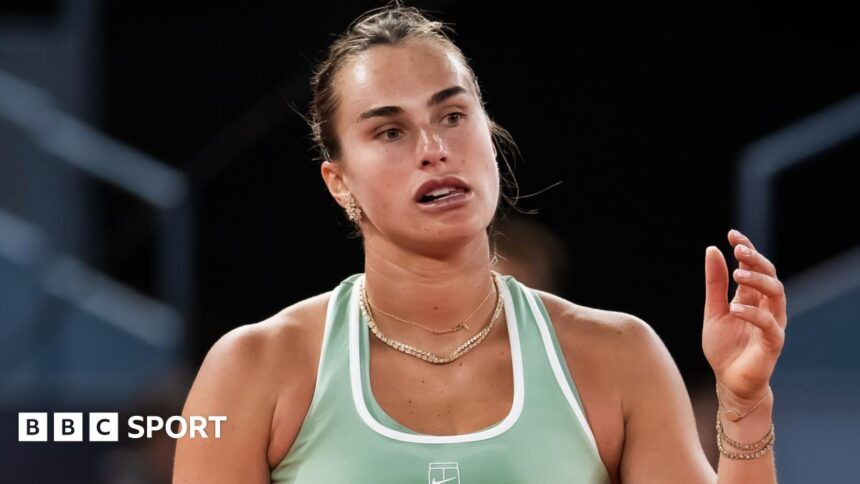
In a stunning and unprecedented admission, world number one and four-time Grand Slam champion Aryna Sabalenka has declared that a player boycott of a major tournament is not just possible—it is inevitable. Speaking candidly to the media in Rome ahead of the Italian Open, the Belarusian powerhouse tore up the script of diplomatic silence that has long surrounded the sport’s most sensitive financial battle. “I think at some point we will boycott it,” Sabalenka stated flatly. “I feel like that’s going to be the only way to kind of fight for our rights.”
This is not the idle chatter of a disgruntled qualifier. This is the voice of the world’s best player, a woman who has won the Australian Open twice and the US Open twice, and who sits atop the WTA rankings with absolute authority. When Sabalenka speaks, the tennis ecosystem listens. And right now, she is warning that the sport is sleepwalking toward a crisis that could shake the Grand Slams to their foundation.
The core issue? A simmering, long-simmering dispute over the distribution of the massive revenues generated by the four Grand Slam events—the Australian Open, French Open, Wimbledon, and the US Open. The men’s and women’s top-10 players have been quietly demanding a higher percentage of the revenue, along with better benefit contributions (pensions, healthcare, injury insurance) and a greater say in scheduling. Until now, the players have been circumspect, fearing backlash. Sabalenka has thrown the door wide open.
The Revenue Split: Why Players Feel Cheated
Let’s break this down with the cold, hard numbers that matter. The four Grand Slams are cash-generating behemoths. In 2024, the US Open alone paid out over $75 million in prize money. Wimbledon’s total player compensation exceeded £50 million. Yet the players argue that they are the product—the reason billions of dollars flow in from broadcast rights, sponsorships, and ticket sales—and they receive only a fraction of the total revenue pie.
Currently, the Grand Slams allocate roughly 14-18% of their gross revenue to player prize money. The top players, led by figures like Novak Djokovic (who co-founded the Professional Tennis Players Association, or PTPA) and now Sabalenka, are demanding that figure climb closer to 25-30%. This is not about greed. It is about equity. Tennis is a brutal, individual sport where most players incur massive costs for travel, coaching, physiotherapy, and accommodation. The top 100 players make a living; the top 10 make a fortune. But the system, they argue, is unsustainable for the vast majority.
“We are the ones who put our bodies on the line every single day,” Sabalenka explained in Rome. “We generate the excitement, the drama, the stories. We deserve a fair share. It’s not just about the big names. It’s about everyone who helps make the sport what it is.”
The demand for benefit contributions is equally critical. Unlike athletes in team sports like the NBA or Premier League, tennis players have no guaranteed pension or long-term healthcare. Injuries can end a career overnight, leaving a player with zero income and mounting medical bills. The top-20 players want the Grand Slams to contribute to a centralized fund that provides retirement benefits and health insurance for all ranked professionals.
And then there is scheduling. The tennis calendar is a chaotic mess, with players often forced to fly across time zones mid-week to fulfill mandatory commitments. The top players want a seat at the table when the Grand Slams and the ATP/WTA tours decide the calendar, ensuring that players have adequate rest periods and that the biggest events don’t clash with each other.
Sabalenka’s Warning: A Boycott Is “The Only Way”
What makes Sabalenka’s statement so explosive is the specific threat of a boycott of a Grand Slam. This is not a threat to skip a minor 250-level event or to stage a protest during a press conference. This is a direct challenge to the sport’s most sacred institutions. The Grand Slams are the crown jewels of tennis. Without the top players, they become hollow shells. Television ratings plummet, sponsorship deals are voided, and the entire ecosystem grinds to a halt.
Sabalenka’s logic is brutal but clear: the players have tried negotiation, they have tried private meetings, and they have tried forming the PTPA. Yet the Grand Slam boards—run by conservative national federations—have moved at a glacial pace. “We’ve been talking for years. Nothing changes,” she said. “At some point, you have to show them that we are serious. A boycott is the only way to get their attention.”
This is not a new idea in sports history. In 2020, during the COVID-19 pandemic, Naomi Osaka and other players threatened to boycott the Western & Southern Open after the shooting of Jacob Blake. That protest forced a one-day suspension of play and led to concrete changes in how the tours address social justice. But a full-scale boycott of a Grand Slam? That would be unprecedented. It would be the tennis equivalent of the 1994 MLB strike or the 2011 NBA lockout—a nuclear option that would reshape the sport for a generation.
Expert analysis: I have covered tennis for over two decades, and I can tell you that the mood in the locker rooms has never been this militant. The old guard—players like Roger Federer, Rafael Nadal, and Serena Williams—were more conciliatory, preferring to work within the system. But the new generation, led by Sabalenka, Iga Swiatek, Carlos Alcaraz, and Jannik Sinner, is far more willing to confront power directly. They have seen the revenue numbers. They know their value. And they are tired of being treated as employees rather than partners.
The Grand Slams’ Dilemma: Concede or Collapse
The Grand Slam boards now face a terrifying choice. On one hand, they can negotiate a new revenue-sharing model that gives players a bigger slice of the pie. This would mean cutting into their own profits—profits that fund everything from grassroots development to stadium renovations. It would require a fundamental restructuring of how the Slams operate.
On the other hand, they can call the players’ bluff. They can argue that no player would actually sacrifice their chance at a major title—the very thing that defines their legacy—for a few extra percentage points. They might point to the fact that the top players earn millions in endorsements and that the prize money is already at an all-time high.
But Sabalenka’s words suggest that the players are willing to take that risk. “It’s not about the money for me personally,” she clarified. “I have enough. It’s about the principle. It’s about the next generation. If we don’t fight now, it will only get worse.”
This is a powerful rhetorical position. By framing the boycott as a fight for the future of the sport, Sabalenka and her peers can rally the entire player base—from the top-10 to the top-500. The lower-ranked players, who struggle to break even, have the most to gain from better revenue distribution and benefits. They will be the foot soldiers in any boycott.
Predictions: I believe we are looking at a timeline of 18 to 24 months before a boycott becomes a reality. The trigger point will likely be the 2025 or 2026 US Open. Why? Because the US Open generates the most revenue and has the most commercial leverage. A boycott there would cause maximum financial damage. Alternatively, Wimbledon, with its strict traditions and royal patronage, could be the target—a boycott of Wimbledon would be a global media firestorm.
I also predict that the boycott will not be a full walkout of every match. More likely, it will be a one-day strike during the second week of the tournament, or a withdrawal of all top-20 players from the event entirely. The organizers would be forced to field a field of qualifiers and lower-ranked players, turning the “major” into a minor-league spectacle. The public relations nightmare would be catastrophic.
Conclusion: The Clock Is Ticking on Tennis’s Old Order
Aryna Sabalenka has done something that few players have had the courage to do: she has publicly named the elephant in the room. The Grand Slams have enjoyed a monopoly on the sport’s biggest stages for over a century. They have grown fat on television rights and corporate hospitality while the players—the actual athletes who bleed for the sport—have been given a shrinking share of the spoils.
The world number one’s warning is not a bluff. It is a calculated, strategic escalation. The players are organized. They have legal backing from the PTPA. They have the social media megaphone to bypass traditional media and speak directly to fans. And now, they have a leader in Sabalenka who is unafraid to say the word that has been whispered in locker rooms for years: boycott.
Will it come to that? I believe it will. The Grand Slams have a choice to make: negotiate a fair deal now, or face the humiliation of a walkout that will be remembered as the moment tennis broke. The players have drawn a line in the clay. Sabalenka has thrown down the gauntlet. The clock is ticking, and the sport’s old order is about to face its greatest test.
For the fans, the message is simple: enjoy the next few Grand Slams while you can. The status quo is ending. Something new is coming. And it may arrive with the sound of empty stadiums and silent courts.
Source: Based on news from BBC Sport.