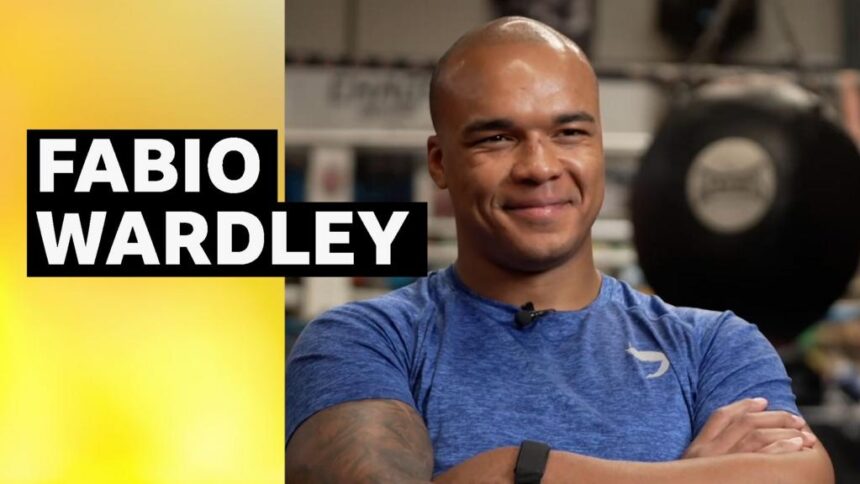
From Ipswich Academy to World Champion: The Unlikely Rise of Fabio Wardley
In an era where most heavyweight champions are forged in the white-hot furnace of amateur internationals, Fabio Wardley’s journey reads more like a Hollywood script than a typical boxing biography. This Saturday, the WBO world champion will make his first title defence against the thunderous-punching Daniel Dubois in Manchester. But to truly understand the man stepping into the ring, you must first understand the path he took—a path that started with a football, moved to a white-collar boxing gym, and ended with a world title belt.
Wardley’s story is a masterclass in defying convention. While his peers were collecting national titles and Olympic medals, he was working a day job, learning to fight in front of rowdy office parties, and taking punches from men who had never laced up gloves before the previous Tuesday. It is a narrative that demands attention, not just for its romance, but for its raw, unapologetic grit.
The Football Dream That Paved the Way
Before the roar of the boxing crowd, there was the pristine turf of Ipswich Town’s academy. Wardley’s first love was football. As a young lad from Ipswich, he spent his formative years chasing a professional contract at Portman Road. The discipline, the physical conditioning, and the mental toughness required to compete in a Championship academy are not to be underestimated. However, as so often happens in the brutal world of football, the dream didn’t materialise.
When the football door closed, Wardley faced a crossroads. Many young men in his position drift. He did not. Instead, he found himself in a local white-collar boxing gym. For the uninitiated, white-collar boxing is a world away from the professional game. It is an amateur sport where corporate workers, tradesmen, and complete novices train for a few weeks before fighting in front of a paying crowd. It is often messy, frequently clumsy, but always brave.
Wardley didn’t just participate in white-collar boxing; he dominated it. He quickly realised that his athleticism from football—the footwork, the hand-eye coordination, and the cardiovascular engine—gave him a massive advantage over the weekend warriors. But more importantly, he discovered something he hadn’t found on the football pitch: a killer instinct.
The White-Collar Crucible: A Unique Foundation
To the purist, white-collar boxing is a novelty. To Fabio Wardley, it was the only school he needed. Let’s be clear: the transition from white-collar bouts to a world title is almost unheard of. Most champions have 50+ amateur fights. Wardley had none. He learned to take a punch not in a controlled amateur vest, but in a setting where the stakes were lower, but the fear was just as real.
What did white-collar boxing teach him that a traditional amateur career could not? The answer is survival pressure. In the amateurs, you can lose a close decision and still be a star. In white-collar, if you get knocked out, you go back to your desk job on Monday with a black eye and a bruised ego. There is no safety net. This pressure forged an incredible resilience in Wardley. He learned to fight through exhaustion, through pain, and through the chaos of a brawl.
His early professional career reflected this. He wasn’t a polished technician. He was raw, aggressive, and heavy-handed. He didn’t know how to box cleverly for ten rounds because he had never needed to. He knew how to finish a man. His first 10 professional fights ended inside the distance. The power was real. The chin was tested. The heart was undeniable.
Key attributes forged in the white-collar world:
- Fearlessness: He had already fought in front of hostile crowds where the only prize was pride.
- Adaptability: He learned to handle unorthodox styles because white-collar fighters have no technique.
- Stamina: Football conditioning combined with the high-intensity bursts of white-collar sparring created a freakish engine.
Expert Analysis: The Wardley vs. Dubois Clash
Now, the real test. Daniel Dubois is not a white-collar novice. He is a legitimate world-class heavyweight with dynamite in both hands. Dubois has been touted as a future champion since he was a teenager. He has the power to end any fight with a single shot. For Wardley, this is the first time he will face a man who hits as hard as he does.
The key to this fight, from an expert perspective, is pressure. Dubois has historically struggled when the pressure is turned up on him. We saw it against Joe Joyce and, to a lesser extent, against Oleksandr Usyk. When he is forced to fight backwards, he can become hesitant.
Wardley’s game plan must be simple: be the bully. He cannot afford to box at range with Dubois. He must use his footwork, honed from his football days, to cut off the ring. He needs to make Dubois feel uncomfortable early. Wardley’s best chance is to turn the fight into a dogfight—the very environment where his white-collar background makes him most dangerous. He has been in the trenches. Dubois has been in the spotlight.
Prediction: This is a genuine 50-50 fight. Dubois has the higher ceiling and the bigger name. However, Wardley has the momentum, the belief, and the unorthodox path that has kept him hungry. I see Wardley winning a brutal, ugly war. He will take Dubois into deep water—rounds 7, 8, and 9—where his superior conditioning and sheer willpower will force a late stoppage. The white-collar warrior will prove that heart beats hype every time.
The Legacy of an Unlikely Champion
If Fabio Wardley beats Daniel Dubois on Saturday, he will cement himself as one of the most remarkable stories in British boxing history. He is a symbol for every young athlete who gets cut from a football academy or told they started too late. He proves that talent is not always measured in gold medals or amateur records. Sometimes, it is measured in the willingness to learn in the dark, to fight without a safety net, and to believe in your own path when no one else does.
Wardley’s rise from the white-collar gyms of Ipswich to the bright lights of the Manchester Arena is a testament to the power of adaptability and resilience. He didn’t take the traditional route. He built his own road. And this Saturday, he has the chance to prove that the road less travelled is the one that leads to greatness.
READ MORE: Wardley v Dubois – all you need to know
Note: To play this video you need to enable JavaScript in your browser.
Source: Based on news from BBC Sport.