Pope in the Firing Line After Gruesome Ashes Day for England in Brisbane
You can come out from behind the sofa now, England fans. The first day of the Ashes in Brisbane is over, and the damage, while severe, is at least quantifiable. But as the dust settles on a brutal opening salvo at the Gabba, the scoreboard tells only part of a grim story. England, bowled out for 147, watched Australia cruise to 221/2 by stumps, a deficit already erased with interest. While the pace of Pat Cummins and Josh Hazlewood rightfully grabs headlines, the spotlight of scrutiny burns fiercely on one Englishman: Ollie Pope, whose dismissal encapsulated a day of self-inflicted wounds and raised urgent questions about England’s batting spine.
A Gabba Gabbling: England’s Batting Collapse Unpacked
The narrative was supposed to be about rust, the green pitch, and the hostile new-ball pair. And for a time, it was. Rory Burns’ first-ball dismissal—a moment of instant Ashes folklore—set a tone of chaotic panic. But what followed was a systematic failure of technique and temperament. Dawid Malan grafted. Joe Root looked imperious. Yet, around them, wickets fell with a softness that will haunt coach Chris Silverwood.
Haseeb Hameed’s loose drive. Ben Stokes’ frenetic charge. Jos Buttler’s waft outside off. Each was a surrender to the pressure Cummins expertly built. The Australian captain was magnificent, but he was aided by a persistent English fallibility outside the off-stump, a technical flaw that has become a psychological scar. The Gabba pitch had juice, but it was no minefield; this was a dismissal of the mind as much as the body.
The Pope Problem: A Technical Examination
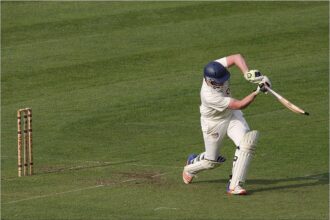
Amid the carnage, one wicket stood out for its symbolic weight. Ollie Pope, England’s great middle-order hope, walked in at 59/4. The situation demanded grit, a backs-to-the-wall occupation. What transpired was a glaring exposure of a critical weakness. Facing Nathan Lyon’s third ball, Pope lunged forward, head falling over to the off-side, hands searching for the ball. He played around his front pad and was trapped plumb LBW. A review was futile.
This was not bad luck. It was a technical flaw, long diagnosed and seemingly unrectified. Pope’s tendency to fall over at the crease makes him a sitting duck for any bowler targeting his pads. For a player of his undeniable talent, with a first-class average touching 50, his Test average languishes in the low 30s. The gap between county dominance and Test production is a chasm, and in the Ashes crucible, it cracked wide open.
- Premeditated Movement: Pope’s shuffle across his stumps leaves him vulnerable to straight bowling.
- Head Position: Falling over compromises his balance and sightlines, especially against spin.
- Selection Quandary: With no ready-made replacements in the squad, England must decide whether to persist with hope or make a brutal change.
His dismissal felt like a turning point—the moment England’s last hope of a competitive total evaporated. When your designated crisis manager in the engine room has a fundamental technical glitch, the entire structure is compromised.
Australia’s Command and England’s Mountain to Climb
If England’s batting was gruesome, Australia’s response was a masterclass in assertive accumulation. David Warner rode his luck, notably after a no-ball reprieve from Stokes, but he and Marnus Labuschagne (112*) showcased the pragmatic aggression England lacked. They left well, punished width mercilessly, and capitalized on England’s wayward lengths, particularly from Stokes and Mark Wood, who struggled for consistency.
Labuschagne was the standout, combining intense concentration with a frenetic energy that drained England’s bowlers. His unbroken partnership with the serene Steve Smith (12*) has already put Australia in a position where only weather can save England. The psychological advantage gained on day one is immense. England’s bowlers now face two more days of toil before even getting a chance to bat again, a prospect that is both physically draining and mentally demoralizing.
The Long Road Back: Predictions and Scenarios
So, where does England go from here? The first Test is almost certainly gone. The mission now is twofold: salvage pride and find solutions before the day-night Test in Adelaide.
Realistic Scenario: Australia build a lead of 250+. England show more fight in the second innings but ultimately lose by a heavy margin within four days. The post-mortem intensifies, with Pope’s place and the top-order’s technique the central debates.
Best-Case Scenario: England’s bowlers produce a miraculous morning session, skittling Australia for under 350. The pitch flattens, and England’s batsmen, shamed into action, compile a massive second innings to set an unlikely target. This, however, requires a reversal of form and fortune that seems fanciful after day one.
Key Prediction: Changes for Adelaide are inevitable. The question is whether they are tactical or philosophical. Will Pope be dropped for Jonny Bairstow? Does the balance of the side need an extra batter? The selection drama will dominate the build-up, potentially overshadowing the necessary technical adjustments.
Conclusion: More Than Just a Bad Day at the Office
The first day of an Ashes series in Australia is a statement. Australia’s was one of power, precision, and ruthless execution. England’s was a stammer—a collection of old failings resurfacing under the brightest lights. While the pace attack drew first blood, it is the fragility of England’s batting, exemplified by Ollie Pope’s troubling dismissal, that is the true takeaway.
This was more than a bad day; it was a stark reminder that potential is not performance. For Pope, and for England, the road back is steep. It requires not just resilience, but a painful, honest confrontation with technical deficiencies that have been papered over in less hostile conditions. The Ashes are often won and lost in the mind. After one gruesome day in Brisbane, England’s minds, and methods, look desperately scrambled. The sofa, it seems, may be a permanent refuge for a while longer.
Source: Based on news from Sky Sports.