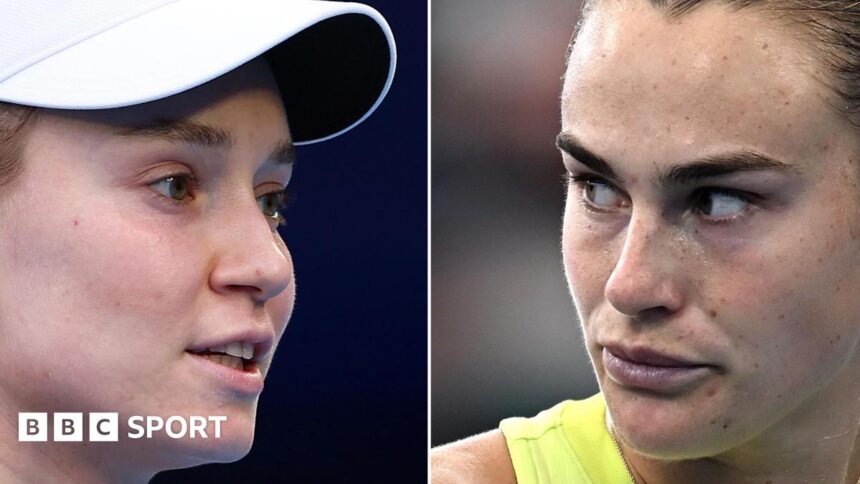
Power vs. Power: Will Rybakina or Sabalenka Blink First in the Australian Open Final?
When the dust settles on the final Saturday of the Australian Open, the champion will have been forged in fire. Not just the scorching Melbourne sun, but in the crucible of raw, unadulterated power. The 2024 women’s final presents a dream collision between the tour’s two most formidable forces: the incendiary passion of Aryna Sabalenka and the glacial firepower of Elena Rybakina. This isn’t just a battle for the Daphne Akhurst Memorial Cup; it’s a primal test of wills, a question of which brand of brilliance can withstand the other’s storm. In a match where both wield serves like sledgehammers and groundstrokes like thunderclaps, the pivotal moment may come down to something far more subtle: who blinks first.
The Anatomy of a Modern Rivalry: Fire Meets Ice
The head-to-head record, narrowly favoring Sabalenka 8-6, tells only half the story. Each encounter is a masterclass in contrasting methodologies, a psychological drama played out with a devastating physical toolkit. Their rivalry has quickly become the defining power clash of this WTA era.
Aryna Sabalenka is a hurricane of emotion and intent. Her game is built on aggressive, first-strike tennis, powered by a ferocious will. Every roared “Come on!” and clenched fist is fuel, an external manifestation of the engine driving her. Her power is visceral, connected directly to her competitive spirit. When she is on, the court feels small, and the ball seems to explode off her strings with malicious intent.
Conversely, Elena Rybakina is the epitome of serene destruction. Standing with the calm of a sniper, she generates astonishing pace with a seemingly effortless, languid swing. Her power is clinical, detached, and deeply efficient. The louder the occasion, the quieter she often becomes. Where Sabalenka seeks to overwhelm with force of personality as much as shot-making, Rybakina aims to dismantle with cold, repetitive precision. It’s fire versus ice, and the court is their proving ground.
Decoding the Weapons: Where the Final Will Be Won
While their personalities differ, their arsenals share a common trait: they are built to dominate. The match will hinge on which player can better impose their signature weaponry while mitigating the other’s.
- The Serve: This is the cornerstone for both. Sabalenka’s improved, relentless first serve is a weapon of mass creation, setting up easy forehand putaways. Rybakina’s serve, arguably the best in the women’s game, is a masterpiece of disguise and placement, earning her countless free points and cheap holds. Whose serve holds firm under final Saturday pressure will establish a critical baseline of confidence.
- Forehand to Forehand: Expect crosscourt exchanges that sound like detonations. Both will look to dictate with this wing. Sabalenka’s is more muscular and loopy, while Rybakina’s is flatter and more direct. The player who can consistently land her forehand deeper, closer to the lines, will force the other onto the defensive.
- The Ad Court Chess Match: A critical tactical battle will be Rybakina’s backhand versus Sabalenka’s forehand. Sabalenka will relentlessly target the Rybakina backhand, but the Kazakh’s slice is effective at diffusing pace, and her two-hander can be a rock-solid counter-punch. Can Sabalenka break it down, or will Rybakina use it to redirect and open the court?
The key factor is first-strike dominance. Long, grinding rallies will be rare. This final will be decided in the first three shots of the point. The player who controls the center of the court and lands the first authoritative blow will win the majority of the points. It’s a high-risk, high-reward strategy that leaves little margin for hesitation.
The Psychological Crucible: Composure vs. Conviction
Beyond the technical, the mental battlefield is where this final will truly be decided. The “blink” we anticipate is not a literal one, but a fractional lapse in intensity, decision-making, or emotional control.
For Sabalenka, the challenge is to harness her fiery energy without letting it boil over. Her demonstrative nature is a strength, but in a tight match against an unflappable opponent, missed opportunities can lead to frustration. Her mission is to maintain her aggressive conviction, point after point, without succumbing to the temptation of over-hitting or emotional dips. Her triumphant run here last year, however, proves she can carry the weight of expectation.
For Rybakina, the challenge is the opposite. Her composure is her superpower, but against Sabalenka’s relentless onslaught, she must ensure her calm does not become passive. She must be willing to step into the court, take time away from Sabalenka, and seize her moments to be the aggressor. Her ice-cool demeanor must mask an inner furnace of competitive fire. She has been here before, winning Wimbledon in 2022 with the same unshakeable poise.
The scoreboard pressure will be immense. A break of serve will feel monumental. How each woman responds to adversity—a missed smash, a double fault at a crucial time, a lucky net cord for the opponent—will reveal who is truly ready to lift the trophy.
Prediction: Who Emerges from the Storm?
Forecasting this final feels like predicting the path of two colliding weather systems. Both have legitimate claims. Sabalenka, as the defending champion and world number one, has been utterly dominant this fortnight, playing with even more controlled aggression than her title-winning run. She is the slight favorite, and her ability to create her own energy from the crowd and her own game is a formidable asset.
Yet, Rybakina possesses the unique toolkit to disrupt that rhythm. Her serve is the ultimate equalizer, and her game matches up well against power players. She has beaten Sabalenka in big matches before, including the 2023 Indian Wells final. She will not be intimidated.
The prediction hinges on a single premise: sustainable aggression. The player who can maintain her peak power game with greater consistency, while making minute tactical adjustments, will win.
This will be a titanic struggle, likely extending to three sets. Sabalenka’s slight edge in current form, her improved mental fortitude, and her hunger to prove her #1 ranking with back-to-back Melbourne titles may prove decisive. However, she will not blink out of fear or frailty. If she falters, it will be because Rybakina’s relentless, pressure-applying power forces her into one too many errors.
Expect a final of breathtaking intensity, where service holds are celebrated like breaks, and every game feels pivotal. In the end, the champion will be the one who dared to swing bigger, for just a millisecond longer, when it mattered most.
Conclusion: A Final for the Ages
The Australian Open final between Aryna Sabalenka and Elena Rybakina transcends a mere championship match. It is a definitive statement on the state of women’s tennis—a sport thriving on athleticism, power, and profound mental strength. This is not a contest of who can merely hit harder, but of who can wield their immense power with smarter precision and steadier nerves over the grueling distance of a Grand Slam final.
Whether it is Sabalenka’s fiery conviction or Rybakina’s icy resolve that ultimately prevails, tennis fans are the true winners. We are set to witness a spectacular display of modern athletic prowess, a clash of styles and personalities that will etch itself into the history of this great tournament. When power meets power, there are no losers, only a victor forged in the most intense heat imaginable. Do not blink, or you might miss the moment that decides it all.
Source: Based on news from BBC Sport.