PSG 5-4 Bayern Munich: PSG edge Bayern in record-breaking Champions League classic
In a night that will be etched into Champions League folklore, Paris Saint-Germain outlasted Bayern Munich in a jaw-dropping 5-4 semi-final first leg at the Parc des Princes. This was not merely a football match; it was a nine-goal symphony of chaos, brilliance, and defensive fragility that shattered records and left fans gasping for air. From Harry Kane’s early penalty to a late Luis Díaz strike that set up a nervy finish, the encounter delivered everything the modern game promises and rarely delivers. Here is the definitive account of how PSG edged Bayern in a contest that redefined the meaning of a classic.
- First-half fireworks: Kane’s record, PSG’s resilience, and a penalty frenzy
- Second-half surge: PSG’s three-goal blitz and Bayern’s fightback
- Expert analysis: Where the game was won and lost
- Record-breaking night: Numbers that defined the chaos
- Predictions: Can Bayern overturn the deficit at the Allianz Arena?
- Conclusion: A night that redefined Champions League drama
First-half fireworks: Kane’s record, PSG’s resilience, and a penalty frenzy
The match began with a cagey, tactical feel—both sides probing for weaknesses. But that equilibrium shattered in the 15th minute when Luis Díaz was tripped inside the box, gifting Bayern a penalty. Up stepped Harry Kane, who coolly sent goalkeeper Matvey Safonov the wrong way. It was Kane’s 54th goal of the season and his 13th in the Champions League, extending Bayern’s remarkable streak of scoring in every game this campaign.
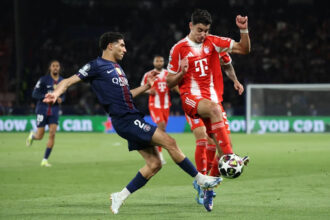
Yet PSG refused to buckle. Within ten minutes, the Parisians turned the tie on its head. First, Khvicha Kvaratskhelia collected a threaded pass from Vitinha, cut inside Dayot Upamecano, and drilled a low shot past Manuel Neuer. Then, João Neves—the Portuguese midfield engine—arrived late in the box to volley home from a corner, sending the home crowd into a frenzy. Bayern, stunned but not broken, responded through Michael Olise, who smashed a half-volley into the top corner after a deflected cross fell kindly for him.
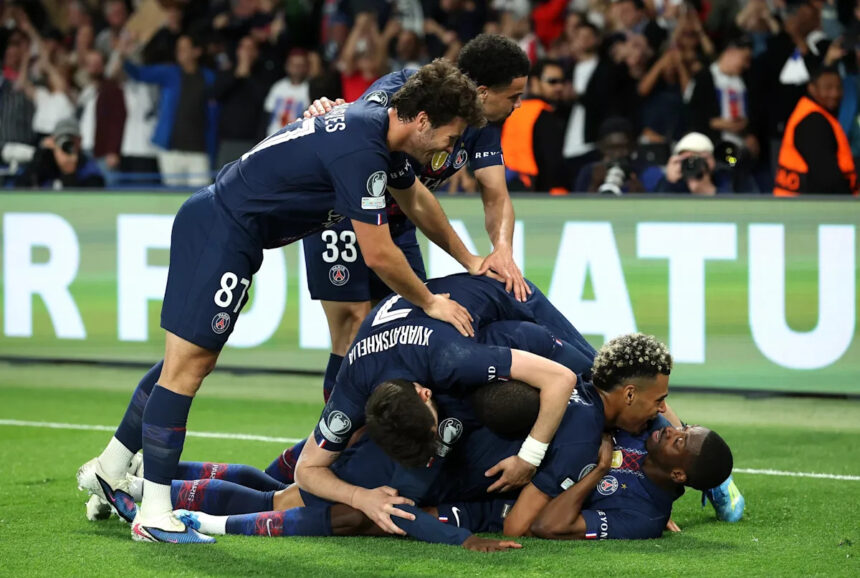
Just before halftime, Ousmane Dembélé stepped up to convert a penalty of his own—awarded for a handball against Alphonso Davies. The first half ended 3-2, but the drama was only warming up.
Second-half surge: PSG’s three-goal blitz and Bayern’s fightback
If the first half was breathless, the second was volcanic. PSG came out with renewed intensity, and within the first 15 minutes after the restart, they had doubled their lead. Kvaratskhelia, now in full flight, latched onto a Dembélé through-ball and chipped Neuer with the outside of his boot—a moment of pure artistry. Minutes later, Dembélé turned from provider to scorer, cutting inside from the right and unleashing a deflected strike that wrong-footed the Bayern defense. Suddenly, it was 5-2 to PSG, and the tie appeared dead.
But Bayern Munich are not European royalty by accident. With 25 minutes remaining, a Joshua Kimmich free-kick floated into a crowded box. Dayot Upamecano rose highest and got a decisive touch, diverting the ball past Safonov to make it 5-3. The goal injected life into the Bavarian bench, and the visitors began to press with desperation. Then, in the 78th minute, Luis Díaz redeemed his early foul by pouncing on a loose ball inside the area, spinning, and firing low into the corner. The scoreboard read 5-4, and the Parc des Princes held its breath.
Despite a frantic final ten minutes—including a Kane header that skimmed the crossbar—PSG held on. The final whistle triggered a mix of relief and euphoria, but the tie is far from over.
Expert analysis: Where the game was won and lost
This match was a masterclass in transitional football. PSG exploited Bayern’s high defensive line with surgical precision, particularly through the Kvaratskhelia-Dembélé axis. The Georgian winger’s ability to drift inside and combine with Neves created overloads that Bayern’s midfield—especially Joshua Kimmich—struggled to contain. Defensively, however, PSG remain vulnerable. Their backline, led by the erratic Marquinhos, was caught out repeatedly by Bayern’s vertical passes. Kane’s movement and Olise’s directness exposed gaps that a more clinical side could punish in the second leg.
For Bayern, the set-piece goal from Upamecano was a lifeline, but their inability to track runners from deep—evident on both Neves’ goal and Dembélé’s second—raises questions about Thomas Tuchel’s defensive structure. The German side also missed the composure of a holding midfielder; Kimmich, while brilliant on the ball, was often caught upfield, leaving gaps for PSG to counter.
Key turning point: The quickfire double from Kvaratskhelia and Neves in the first half changed the momentum entirely. Bayern never fully recovered their defensive shape after that.
Record-breaking night: Numbers that defined the chaos
This was not just a thriller; it was a record-breaking spectacle. The nine goals scored represent the highest-scoring Champions League semi-final in history, surpassing the previous record of seven set in 2018. Additionally, it was the first time in the competition’s history that both teams scored four or more goals in a single knockout match. Harry Kane’s 54th goal of the season also extended his personal best, while Kvaratskhelia became the first PSG player to score a brace in a Champions League semi-final since Zlatan Ibrahimović in 2015.
Here are the key stats from the night:
- 9 goals – Most in any Champions League semi-final
- 4 penalties – A record for a single knockout match
- Harry Kane – 54 goals in all competitions (13 in UCL)
- Khvicha Kvaratskhelia – 2 goals, 1 assist on the night
- Ousmane Dembélé – 2 goals, 1 assist
Predictions: Can Bayern overturn the deficit at the Allianz Arena?
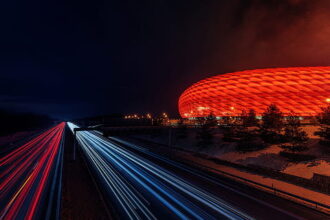
History suggests this tie is far from settled. Bayern have overturned a one-goal deficit at home before—most notably against Barcelona in 2015. However, PSG’s away goal tally (five) means a 2-0 win for Bayern would still send the French side through. The Allianz Arena will be a cauldron, but PSG’s counter-attacking speed—led by Kvaratskhelia and Dembélé—could exploit Bayern’s high line again.
Key factor: Bayern must score early. If they net within the first 20 minutes, the pressure shifts entirely to PSG. But if Paris holds firm and scores first, the tie could be over. Expect a more disciplined Bayern performance, but also expect goals. My prediction: Bayern wins 3-1, but PSG advances 6-5 on aggregate—a fittingly chaotic conclusion to a historic tie.
Conclusion: A night that redefined Champions League drama
In a season filled with memorable matches, PSG 5-4 Bayern Munich stands alone. It was a contest that had everything: penalties, world-class finishes, defensive errors, and relentless drama. For the neutral, it was a gift. For the purist, it was a reminder that football’s beauty often lies in its imperfections. PSG now take a slender lead to Germany, but Bayern will believe they can finish the job. One thing is certain: the second leg will be unmissable. This is why we watch the Champions League—for nights like these, where records fall and legends are made.
Source: Based on news from Yahoo Sports.