Quiet and Steady: The 20-Year Blueprint Behind Lincoln City’s Historic Ascent
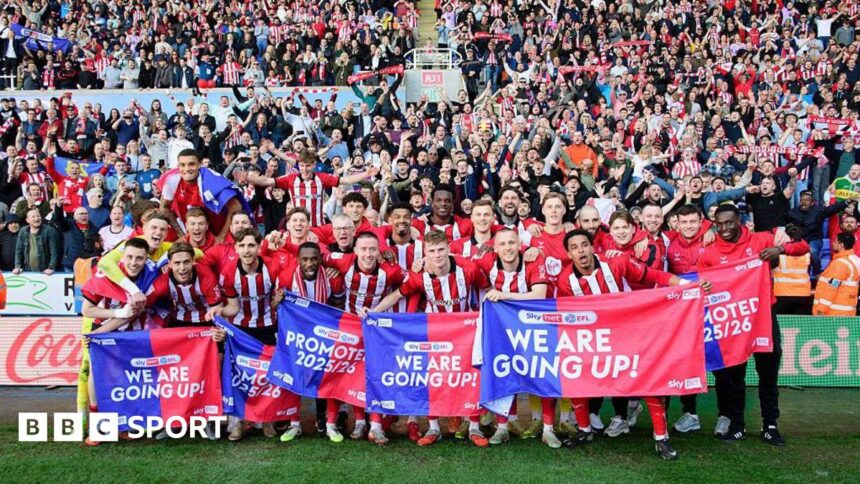
The roar that erupted from the away end at the Select Car Leasing Stadium was one of pure, unadulterated catharsis. Deep into the 96th minute, with promotion a mere point away, Jack Moylan’s winner didn’t just secure a 2-1 victory at Reading; it shattered a 65-year wait. Lincoln City, a club with one of the smallest budgets in League One, had mathematically sealed their return to the second tier with five games to spare. The scenes were of chaotic joy, but the story behind them is one of remarkable calm, a testament to a philosophy two decades in the making. This was not a flash in the pan. This was the harvest of seeds planted long ago.
From Administration to Ambition: The Foundations of a New Era
To understand the magnitude of Lincoln City’s achievement, you must rewind to 2002. The club was in administration, languishing at the foot of the Football League, staring into the abyss of non-league obscurity. The survival and eventual revival that followed were built not on a sugar daddy’s wealth, but on a culture of prudence, community, and long-term vision. As John Pakey, former sports editor of the Lincolnshire Echo, notes from conversations with his former colleagues, this period was the crucible. “The club learned a brutal lesson in sustainability,” Pakey reflects. “Out of that near-death experience came a resolve to build something that could last, brick by brick, season by season.”
This foundational ethos was crystallized with the arrival of the Cowley brothers in 2016, whose explosive success provided the rocket fuel for belief and national attention. Yet, crucially, when they departed, the club didn’t collapse. Instead, it evolved. The appointment of Michael Appleton, and then the visionary hiring of director of football Jez George and head coach Michael Skubala, signaled a commitment to a modern, structured football project. The blueprint shifted from charismatic management to a holistic system.
- Data-Driven Recruitment: The club became famed for identifying undervalued talent, selling players for significant profits (like Morgan Rogers and Anthony Scully), and reinvesting smartly.
- Infrastructure Investment: While the playing budget remained modest, millions were poured into the state-of-the-art training ground at LNER Stadium, a tangible commitment to the future.
- Cultural Continuity: The “Imps” identity—hard-working, unified, resilient—became embedded from the first team down to the academy.
The Skubala Symphony: Tactical Intelligence Meets Unshakeable Belief
When Michael Skubala took the reins in November 2023, Lincoln were 18th. His task was not just to steady the ship, but to elevate it. A former England futsal coach, Skubala brought a nuanced, possession-based philosophy that was both progressive and pragmatic. He didn’t rip up the squad; he refined it. The transformation has been breathtaking. Skubala’s Lincoln control games with a calm authority that belies their underdog status.
The statistics are compelling, but the style is even more so. This is a team that wins through collective intelligence, not financial muscle. Key to this has been the development of players like Ethan Erhahon, a metronomic presence in midfield, and the attacking fluidity of Danny Mândroiu and Lasse Sørensen. The dramatic winner at Reading, created and finished with ice-cool precision in the dying seconds, was not luck. It was the product of a team drilled in belief and structure, a physical manifestation of the quiet confidence that now permeates the club.
“What Skubala and his staff have done is synthesize the club’s gritty identity with a sophisticated tactical approach,” says Pakey. “They play ‘the Lincoln way’—but it’s a Lincoln way that has evolved for the Championship. They’ve proven you can be both tough to beat and easy on the eye.”
The Championship Horizon: Consolidation and a New Challenge
With promotion secured and a League One title now in their sights, the inevitable question arises: can Lincoln City survive in the Championship? The gap in resources will be colossal, facing clubs recently relegated from the Premier League with parachute payments dwarfing Lincoln’s entire turnover. Yet, to dismiss them would be to ignore the very lesson of the last 20 years.
The club’s strategy for the second tier is already clear and will be an extension of the model that got them there:
- Stick to the Recruitment Model: They will again target hungry, developmental players, potentially using the loan market astutely to bridge the quality gap.
- Leverage the Infrastructure: The top-class training facilities will be a major selling point to attract talent.
- Embrace the Underdog Status: Sincil Bank, likely to be packed and fervent, must become a fortress. The unity between team, staff, and supporters will be their secret weapon.
Survival will be the primary aim, and it will be a monumental task. However, Lincoln City are not a club that measures success solely by league position. The project has always been about sustainable growth. A season of hard-fought Championship football, further establishing their model, would represent another successful step.
More Than a Promotion: A Blueprint for the Modern Game
Lincoln City’s story is a powerful antidote to the narrative that football is only a rich man’s game. In an era of financial disparity, they have authored a masterclass in intelligent club building. Their promotion is a victory for patience, for strategy over splurge, and for a community that owns its club’s heart.
As the celebrations continue and the focus turns to lifting the League One trophy, the broader legacy is already secure. They have proven that with clear vision, exemplary leadership, and a commitment to a long-term plan, history can be made on a sensible budget. The journey from administration to the Championship in two decades is a remarkable tale of resurrection.
The final whistle at Reading didn’t just signal a promotion; it was the validation of a 20-year philosophy. Quiet and steady, Lincoln City didn’t just win a game—they won the argument for how a modern football club can thrive. The Championship awaits, but no matter what comes next, the foundations at Sincil Bank are built not on sand, but on stone.
Source: Based on news from BBC Sport.