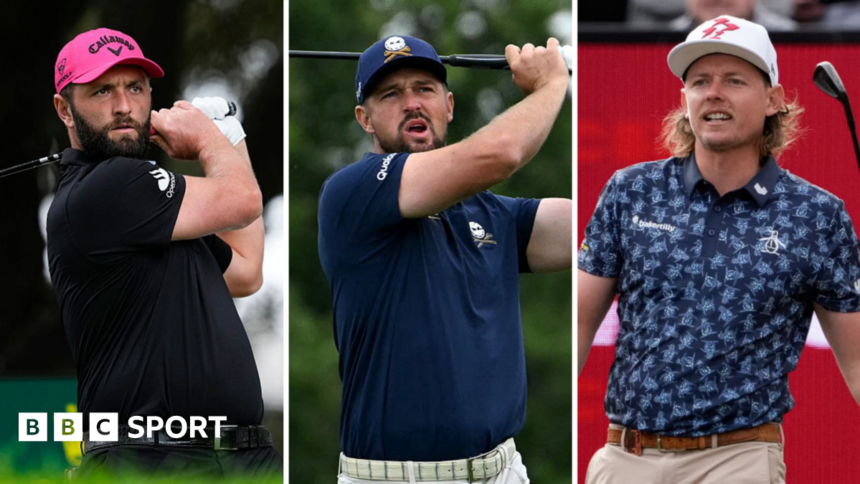
The Defiant Stand: Why Rahm, DeChambeau & Smith Are Doubling Down on LIV Golf
The revolving door between the PGA Tour and LIV Golf, propped open by a framework agreement and a temporary amnesty, just had a massive slam. In a move that reverberates through the sport’s foundation, three of the game’s most electrifying major champions—Jon Rahm, Bryson DeChambeau, and Cameron Smith—have publicly and definitively shut the door on a PGA Tour return. Despite a pathway back, exemplified by Brooks Koepka’s recent reinstatement, this trio is not coming home. Their collective snub is more than a personnel decision; it’s a powerful declaration that signals a permanent fracture in men’s professional golf and the entrenchment of LIV as a formidable, athlete-first enterprise.
The Amnesty That Wasn’t: Koepka’s Return vs. The Trio’s Rejection
In the wake of a tumultuous year, the PGA Tour extended an olive branch—or perhaps a tactical lifeline. Following Brooks Koepka’s return, citing family needs, the Tour established a returning member programme with a February 2nd deadline. This window was a chance for other defectors, especially those with major championship pedigree, to potentially reintegrate. The calculus seemed straightforward: regain access to iconic venues, historic records, and the Tour’s traditional ecosystem.
Yet, at a recent LIV Golf captains’ news conference, that calculus was publicly shredded. Rahm, the stoic 2023 Masters champion; DeChambeau, the reinvented 2024 U.S. Open winner; and Smith, the gritty 2022 Open Champion, quashed all speculation. Their unified stance sends an unambiguous message: the incentives of LIV Golf now outweigh the legacy pull of the PGA Tour for its top stars. This isn’t a negotiating ploy; it’s a settled decision that underscores a fundamental shift in player priorities and power dynamics.
Beyond the Paycheck: The Calculated Bet on LIV’s Future
To dismiss this decision as purely financial is to miss the deeper strategic play. While the signing bonuses—reportedly in the hundreds of millions for Rahm alone—are life-altering, these athletes are betting on the future of the LIV product itself. Their commitment is a vote of confidence in the league’s growth trajectory and its distinct model.
- Format & Atmosphere: All three have thrived in LIV’s team-based, shotgun-start, 54-hole format. It offers a less grueling schedule, a guaranteed payday, and a fraternal team environment that contrasts sharply with the Tour’s individual grind.
- Global Platform: LIV’s international schedule aligns with these players’ global appeal, particularly for Smith (Australia) and Rahm (Europe), offering a platform that the PGA Tour’s predominantly U.S. slate cannot match.
- Autonomy & Influence: As team captains, they wield significant influence over roster decisions, branding, and the direction of their franchises—a level of ownership and voice rarely granted to players in the traditional model.
“We’ve made our decision,” DeChambeau stated succinctly. That decision is a bet that LIV’s model is not an experiment, but the new reality.
The Major Dilemma and the New World Order
The most fascinating wrinkle in this standoff remains the major championships. Rahm, DeChambeau, and Smith are not just LIV golfers; they are current or recent major winners, the sport’s ultimate laurel. Their eligibility for The Masters, PGA Championship, U.S. Open, and The Open is secure for years to come based on their victories. This grants them a unique, hybrid existence: they can bypass the PGA Tour’s ecosystem while still competing for its most coveted prizes on golf’s grandest stages.
This creates a surreal new world order where the narrative for half the year will be dominated by LIV stalwarts crashing the traditional bastions of the game. Imagine the scene if Rahm defends a green jacket or DeChambeau hoists another U.S. Open trophy while remaining a LIV team captain. Their success at majors doesn’t just validate their talent; it validates their career choice, proving that peak performance and preparation are possible outside the PGA Tour structure.
Predictions: Ripple Effects and an Irreversible Split
The ramifications of this trio’s decision will cascade through the sport for years. Here’s what to expect:
- PGA Tour Loyalty Rewritten: The Tour will now aggressively pivot its narrative, celebrating those who stayed loyal (Scheffler, Homa, Morikawa) while the returning member programme likely fades. The era of easy reconciliation is over.
- LIV’s Credibility Surge: Securing these stars long-term is LIV’s biggest victory since its inception. It stabilizes the league, attracts sponsors, and provides undeniable star power for its broadcast negotiations.
- The “Other” Major Winners Become Targets: Pressure will now intensify on other major-winning LIV players like Phil Mickelson, Dustin Johnson, and Martin Kaymer to declare their permanence. The exodus back to the Tour appears to have stopped with Koepka.
- Fan Base Fragmentation: Golf audiences will be forced to choose. Many will follow their favorite stars to LIV broadcasts, while others will cling to the PGA Tour’s heritage. A unified, top-tier tour featuring all the best players is now a distant dream.
Conclusion: A Line Drawn in the Bunker
Jon Rahm, Bryson DeChambeau, and Cameron Smith have done more than choose a employer. They have drawn a line in the bunker. By rejecting the PGA Tour’s amnesty, they have moved beyond being defectors or mercenaries. They are now the foundational pillars of a parallel golf universe. Their decision is a stark acknowledgment that the golf civil war has reached a cold, stable détente. Two leagues will coexist, compete for talent, and split the attention of the golfing world. The return of Brooks Koepka now looks less like a trend and more like an outlier. The future is bifurcated, and three of golf’s biggest stars have just placed a massive, long-term bet on the new side winning. The game will never be the same.
Source: Based on news from BBC Sport.