Rams’ Sean McVay Demands Answers After Seahawks’ Bizarre, Game-Tying Two-Point Conversion
In a season-defining Thursday night clash that will be dissected for years, the Los Angeles Rams and Seattle Seahawks didn’t just play a football game; they authored a chaotic, rulebook-twisting epic that may have permanently altered the NFC playoff landscape. The Rams’ 37-38 overtime loss was a masterpiece of drama, but its central, mind-bending moment—a two-point conversion that died, was resurrected by replay, and ultimately saved Seattle’s season—has left Head Coach Sean McVay and the football world searching for explanations. This wasn’t just a play; it was the moment the 2024 NFL season truly lost its plot.
The Crucible: A Season on the Line in the Fourth Quarter
With seven minutes remaining in a game with massive implications for the NFC’s top seed, the Rams seemed to have a firm grip on victory. Leading 30-22, their defense faced a resurgent Seahawks offense that had just sliced down the field. Seattle quarterback Sam Darnold found rookie tight end AJ Barner for a 26-yard touchdown, setting the stage for a critical two-point attempt to tie the game. The Rams’ defense appeared to deliver a knockout blow, as defensive tackle Kobie Turner batted Darnold’s quick screen pass into the turf. The ball fell harmlessly. The stadium exhaled. Players began to mill toward their sidelines, preparing for the ensuing kickoff. The game, for all intents and purposes, seemed to have its answer.
But the officials had not blown the play dead. In a move that instantly injected tension into the stadium, the replay official buzzed down, initiating a review. What followed was a slow-motion revelation that changed everything. The broadcast replay showed, with unsettling clarity, that Darnold had not thrown a forward pass. He had, in fact, delivered a backward lateral—a live football. The ball, therefore, was never dead.
Chaos Theory: The Lateral That Lived and the Fumble That Counted
As the video evidence became undeniable, a new narrative emerged from the chaos. While 21 players reacted to an incomplete pass, one Seahawk played to the whistle. Running back Zach Charbonnet, following his assignment, had casually collected the ball in the end zone after it skidded across the turf. In the surreal silence of the review, this simple act transformed from a meaningless post-play ritual into the most heads-up play of the Seahawks’ season.
- The Official Ruling: The play was ruled a backward pass, recovered by Seattle in the end zone.
- The Points Awarded: The recovery resulted in a successful two-point conversion.
- The Score: A presumed 30-28 Rams lead was suddenly a 30-30 tie, sucking the air out of SoFi Stadium.
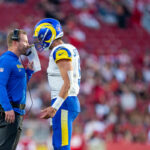
On the Rams sideline, Sean McVay’s confusion quickly morphed into visible frustration. His team had executed defensively, only to have the victory condition rewritten by a technicality. “I asked for an explanation. I got one. I don’t necessarily agree with it,” McVay stated tersely in his post-game press conference. “When the ball is batted backwards, it’s a live ball. They said it was a backwards pass, Charbonnet recovered it. That’s the explanation. It’s a tough way to have a game swing like that.”
Expert Analysis: Rulebook Precision Meets On-Field Instinct
This play exists in the razor-thin margin between a forward pass and a lateral, a distinction that is often millimeter-perfect and impossible to judge in real-time. From an officiating standpoint, the call was ultimately correct upon review. The NFL rulebook is unequivocal: a backward pass is live at all times and can be advanced by either team. The officials’ failure to kill the play on the field, while jarring, was technically accurate—the ball was live.
However, the football intelligence displayed by Zach Charbonnet cannot be overstated. In a league where players are drilled to play to the whistle, 99% of athletes in that situation would have ignored the ball. The play was “over.” The context screamed “incomplete pass.” Charbonnet’s subconscious adherence to fundamental training saved Seattle’s season. Conversely, the Rams’ defense, in a collective and understandable lapse, assumed the play was dead. This created the bizarre tableau of a game-tying score being recorded with virtually no defensive resistance.
The real controversy lies in the application of “clear and obvious.” The review system is designed to correct egregious errors. This was not an error of call, but an error of perception by everyone except the replay official. The review corrected a non-call with a monumental consequence, which sits uncomfortably with many purists who believe the flow and instinct of the game were undermined.
Ripple Effects: NFC West Upheaval and Playoff Predictions
The ramifications of this single play are seismic. Instead of the Rams potentially icing the game with a two-score lead, the contest was forced into overtime, where Seattle won on a daring second two-point conversion attempt. The result flips the NFC West on its head.
- Seahawks’ Path: Seattle now controls its destiny for the division title and a potential first-round bye. This win injects an immeasurable dose of belief into a resilient squad.
- Rams’ Challenge: Los Angeles falls from the driver’s seat into a fierce wild-card scramble. The psychological blow of *how* they lost could be more damaging than the loss itself.
- NFC Picture: The conference’s top seed is now a wide-open battle, with multiple teams benefiting from the Rams’ stumble.
Looking ahead, the mental fortitude of both teams will be tested. Can the Seahawks harness this miraculous energy into a consistent, disciplined run? More pressingly, can Sean McVay rally his Rams squad from a defeat that feels unjust? History shows that teams can be galvanized by such hardship, but they can also fracture. The Rams’ response in their next heavyweight matchup will tell us everything about their championship mettle.
Conclusion: A Game That Redefined “Live Ball”
Thursday night’s thriller was more than a game; it was a referendum on the modern NFL, where a play can be dead in spirit but alive by rule, where a season can pivot on a quarterback’s release point and a running back’s muscle memory. Sean McVay’s request for an explanation is symbolic of every fan’s bewilderment. We witnessed a football singularity—a play that defied conventional understanding and rewrote the game’s outcome in real-time.
In the end, the Seahawks’ victory was earned through relentless effort and one player’s singular awareness. Yet, the Rams’ loss was inflicted by a phantom—a lateral that no one saw, in a play everyone thought was over. This contest will be remembered not just for its overtime heroics, but for the moment the sport paused, looked into the replay monitor, and descended into beautiful, chaotic madness. The plot isn’t just lost; it’s been shredded, taped back together, and sent to New York for review.
Source: Based on news from Yahoo Sports.