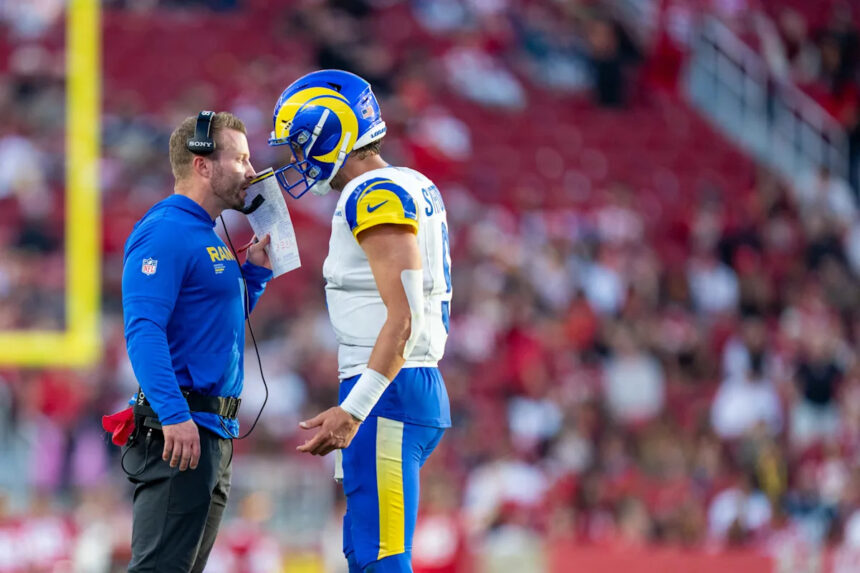
Matthew Stafford and Sean McVay Baffled by Seahawks’ Bizarre, Overturned 2-Point Conversion
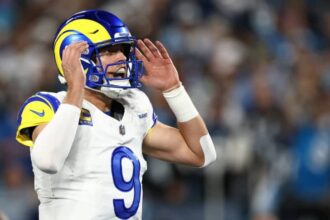
In the NFL, a league where innovation and chaos often collide, Sean McVay and Matthew Stafford are seasoned veterans of the unexpected. Yet, in the aftermath of a stunning 38-37 overtime loss to the Seattle Seahawks, both the Los Angeles Rams’ head coach and his veteran quarterback were left genuinely perplexed. The source of their bewilderment wasn’t a Hail Mary or a controversial penalty, but a two-point conversion attempt so strange, so utterly dormant, that it rewound the game’s timeline and altered its outcome in a way neither football lifer had ever witnessed.
A Routine Stop Turns Into a Rulebook Nightmare
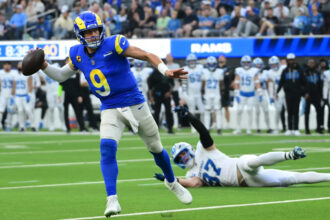
The scene was set for a classic NFC West finale. With just over a minute remaining in regulation, the Seahawks scored a touchdown to pull within two points, 30-28. Opting to go for the win, Seattle dialed up a pass play. Quarterback Sam Darnold, under pressure, fired a pass toward the sideline that fell harmlessly incomplete. The Rams’ defense celebrated what appeared to be a game-sealing stop. The kickoff unit began to trot onto the field. The game, for all intents and purposes, seemed to be moving on.
Then, the unthinkable happened. A review was initiated. In the quiet confusion of a paused stadium, officials scrutinized the play and arrived at a conclusion that left everyone, including the players on the field, in the dark. The ruling: Darnold’s pass was not a forward pass, but a backwards lateral. This critical distinction meant the ball was live the entire time.
The dominoes of chaos began to fall:
- The deflection: Rams rookie Jared Verse, in his pursuit of Darnold, inadvertently tipped the errant lateral.
- The live ball: The tipped ball trickled into the end zone, a live fumble available for anyone to recover.
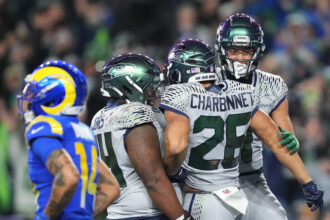
- The accidental recovery: Seahawks running back Zach Charbonnet, thinking the play was dead, casually picked up the football as if retrieving a practice ball.
By rule, Charbonnet’s nonchalant scoop constituted a clear recovery in the end zone. The result: two points for Seattle, tying the game at 30-30 and sending it to overtime, where the Seahawks would eventually win. “I’ve never quite seen anything like what happened,” a bemused McVay stated post-game.
Expert Analysis: The Anatomy of a Football Anomaly
This play wasn’t just unusual; it was a perfect storm of procedural oddity and rulebook nuance. The confusion stemmed from a universal assumption on the field that the play was dead. Every single player, in both blue and white jerseys, stopped competing. The officials on the field initially signaled an incomplete pass. The reaction—or lack thereof—from Charbonnet was the most telling evidence; he collected the ball with the urgency of a fan catching a souvenir.
From a technical standpoint, the officials in New York got the call correct according to the letter of the law. The ball did travel backwards from Darnold’s hand. Once Verse touched it, it became a free ball. The NFL’s replay review system is designed to correct such objective errors, even if the subjective experience of the play was one of concluded action.
However, the philosophical debate it ignites is fierce. Should a play that no participant believed was live be allowed to decide a game? Football is a game of continuous, violent competition. This play contained none of that after the release. It existed in a vacuum created by instant replay, rewarding a team for an action taken with zero competitive intent. Stafford’s puzzlement likely echoes this sentiment—the play defied the very essence of how the game is played between the whistles.
Ripple Effects: What This Means for the Rams and the NFC Playoff Picture
While bizarre, this moment had serious consequences. For the Rams, a victory would have solidified their playoff positioning and delivered a critical division win. Instead, they leave Seattle with a devastating, confusing loss. The psychological impact of such a defeat cannot be understated. Defensive players, particularly Jared Verse, must now process that even a well-executed pressure can lead to a catastrophic, fluke result.
For the team’s leadership, the challenge is twofold. First, McVay must ensure this unprecedented loss doesn’t create a lingering hangover as they push for the postseason. Second, it serves as a stark, almost surreal coaching point: play to the whistle, even when the whistle seems implicit. The Rams’ season is far from over, but this game will linger as a prime example of football’s unpredictable cruelty.
For the Seahawks, it’s an immeasurable boost. A gift-wrapped two points and a lifeline they fully capitalized on. It could be the turning point that salvages their season, proving that in the NFL, fortune sometimes favors the unaware.
Predictions: Will the “Seattle Surprise” Change NFL Replay?
This play will not soon be forgotten in league circles. It immediately enters the pantheon of NFL oddities, alongside the “Holy Roller” and the “Butt Fumble.” But will it effect change? We predict a few key outcomes:
- Emphasis on Education: The NFL will likely circulate a video of this play to all 32 teams as a case study in the importance of playing through the echo of the whistle, especially on laterals.
- Coaching Point Paranoia: Coaches like McVay will drill into their defenders, particularly edge rushers, to be hyper-aware of bat-downs that could become live balls. We may see more defenders diving on “incomplete” passes near the line of scrimmage.
- No Major Rule Change: While controversial, the call was correct. The NFL is unlikely to alter its replay rules to account for “football intent” or the cessation of play by participants. The system’s goal is objective accuracy, which it achieved here, however unsatisfying the process.
The play also sets a bizarre precedent. Could we see teams in the future design trick plays that mimic dead-ball scenarios? It’s unlikely, but the blueprint for chaos now exists in the film library.
Conclusion: A Moment That Defies Convention
The overturned two-point conversion in Seattle was more than a turning point in a game; it was a collision between cold, hard rules and the warm, assumed reality of competition. Sean McVay and Matthew Stafford, two men who have dedicated their lives to understanding this game’s every contour, were left with only questions. There was no blame for a missed assignment, no critique of a play call—just sheer disbelief at a sequence that rewrote a game’s narrative during a commercial break.
In the end, this play reinforces a fundamental, if frustrating, truth about modern football: the game is not truly over until the replay official in New York says it is. It serves as a reminder that in the NFL, the extraordinary is always possible, even when it arrives disguised as the mundane. For the Rams, it’s a painful lesson learned in the most surreal fashion imaginable. For the rest of us, it’s the reason we watch—because even the experts can still see something they’ve never seen before.
Source: Based on news from Yahoo Sports.