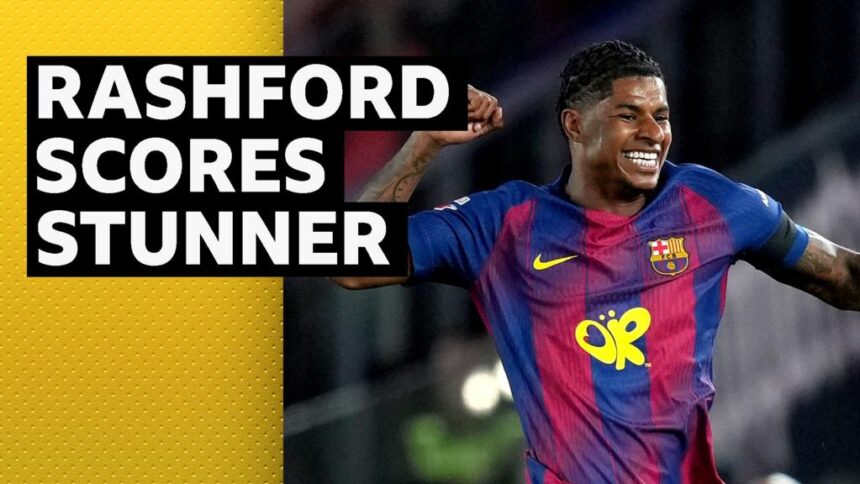
Rashford’s Decisive Strike Seals La Liga Glory: Barca Edges Real in a Classic El Clasico Showdown
The roar at the Camp Nou was deafening, a cathartic release of tension and triumph. In a season defined by tactical genius and relentless ambition, Barcelona have done it again. In a pulsating El Clasico that had the entire football world on the edge of their seats, a solitary moment of brilliance from Marcus Rashford proved to be the difference, handing the Blaugrana a 1-0 victory over their eternal rivals, Real Madrid, and securing back-to-back La Liga titles. This was not just a win; it was a statement. A declaration that under the stewardship of Hansi Flick, this Barcelona side is a well-oiled, championship-winning machine.
The narrative heading into the match was heavy with history. Real Madrid, desperate to halt Barca’s domestic dominance, arrived with a swagger that only a club of their stature can possess. Yet, from the first whistle, it was clear that Flick’s men were playing for something more than three points—they were playing for a legacy. The match, as expected, was a tactical chess match, a whirlwind of high-pressing, pinpoint passing, and moments of sheer individual genius. But in the 67th minute, the script was torn up and rewritten by an Englishman.
This article provides a deep dive into the decisive moment, the tactical masterclass from Hansi Flick, and what this victory means for the future of Spanish football. We will analyze the key battles, the unsung heroes, and why this title feels different from the last.
The Moment of Magic: How Rashford Broke the Deadlock
For the first hour, the game was a stalemate. Both defenses, marshaled by the commanding presence of Ronald Araujo and the veteran savvy of Antonio Rüdiger, were impenetrable. Chances were few and far between. Lamine Yamal was causing havoc on the flanks, but Real’s midfield trio of Jude Bellingham, Eduardo Camavinga, and Federico Valverde was plugging gaps with athletic ferocity. The game needed a spark. It needed a player capable of defying the tactical structure.
That player was Marcus Rashford. The Manchester United loanee, who has revitalized his career under Flick, had been relatively quiet, starved of service by a disciplined Real Madrid backline. But in the 67th minute, the script flipped. A quick throw-in from Jules Koundé found Ilkay Gündoğan in the half-space. The German maestro, with the vision of a clairvoyant, spotted Rashford making a darting run in behind the static Real defense. Gündoğan’s pass was weighted to perfection, splitting Dani Carvajal and David Alaba.
Rashford’s first touch was immaculate, taking the ball away from the onrushing Thibaut Courtois. With the angle narrowing and the pressure mounting, the English forward showed ice-cold composure. Instead of lashing at the ball, he slotted a precise, low-driven shot across the face of goal, nestling it into the far corner. The net bulged. The Camp Nou erupted. It was a finish that combined power, placement, and poise—a goal worthy of winning any El Clasico.
Key elements of the goal:
- The Trigger Run: Rashford’s timing was perfect, catching the Real Madrid defense flat-footed.
- The Pass: Gündoğan’s through-ball was the definition of “defense-splitting.”
- The Finish: Clinical, calm, and collected under immense pressure.
- The Impact: It silenced the traveling Madrid fans and sent the Barca faithful into a frenzy.
This goal was not just a moment of individual brilliance; it was the culmination of Flick’s tactical philosophy—quick transitions, vertical passing, and exploiting space in the final third.
Flick’s Tactical Masterclass: The Blueprint for Domination
While Rashford will rightly grab the headlines, the real architect of this victory was Hansi Flick. The German manager has reshaped Barcelona from a possession-heavy, sometimes predictable side into a dynamic, high-octane pressing machine. This El Clasico was the ultimate vindication of his methods.
Flick’s game plan was simple yet devastatingly effective. He instructed his team to cede possession in non-threatening areas, baiting Real Madrid into a false sense of security. Then, the moment the ball was turned over, Barca would strike with lightning speed. The midfield trio of Pedri, Gündoğan, and Frenkie de Jong were instructed to bypass the midfield battle and look for runners immediately. This verticality caught Real Madrid off guard repeatedly.
Furthermore, Flick’s defensive setup was a masterstroke. He tasked Alejandro Balde with man-marking Vinícius Júnior, a role that often sees full-backs get destroyed. But Balde, with his raw pace and tenacity, stuck to the Brazilian like glue, limiting his influence to long-range shots. Meanwhile, Araujo handled the physical presence of Rodrygo with ease. The result was a Real Madrid attack that looked toothless and frustrated.
What Flick has done is create a system that is greater than the sum of its parts. He has turned doubters into believers. The way he has integrated Rashford, a player who struggled for confidence at Manchester United, into a fluid front three alongside Yamal and Robert Lewandowski is a testament to his man-management. This title is not just a trophy; it is a blueprint for how modern football should be played—with intensity, intelligence, and a relentless will to win.
Expert Analysis: Why This Title Tastes Sweeter for Barca
Winning a league title is always impressive. Winning back-to-back titles is a sign of a dynasty. But this particular La Liga crown feels different. It is a victory forged in the fires of adversity. Last season, Barcelona won the league with a solid defense and a reliance on individual moments from Robert Lewandowski. This season, under Flick, they have evolved into a multi-dimensional threat.
The numbers back this up. Barcelona have scored more goals from open play than any other team in Europe’s top five leagues this season. They have also recorded more high-pressing turnovers in the final third. This is a team that doesn’t just wait for opportunities; it creates them through sheer force of will. The victory over Real Madrid was a perfect microcosm of their season: disciplined, tactical, and ruthless.
Let’s break down the key factors that secured this title:
- Defensive Solidity: The partnership of Araujo and Koundé has conceded fewer goals than any other center-back pairing in La Liga.
- Midfield Engine: The energy of de Jong and the creativity of Gündoğan have provided the perfect balance.
- Youthful Explosion: Lamine Yamal has become a world-beater, providing assists and goals from the right flank.
- Flick’s Flexibility: The ability to switch between a 4-3-3 and a 4-2-3-1 mid-game has made Barca unpredictable.
From an expert perspective, the most impressive aspect is the psychological resilience. Real Madrid pushed them hard. There were moments in the season where Barca dropped points—a shocking loss to Rayo Vallecano, a draw with Athletic Bilbao. But each time, they bounced back with a win. That resilience, that refusal to accept defeat, is the hallmark of champions. This team believes in the system, and the system delivers.
Predictions: What This Means for the Future of El Clasico and Europe
With this title wrapped up, the focus now shifts to the future. For Barcelona, this victory is a springboard. They have already secured Champions League football for next season, but with this squad and this manager, the ambition will be to conquer Europe. The fear factor that Barca once possessed is back. Teams will dread drawing them in the knockout stages.
For Real Madrid, this is a wake-up call. They have the individual talent—Bellingham, Vinícius, and Valverde are generational players—but they lack the collective identity that Flick has instilled at Barca. Carlo Ancelotti will have to go back to the drawing board. Expect a summer of significant transfers for Los Blancos, likely targeting a world-class striker and a creative midfielder to break down low blocks. The gap between the two giants is now visible, and it is tactical, not just financial.
Looking ahead to next season, my prediction is that this rivalry will reach new heights. Barcelona will enter the season as favorites to win a third consecutive title, a feat not achieved since the days of Pep Guardiola. However, Real Madrid will be hungry for revenge. The next El Clasico will be played with even more intensity. But for now, the crown belongs to Catalonia.
Marcus Rashford’s goal will be replayed for years. It was the moment a new Barcelona dynasty was officially crowned. The Englishman came to Spain seeking redemption, and he found it in the most spectacular fashion possible—by scoring the winner in an El Clasico to win the league. It is a storybook ending to a remarkable campaign.
Conclusion: A Title Built on Belief and Brilliance
As the confetti rained down on the Camp Nou pitch, and the players lifted Hansi Flick onto their shoulders, the message was clear: Barcelona is back. Not just as a competitive force, but as the dominant power in Spanish football. The 1-0 victory over Real Madrid was not a lucky escape; it was a tactical domination, a psychological victory, and a celebration of a season of hard work.
Marcus Rashford will be the name on everyone’s lips, and rightfully so. His finish was one of the finest we have seen in an El Clasico in recent memory. But this title belongs to the collective. It belongs to the fans who never stopped believing, to the young stars who stepped up, and to the manager who dared to reshape a giant.
This is more than just a trophy. It is a statement of intent. Barcelona have not only won La Liga; they have redefined how it should be played. The future is bright, and it is Blaugrana. The dynasty has begun.
Source: Based on news from BBC Sport.