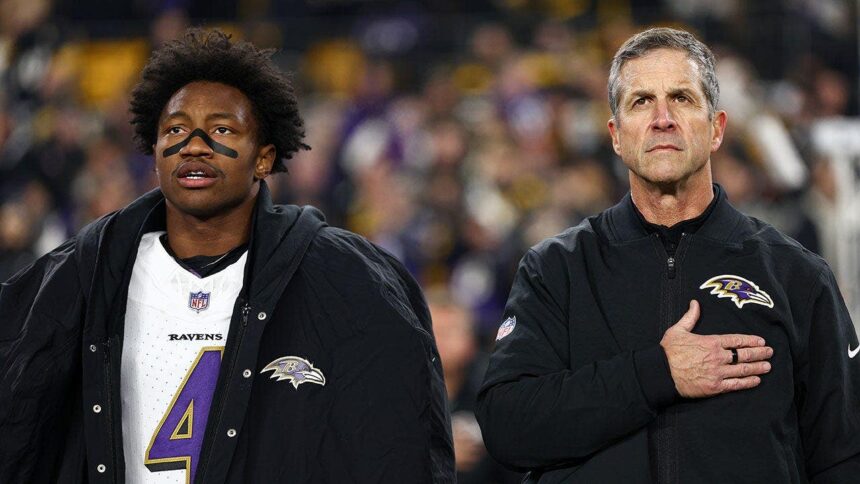
Zay Flowers’ Harbaugh Critique Ignites NFL Practice Philosophy Debate
The relationship between a head coach and his players is often a complex tapestry of respect, pressure, and pursuit of a common goal. Occasionally, that complexity spills into public view, offering a rare glimpse into the grind of an NFL season. A recent comment from Baltimore Ravens star wide receiver Zay Flowers about his former coach, John Harbaugh, has done just that, sparking a league-wide conversation about practice intensity, player health, and the fine line between preparation and punishment.
The Load Was Heavy: Flowers’ Candid Podcast Revelation
During an appearance on the 4th and South podcast, Zay Flowers, 25, didn’t hold back when reflecting on his three seasons under John Harbaugh in Baltimore. The talented receiver painted a picture of a relentless practice regimen that persisted deep into the grueling NFL calendar. “Full pads all the time,” Flowers stated. “However many practices in pads you can get, every single one. We’re doing one-on-ones in Week 17. Week 17, we’re doing one-on-ones, everybody out there, we’re tired, we’re still going.”
Flowers’ description goes beyond mere complaint; it touches on a critical and controversial point in modern football. He directly connected Harbaugh’s rigorous, contact-heavy approach to the team’s injury woes. In a league where player health and safety are paramount, the suggestion that practice methodology could contribute to the physical toll is a significant charge. It frames the classic “hard-nosed” football philosophy against a more contemporary, sports-science-informed approach to player management.
Harbaugh’s Philosophy: Old School Grit in a New School League
John Harbaugh, the NFL’s longest-tenured active coach with one team, is renowned for his disciplined, tough-minded approach. His methods have yielded consistent success, including a Super Bowl XLVII victory. Harbaugh has always operated at the maximum limit of the NFL’s collective bargaining agreement rules regarding padded practices. For him, this isn’t about being harsh; it’s about building what he calls “calloused” toughness—a resilience forged through repeated physical challenge that prepares a team for the brutal realities of game day, especially in the crucible of January football.
This philosophy stands in stark contrast to many modern NFL teams, which have drastically reduced live contact in practice, relying instead on walk-throughs, film study, and advanced recovery techniques. The core debate Flowers’ comments illuminate is this:
- Pro-Harbaugh View: Physical practices build mental and physical toughness, improve tackling technique, and create a team identity. They separate the contenders from the pretenders when the weather turns cold.
- Player-Centric View: The NFL season is already a 17-game car crash. Adding unnecessary wear-and-tear in practice increases injury risk, saps energy for games, and can shorten careers. Practice should be about strategy and repetition, not repeated collisions.
Notably, Harbaugh was recently in the news for a different reason, chatting with Fox News host Brian Kilmeade about leadership and mentorship, and even receiving a shoutout from former President Donald Trump. This juxtaposition highlights the multifaceted nature of a head coach’s role: a CEO, a motivator, a strategist, and, sometimes, a lightning rod for criticism.
Expert Analysis: Weighing Risk vs. Reward
Sports medicine professionals and former players are often divided on this issue. “The data is clear that cumulative contact is a major factor in soft-tissue injuries and overall player fatigue,” says Dr. Elena Rodriguez, a sports performance consultant. “While some contact is necessary for acclimation, maximizing every allowable padded session, especially late in the season, presents a diminishing return with heightened risk.”
Conversely, former Ravens linebacker Jarret Johnson, who played under Harbaugh, often credits that very practice environment for the team’s perennial defensive prowess. “You hate it on Wednesday, but you’re thankful for it on Sunday in the fourth quarter,” is a common refrain from veterans of such systems. The question becomes: does this advantage outweigh the potential cost of losing a star player like, say, Zay Flowers, to a practice injury in December?
Flowers’ perspective is particularly telling because he is a skill-position player. Wide receivers and defensive backs engaging in intense one-on-one battles in Week 17 are risking ankles, knees, and shoulders in drills that, while competitive, may not directly translate to the structured chaos of a game situation. His comments suggest a generational shift in how players view their bodies—not as limitless tools, but as valuable, finite assets to be managed for long-term performance.
Predictions: A League-Wide Ripple Effect
Zay Flowers’ public airing of this grievance is unlikely to be an isolated incident. It signals a growing willingness among players to question traditional authority structures, especially concerning their health. We can predict several potential outcomes:
- Internal Scrutiny for the Ravens: While Harbaugh’s job security is not in question, General Manager Eric DeCosta and the front office will undoubtedly weigh player feedback on practice intensity, especially when courting free agents or managing veteran recovery.
- Empowerment for Players League-Wide: Flowers’ comments may encourage other players to voice similar concerns to their coaches or player unions, pushing more teams toward a “less is more” practice model.
- A Hybrid Model Emerges: The most likely evolution is not a full abandonment of tough practices, but a more nuanced, data-driven approach. Teams may still have “callousing” periods in training camp and select weeks but will incorporate more rest and recovery cycles as the season progresses, preserving players for the games that matter most.
- Impact on Harbaugh’s Legacy: This episode adds a layer to Harbaugh’s legacy. He will be seen not just as a champion, but as a standard-bearer for an increasingly challenged style of coaching. His adaptability, or lack thereof, will be closely watched.
Conclusion: The Delicate Balance of Championship Culture
Zay Flowers’ simple statement—“The load was heavy”—has lifted the lid on one of the NFL’s most enduring tensions. There is no easy answer. Championship teams undoubtedly require a level of grit and resilience that must be cultivated. Yet, the goal of any season is to have your best players healthy and explosive on the field on game day, not worn down on the practice field.
Flowers, now looking ahead to a new season, has voiced what many players likely feel. John Harbaugh, a proven winner, operates on a philosophy that has stood the test of time. The collision of these two viewpoints is not merely a Ravens storyline; it is a microcosm of the NFL’s ongoing evolution. The coaches and organizations that successfully navigate this divide—fostering a culture of accountability and toughness without compromising the physical well-being of their athletes—will be the ones who thrive in the future. The pursuit of a Lombardi Trophy is a heavy load indeed; the debate is now centered on where, exactly, that load should be carried.
Source: Based on news from Fox Sports.


![Ravens OC Todd Monken says he 'didn't coach Lamar [Jackson] well enough'](https://yetiscore.com/wp-content/uploads/2026/01/sports-1767966485-330x220.jpg)