Referee and Assistant Stood Down: FA Cup Mistakes Spark Premier League Omission
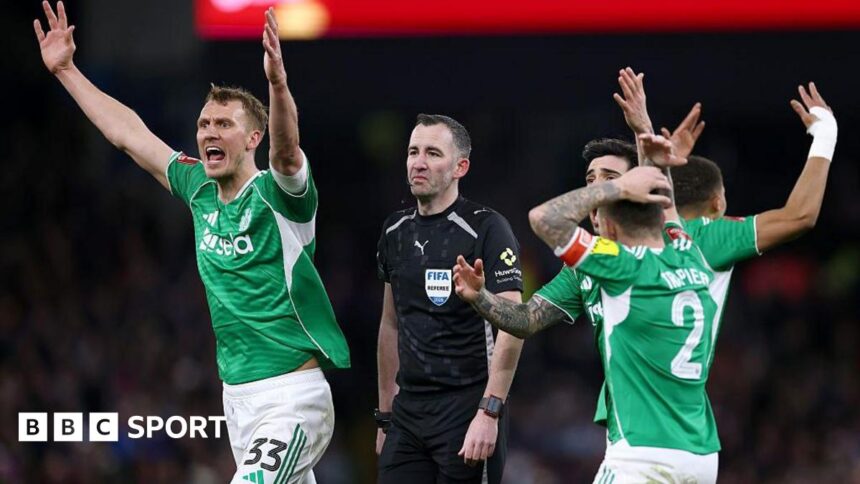
The roar of the crowd, the flash of a boot, the ball hitting the net—these are the moments that define football. But sometimes, the most consequential moments are those of silence: a whistle not blown, a flag not raised. This past weekend, such silences in an FA Cup classic have reverberated through the corridors of power at the Professional Game Match Officials (PGMO), leading to a stark and public accountability measure. Referee Chris Kavanagh and assistant Nick Greenhalgh have been omitted from this weekend’s Premier League appointments following their heavily scrutinized performance in Aston Villa’s 3-2 victory over Newcastle United.
A Pivotal Non-Call in a Cup Classic
The FA Cup fourth-round tie at Villa Park was a pulsating affair, a showcase of the competition’s magic. Yet, a critical incident just before halftime threatens to overshadow the football. With Newcastle leading 1-0, Villa’s Matty Cash appeared to handle the ball inside his own penalty area while under pressure from Anthony Gordon. Referee Chris Kavanagh, positioned mere yards away, waved play on, awarding only a free-kick for an earlier infringement. The absence of Video Assistant Referee (VAR)—not introduced until the fifth round—left the decision irrevocably in the moment.
In a twist of fate, Newcastle’s Kieran Trippier scored directly from the resulting free-kick, doubling the Magpies’ lead. This outcome, however, does not absolve the officiating error. The Key Match Incidents panel, an independent body that reviews major decisions, would have undoubtedly classified this as a missed penalty. The controversy highlights the stark reality of the modern game: the same match can be officiated under two completely different technological paradigms depending on the competition round, creating a jarring inconsistency for players, managers, and fans.
The Mechanics of Accountability: How PGMO Reacts
The subsequent omission of Kavanagh and Greenhalgh from the Premier League roster is not a random punishment but a structured outcome of the PGMO’s review system. This process is a cornerstone of maintaining standards in the high-pressure world of elite officiating.
- Post-Match Performance Assessment: Every official’s game is meticulously reviewed by senior PGMO coaches.
- Independent Key Match Incidents Panel: This separate group, comprising former players, managers, and officials, analyses major decisions, grading them for accuracy.
- Appointments Based on Merit: The PGMO operates a merit-based selection system for each match round. Performance, including these assessments, is the primary factor.
“This is standard procedure,” a source familiar with the process explained. “When an official’s performance in a high-profile match is deemed below the expected standard, especially with a clear error in a Key Match Incident, they are often ‘stood down’ for the next round of fixtures in that competition. It’s a recalibration, not a career sentence.” The move underscores that accountability for officials is a real and transparent process, even if the mechanisms often work behind the scenes.
VAR’s Shadow: The Unavoidable Conversation
This incident acts as a powerful case study in the ongoing debate about technology’s role in football. The FA’s staggered implementation of VAR in its own flagship competition is, in itself, a point of contention. It creates a two-tier system where the stakes are identical, but the safety net is not.
For 90 minutes at Villa Park, the officials were operating in a bygone era, solely reliant on their instantaneous perception. In the Premier League that same weekend, an incident like Cash’s potential handball would have been stopped, reviewed, and almost certainly overturned. This disparity fuels frustration. Proponents of uniform technology argue that fairness must be consistent across all matches at the elite level. Critics, however, might point to this game as a reminder of the raw, uninterrupted drama that a VAR-less match can still produce—flaws and all. The goal that came from the controversy became a legendary cup moment, a complexity that the binary “right/wrong” analysis of VAR often strips away.
Looking Ahead: Repercussions and Reintegration
What does the future hold for the officials involved and the system itself? For Chris Kavanagh, a seasoned FIFA-listed referee, this is a setback but likely a temporary one. His reinstatement in subsequent Premier League rounds will be anticipated, following a pattern seen with other top officials who have been similarly omitted after high-profile errors.
The broader predictions are more nuanced:
- Increased Pressure for Full VAR Integration: The FA will face renewed calls to implement VAR from an earlier round in future seasons to avoid such headline-grabbing inconsistencies.
- Scrutiny on Assistant Referees: Nick Greenhalgh’s role in the non-call will be dissected, highlighting that the post-match performance assessments extend to the entire on-field team.
- Focus on “Clear and Obvious”: Even with VAR, debates rage. This incident reminds everyone that the human element—and human error—is merely shifted, not eliminated, by technology.
The path forward for Kavanagh and Greenhalgh involves intensive review, coaching, and likely a return to Championship or other high-level matches to rebuild confidence before a Premier League recall. Their absence this weekend is a silent but powerful message to every official: in an era where every decision is magnified, accountability is non-negotiable.
Conclusion: A Necessary Silence Speaks Volumes
The omission of Chris Kavanagh and Nick Greenhalgh from the Premier League schedule is a story told not by a whistle, but by a fixture list. It is a definitive, administrative action that speaks louder than any post-match interview. While Newcastle’s subsequent goal rendered the mistake “costless” on the scoresheet, it was not consequence-free in the world of officiating. This episode reaffirms that the PGMO’s systems for evaluation and meritocracy have tangible teeth.
Ultimately, this saga sits at the intersection of football’s enduring soul and its technological future. It reminds us of the immense pressure on officials operating without a net, and of the systems in place to uphold standards when they falter. As the FA Cup progresses and VAR enters the fray, the echoes from Villa Park will remain: a reminder that in the pursuit of fairness, accountability for officials and the consistency of the tools they use are debates that are far from over. The beautiful game continues to evolve, one difficult decision at a time.
Source: Based on news from BBC Sport.