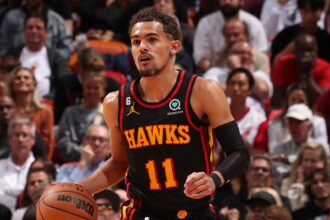
Atlanta Hawks Trade Trae Young to Washington Wizards in Franchise-Altering Deal
The NBA landscape shifted dramatically Wednesday night, as multiple reports confirmed the Atlanta Hawks are trading four-time All-Star point guard Trae Young to the Washington Wizards. This move signals the end of an era in Atlanta and the beginning of a bold, high-risk pivot for a Wizards franchise deep in its rebuild. In return, the Hawks are reportedly acquiring veteran guard CJ McCollum and forward Corey Kispert, a package that prioritizes roster flexibility and shooting over superstar talent. The trade, pending league approval, is one of the most consequential player movements of the offseason, carrying profound implications for both franchises and the Eastern Conference hierarchy.
The End of an Era in Atlanta: Assessing the Hawks’ Calculated Gamble
For six seasons, Trae Young was the Atlanta Hawks. The electrifying, high-volume guard, acquired on draft night in 2018, became the face of the franchise and its statistical leader. His tenure peaked with a magical 2021 run to the Eastern Conference Finals, where his iconic game-winner at Madison Square Garden announced his arrival on the league’s biggest stages. However, the trajectory since has been one of stagnation and frustration. Despite Young’s gaudy individual numbers—he leaves as the franchise’s all-time leader in assists and three-pointers—the team failed to advance past the first round in subsequent seasons, culminating in back-to-back play-in tournament eliminations.
The Hawks’ decision to trade Young is not a reaction to a single failing, but a strategic recalibration. The experiment of pairing Young with another ball-dominant guard, Dejounte Murray, never achieved the two-way consistency needed for a deep playoff run. By moving Young now, the Hawks’ front office, led by new general manager Landry Fields, is making a stark statement:
- Roster Rebalancing: The return of CJ McCollum, a proven scorer and secondary playmaker, and Corey Kispert, a elite movement shooter, provides a different stylistic fit alongside Murray. It adds needed floor spacing and veteran savvy without the overwhelming offensive usage Young commanded.
- Financial Flexibility: McCollum’s contract is sizable, but moving Young’s potential supermax extension off the books in future years opens significant avenues for the Hawks to reshape their roster under a new team identity.
- Defensive Realities: Young’s size made him a perpetual target in playoff settings. This trade is an implicit acknowledgment that building a sustainable contender may require a different defensive foundation at the point of attack.
Washington’s Audacious Swing: Trae Young as the Rebuild’s Centerpiece
For the Washington Wizards, this trade is a thunderclap following years of quiet accumulation of assets. After trading away Bradley Beal and Kristaps Porzingis, the franchise appeared committed to a long, patient rebuild under president Michael Winger. The acquisition of Trae Young fundamentally alters that timeline. Washington is not acquiring a complementary piece; they are installing a 27-year-old, four-time All-Star as the sun around which their entire solar system will orbit.
This is a high-variance, high-reward gamble. Young immediately becomes the most talented offensive player to wear a Wizards jersey in a generation. His unparalleled pick-and-roll artistry and deep shooting range will supercharge an offense that ranked near the bottom of the league. He will form an intriguing partnership with last year’s top pick, Bilal Coulibaly, whose defensive versatility can help mitigate some of Young’s limitations. Furthermore, Young’s playmaking should unlock the potential of young bigs like Marvin Bagley III and the recently drafted Alex Sarr.
However, the challenges are evident. The Wizards’ roster, as currently constructed, is ill-equipped to contend. The defense will be a major project. The pressure on Young to carry an immense offensive load, without the proven secondary creators he had in Atlanta, will be immense. The Wizards are betting that Young’s star power and offensive genius will accelerate their rebuild, attract other talent, and make them relevant years ahead of schedule. The risk is that they become a fun, high-scoring team that struggles to win meaningful games, trapping them in the dreaded “middle” of the NBA standings.
Expert Analysis: Winners, Losers, and Ripple Effects
From a league-wide perspective, this trade creates fascinating ripple effects. For the Atlanta Hawks, the immediate on-court product likely takes a step back. Losing a player of Young’s caliber almost guarantees a drop in offensive rating. The success of this deal will be judged in the coming 18-24 months: Can they use their newfound flexibility to build a more balanced, defensively competent roster around Dejounte Murray and Jalen Johnson? The pressure is now on Murray to prove he can be the lead guard on a playoff team.
For the Washington Wizards, the metric is different. Wins and losses in the 2024-25 season are less important than establishing a new culture and identity. The trade is a win if Young buys into the long-term vision, if he elevates the play of the young core, and if his presence makes Washington a desirable destination for future free agents or disgruntled stars. They have their tentpole superstar; now the arduous work of building a competent team around him begins.
The Eastern Conference sees a power vacuum. Atlanta, a perennial play-in team, has voluntarily stepped back. Washington, a cellar-dweller, has leaped forward but not yet into the playoff picture. This creates an opportunity for other teams on the fringe, such as the Brooklyn Nets or Charlotte Hornets, to potentially move up the ladder. Meanwhile, contenders like the Boston Celtics and New York Knicks will be pleased to see one less elite offensive engine in their path.
Predictions and the Road Ahead for Both Franchises
Looking ahead, the trajectories of these two franchises have been irrevocably changed. In Atlanta, the Dejounte Murray era begins in earnest. Expect the Hawks to play a more physical, defensively-oriented style. The development of Jalen Johnson and Onyeka Okongwu becomes paramount. This trade feels like the first of several moves, with the Hawks likely to remain active in seeking the right mix of two-way players.
In Washington, the spectacle returns to Capital One Arena. Ticket sales will spike. Every night will feature the possibility of a Trae Young heat-check from the logo. The prediction here is that the Wizards will be one of the league’s most entertaining and volatile teams—capable of beating anyone on a hot-shooting night and losing to anyone on a cold one. Their immediate future hinges on what other moves follow. They still possess a treasure trove of future draft picks and will be aggressively seeking a second star to pair with Young, likely a versatile, defensive-minded forward or center.
Ultimately, this is a trade born of necessity for Atlanta and ambition for Washington. The Hawks decided the ceiling with Trae Young at the helm was defined, and they chose to dismantle it rather than double down. The Wizards, tired of anonymity, chose to fast-track their rebuild by acquiring a bona fide box-office attraction and offensive savant. Only time will tell which franchise read the moment correctly, but one thing is certain: the NBA’s offseason just delivered its first seismic shock, and the aftershocks will be felt for seasons to come.
Source: Based on news from Deadspin.
Image: CC licensed via www.wallpaperflare.com