John Robertson: The Scruffy Fat Lad Who Conquered Europe Twice
In the pantheon of Scottish footballing greats, the names are etched in folklore: Dalglish, Law, Baxter. Yet, among them exists a figure of such improbable legend that his story defies the modern athletic archetype. John Robertson, who has died at the age of 72, was not sculpted from marble. He was, in the affectionate words of those who knew him, “the scruffy fat lad.” But with a left foot of wand-like precision and a heart of pure Nottingham Forest, he scaled the summit of European football not once, but twice, cementing a legacy that is as unique as it is glorious.
An Unlikely Icon in the Age of Clough
To understand John Robertson’s genius, one must first understand the environment that forged it: the mercurial, brilliant reign of Brian Clough at Nottingham Forest. Clough, a manager who valued character and cunning as much as conditioning, saw in Robertson not a physical specimen, but a footballing brain. While the game began to idolize pace and power, Robertson thrived on intelligence, spatial awareness, and a first touch that could kill a ball stone dead. He was, as many have noted, the personification of Clough on the pitch—the technical executor of the manager’s unorthodox vision.
His appearance was famously disheveled; socks rolled down, shirt often untucked, a physique that suggested anything but elite sport. Yet, this was his disguise. “He looked like he’d just rolled out of a pub and onto the pitch,” former teammates would joke. But once the ball arrived at that magical left foot, the illusion shattered. He possessed a devastating combination: the ability to beat a full-back with a drop of the shoulder and a burst of surprising acceleration, followed by a cross of pinpoint accuracy or a finish of cold-blooded composure.
The Architect of European Glory
Robertson’s legacy is irrevocably tied to Forest’s back-to-back European Cup triumphs in 1979 and 1980—a staggering achievement for a provincial club. He is one of an elite band of just seven Scots to have won the trophy twice. His contributions were not merely supportive; they were decisive, defining moments etched in history.
- In the 1979 final against Malmö, it was Robertson’s mazy run and perfect, disguised pass that set up Trevor Francis for the game’s only goal.
- In the 1980 final against Hamburg, he stepped forward as the undisputed hero. Picking up the ball on the left, he cut inside and, with that trusted left foot, drilled a low, unstoppable shot past the legendary German keeper Harald Schumacher. It was the winner.
This capacity for the grand stage extended to the international arena. He scored the only goal in Scotland’s famous 1-0 win over England at Wembley in 1981, a nation-defining moment, and also netted at the 1982 World Cup in Spain. His trophy cabinet, brimming with league titles, League Cups, and European Super Cups, tells the tale of a winner.
Expert Analysis: The Modern Game’s Missing Piece
From a tactical standpoint, Robertson’s career offers a fascinating case study. In today’s era of data analytics and hyper-specific physical profiles, would a “scruffy fat lad” even make it to an academy? It’s a question that shames the modern system. Robertson’s game was built on qualities that metrics struggle to quantify: footballing IQ, decision-making under pressure, and technical mastery in the final third.
He was a classic, touchline-hugging winger in an age before inverted wingers became the norm. His role was simple: receive the ball, create danger, and deliver. His partnership with striker Tony Woodhouse was telepathic, a testament to hours of practice and innate understanding. Robertson’s success is a powerful argument for valuing technical skill and mental fortitude over pure physical aesthetics. He proved that vision could outweigh velocity, and that a footballer’s heart and mind are muscles just as critical as any other.
A Lasting Legacy and a Lesson for the Future
John Robertson’s story is more than a nostalgic trip. It is a vital reminder of football’s soul. In an age where athletes are often sanitized and media-trained, Robertson was refreshingly, authentically himself. His later success as a coach, notably as part of Martin O’Neill’s backroom staff at Celtic and Aston Villa, where he continued to collect trophies, proved his football brain was always his greatest asset.
For young players and coaches today, his journey underscores essential truths:
- Technical excellence is non-negotiable. A perfect first touch and pass will never go out of style.
- Football intelligence can trump athleticism. Seeing the game a second faster is a superpower.
- Character fits a system. Clough built a team of misfits and mavericks, and Robertson was his on-field conductor.
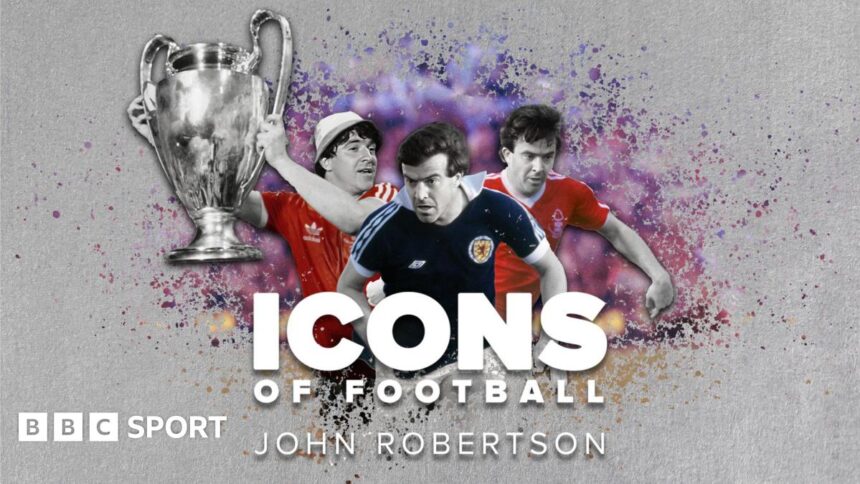
The recent BBC Scotland documentary, Icons of Football, which featured Robertson, serves as a timely tribute, allowing a new generation to discover this most unconventional of legends. Watch Icons of Football with John Robertson on the BBC iPlayer now to hear from those who knew him best and to witness the magic of that left foot.
Conclusion: The Ultimate Footballing Paradox
John Robertson leaves us as the ultimate footballing paradox: the unlikeliest of elite athletes who became a defining figure in European football’s greatest fairy tale. He conquered Europe twice, humbled England at Wembley, and did it all with a style and appearance that belonged to a bygone park pitch. But his talent was timeless. He was the proof that genius does not come in a prescribed package; it can arrive with rolled-down socks, a mischievous grin, and a left foot that could bend the biggest games to its will. The scruffy fat lad wasn’t just part of Clough’s circus; he was the star attraction who delivered when the lights burned brightest. His legacy is a testament to the enduring power of skill, grit, and an unshakeable belief in one’s own unique abilities.
Source: Based on news from BBC Sport.