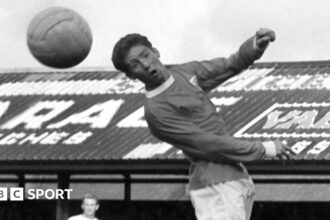
The Unlikely Architect: How John Robertson’s Left Foot Twice Conquered Europe for Nottingham Forest
European football’s pantheon is filled with sculpted athletes, global superstars, and tactical masterminds from storied institutions. And then, there is John Robertson. Not a chiselled Adonis, but a stocky, unassuming winger from Scotland who preferred a pint and a punt to the glamour of the continental elite. His tool was not a diverse array of step-overs or blistering pace, but a wand of a left foot that possessed an almost supernatural sense of weight and direction. In the unlikeliest of footballing fairy tales, it was this foot, guided by the genius of Brian Clough, that twice carved Nottingham Forest’s name onto the European Cup, turning provincial ambition into immortal reality.
The Maestro and His Instrument: Clough’s Trust in a Flawed Genius
To understand Robertson’s monumental achievement, one must first appreciate the context. When Brian Clough and Peter Taylor arrived at a struggling Nottingham Forest in 1975, Robertson was an inconsistent talent, overweight and drifting. Where others saw a problem, Clough saw pure, unrefined potential. He famously told Robertson he was a “fat little bastard” but also that he was the best left-winger in the country. This was the Clough-Robertson dynamic in a nutshell: brutal honesty underpinned by unshakeable belief.
Clough’s system was not complex, but it was devastatingly effective. It was built on a bedrock of defensive solidity, but its creative spark was singular: get the ball to John Robertson’s left foot. From his station on the touchline, Robertson was the team’s chief playmaker. His game intelligence was supreme. He knew when to hug the line and when to drift infield, when to whip a cross early and when to hold possession, drawing defenders before delivering the killing pass.
- Unrivalled Delivery: His crossing, both from open play and set-pieces, was a thing of geometric beauty, consistently finding the space between goalkeeper and defence.
- Deceptive Movement: Lacking speed, he mastered the art of the half-yard—creating separation with body feints and intelligent positioning rather than explosive acceleration.
- Ice-Cold Temperament: In an era of brutal tackling, Robertson retained a preternatural calm, rarely flustered and always focused on the next decisive action.
He was not a traditional flying winger; he was a quarterback in football boots, the strategic pivot upon which Forest’s entire European campaign was balanced.
1979: The First Conquest and a Cross for the Ages
Forest’s first European Cup triumph in 1979, just a year after winning the First Division, defied all logic. Their journey was a testament to Clough’s man-management and a squad performing at its peak. Yet, in the biggest moments, the spotlight invariably found Robertson. The final in Munich’s Olympiastadion against Malmö FF was a tense, scrappy affair. The Swedish champions were well-organised and disciplined, frustrating Forest’s flowing play.
The breakthrough, when it came, was pure Robertson. On 45 minutes, receiving the ball wide left, he didn’t blast past his man. Instead, he used that trademark shuffle inside, buying a fraction of a second. His cross wasn’t hammered; it was curled with exquisite precision between the retreating defender and the hesitant goalkeeper. It was a ball that demanded to be finished, and Trevor Francis, arriving at pace, obliged with a legendary diving header. One moment of supreme quality from Robertson’s left foot had decided a European Cup final. It was the ultimate validation of Clough’s philosophy: trust in talent, and it will deliver.
1980: Defying the Odds and Securing Immortality
Retaining the European Cup is a rarity, a feat that confirms greatness rather than a fortunate run. In 1980, Forest, and Robertson, faced an even sterner test. The final in Madrid was against a true European heavyweight: Hamburg SV, led by the majestic Kevin Keegan. Forest were underdogs, their achievement the previous year now framed as a fluke by many.
This time, the decisive moment came not from a cross, but from a piece of individual audacity that silenced the doubters. Midway through the first half, Robertson picked up the ball on the left, cut inside onto his sacred foot, and faced the Hamburg defence. Instead of looking for a pass, he unleashed a swerving, dipping shot from the edge of the area that arrowed past the legendary goalkeeper Harald ‘Toni’ Schumacher and into the far corner. It was a goal of stunning confidence and technical brilliance, a strike worthy of any final.
Once again, Robertson had provided the singular moment of magic that defined the contest. Forest’s resilient defence, marshalled by the peerless Larry Lloyd and Kenny Burns, held firm, and the European Cup was returning to Nottingham. Robertson had not just participated in two triumphs; he had been the architect of the decisive goal in both finals. This was no supporting actor; this was the leading man in football’s most incredible underdog story.
The Modern Mirror: Robertson’s Legacy in Today’s Game
In an era dominated by data, pressing systems, and multi-functional attacking midfielders, the classic touchline winger like Robertson seems an anachronism. Yet, his legacy is more relevant than ever. He is the ultimate argument for specialisation over systematisation. Coaches today seek players who can perform multiple roles, but Robertson’s career screams the value of mastering one thing so completely that it becomes an unstoppable weapon.
Think of Kevin De Bruyne’s right-footed delivery, or Trent Alexander-Arnold’s passing range from full-back. They are modern iterations of the Robertson principle: a player whose primary skill is so potent it shapes the team’s entire tactical approach. Robertson’s story is also a timeless lesson in man-management. Clough didn’t try to change Robertson’s character; he harnessed it, building a system that maximised his unique talent while mitigating his flaws.
Predicting the next John Robertson is impossible, because his breed is extinct. But predicting the continued need for his type of influence is easy. As football evolves, the teams that succeed will still be those that can unlock a deep-lying defence with a moment of preternatural quality. They will still need a player who, when the system stalls, can produce something from nothing—a perfect cross, a visionary pass, a thunderous strike. They will need, in essence, a player with the heart, the mind, and the left foot of John Robertson.
Conclusion: The Eternal Underdog’s Footprint
John Robertson’s story transcends statistics. It is a narrative of belief, of a perfect synergy between a maverick manager and a unique player. He did not conquer Europe with a superclub’s resources or a nation’s expectations on his shoulders. He did it with Nottingham Forest, a team from a provincial city, by being relentlessly, devastatingly excellent at the one thing he did best. In an age of footballing hyperbole, his achievements stand as a quiet, monumental testament to the power of simplicity and supreme skill. The European Cup is sport’s most demanding club trophy, and John Robertson, the unlikely architect, twice wrote Nottingham Forest’s name on it not with flamboyance, but with the unerring, unforgettable stroke of his left foot.
Source: Based on news from BBC Sport.
Image: CC licensed via www.hippopx.com