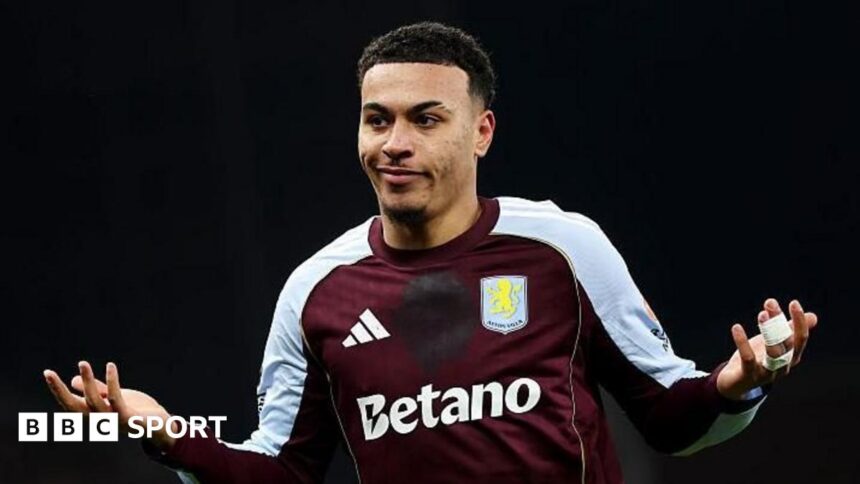
Morgan Rogers: Aston Villa’s Unlikely Architect in a Historic Title Chase
The roar that greeted Morgan Rogers’ second goal against Manchester United was more than just celebration; it was a seismic shift in belief. At Villa Park, where history whispers from the Holte End, a new chapter is being written, not by a marquee signing, but by a 23-year-old once deemed surplus to requirements elsewhere. In a 2-1 victory that extended Aston Villa’s winning run to an astonishing ten matches—their best as a top-flight club since 1914—Rogers didn’t just score twice. He announced himself as the vital, unexpected cog in Unai Emery’s meticulously crafted machine, proving why Villa’s Premier League title aspirations are not a fantasy, but a formidable reality.
From Middlesbrough Misfit to Villa Virtuoso: The Emery Effect
When Villa signed Morgan Rogers from Middlesbrough in January for a modest fee, it raised eyebrows. Here was a player with undeniable physical gifts but raw, unrefined edges. Fast forward four months, and Rogers is the embodiment of Unai Emery’s transformative coaching. The player himself calls his manager a “genius,” a sentiment echoed across the club’s Bodymoor Heath training ground. But this is not blind praise; it’s a recognition of a specific, intelligent process.
Emery hasn’t changed Rogers; he has weaponized him. Deployed in a hybrid role, often starting wide left but drifting infield to become a second striker or a powerful number ten, Rogers is a tactical nightmare. His versatility and tactical intelligence allow him to exploit spaces between midfield and defense, areas where his unique blend of strength, pace, and burgeoning technical skill can do maximum damage. Against United, his movement constantly pulled their backline out of shape, creating chaos for Ollie Watkins to exploit and space for midfield runners.
- Physical Power: Rogers’ frame allows him to hold off defenders and progress the ball in tight areas, a rarity for a player in his positions.
- Intelligent Movement: His understanding of when to drift, when to run in behind, and when to link play shows a footballing maturity beyond his years and experience.
- Clinical Edge: Once questioned, his finishing is now ice-cool, evidenced by his two expertly taken goals against United.
Deconstructing a Statement Performance: Rogers’ Masterclass vs. United
Sunday’s match was more than a win; it was a manifesto delivered by Rogers. His opening goal was a moment of sublime, individual quality—collecting the ball on the left, driving infield with purpose, and unleashing a devastating, curling strike into the far corner. It was the goal of a player operating at the peak of confidence, a spectacular strike that set the tone. His second, a predatory, near-post finish from a Leon Bailey cross, showcased the other side of his game: razor-sharp instincts in the penalty area.
But his contribution ran far deeper than the scoresheet. Rogers was a constant outlet, a ball-progressor, and a defensive asset. He completed dribbles, won duels, and his work rate in Emery’s demanding system was relentless. This performance underlined a crucial point for Villa’s title credentials: their threat is multidimensional. When teams focus on silencing Ollie Watkins or containing Douglas Luiz, Rogers emerges as the devastating unexpected game-winner. In a title race where margins are razor-thin, having such a wildcard is priceless.
Sustaining the Challenge: Can Villa’s Historic Run Power a Title?
A ten-match winning run in the Premier League era is the hallmark of champions. Villa are not just winning; they are dominating periods of games, showing tactical flexibility, and displaying a resilience that was once absent. The best run in over a century is no accident. It is built on Emery’s tactical blueprint, a ferocious team spirit, and the emergence of players like Rogers who have elevated the entire squad’s ceiling.
For Villa to stay the course, two factors will be paramount. First, maintaining the health of key players like Rogers, Watkins, and Emi Martínez is non-negotiable. Their squad, while talented, cannot afford long-term absences to its core. Second, they must continue to treat every match with the same cup-final intensity. The pressure will mount, and the spotlight will burn brighter. However, Emery’s experience in high-stakes environments and the seemingly unshakeable belief within the dressing room are powerful counterweights.
The run-in presents a brutal test, but Villa have already proven they fear no one. Their destiny is in their own hands, and with each passing week, the belief grows from a whisper to a roar.
Conclusion: More Than a Flash, A Foundation for the Future
Aston Villa’s victory over Manchester United was significant not just for the three points, but for its symbolism. It was a victory engineered by the manager’s mind and executed by a player who is his perfect prototype. Morgan Rogers is no longer a prospect; he is a proven Premier League force, a testament to elite coaching and personal dedication. His importance to Villa’s title race challenge cannot be overstated. He provides the unpredictable X-factor that breaks stubborn defenses and wins tight matches.
As the season reaches its crescendo, Villa Park is a fortress of belief. The dream of a first league title since 1981 is alive and pulsating. And at the heart of this historic charge is a young man with a beautiful mind for the game, sculpted by a genius, and now terrifying every defender in his path. The message to the rest of the Premier League is clear: Aston Villa are not just participating in this title race; they are here to win it, and Morgan Rogers is the compelling proof.
Source: Based on news from BBC Sport.