‘Rude, they gave me silver!’: Zoe Atkin’s Hilarious Clash with AI Over Olympic Glory
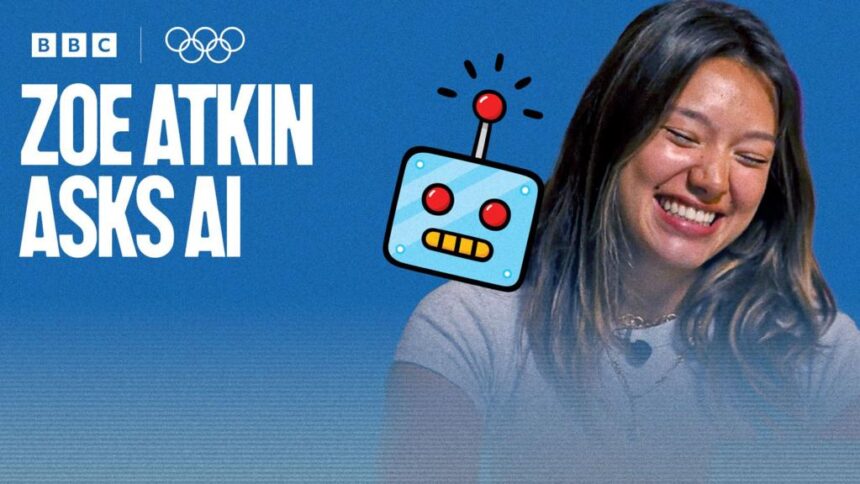
The cold, calculated logic of artificial intelligence has met its match: the fiery, world-beating talent of a British halfpipe skier with a point to prove. As the world turns its gaze towards the snow-capped peaks of Milano Cortina 2026, Team GB’s Zoe Atkin, the reigning halfpipe skiing world champion, has thrown down a playful gauntlet. After being presented with an AI-generated prediction for her Olympic fate, her response was pure, unscripted champion material: “Rude, they gave me silver!” This moment, equal parts humorous and revealing, opens a fascinating window into the mind of an athlete at the peak of her powers, staring down the binary gaze of algorithmic prophecy.
The Algorithm’s Verdict: A Silver Lining or a Sporting Insult?
In the meticulous build-up to the Winter Olympics, athletes are subjected to every form of analysis imaginable—from biomechanical breakdowns to psychological profiling. Now, a new player has entered the arena: the AI sports oracle. For Zoe Atkin, the AI Olympic prediction served up a second-place finish. To the untrained eye, an Olympic silver medal is a monumental, life-defining achievement. To a competitor who has stood atop the world championship podium, it can feel like a slight. Atkin’s reaction wasn’t one of anger, but of a champion’s intrinsic defiance. It highlights the unquantifiable human element that machines struggle to process: the heart, the hunger, and the sheer will to be the absolute best. Where AI sees past data points and statistical trends, Atkin sees a canvas for a gold-medal performance yet to be painted.
Atkin’s Ascent: From PyeongChang Prodigy to Cortina Contender
To understand why settling for silver isn’t in Atkin’s DNA, one must look at her trajectory. Her first Olympic experience at PyeongChang 2018 was as a talented 15-year-old, a glimpse of future potential. The years since have been a masterclass in progression. Her halfpipe skiing world champion title, claimed in 2023, was no fluke; it was the culmination of technical innovation and competitive consistency. Atkin’s skiing is characterized by a unique blend of amplitude, technical difficulty, and stylistic grace. As she heads to Milano Cortina 2026, she does so not as a hopeful, but as a pillar of the sport. Her toolkit for challenging the AI’s prediction is formidable:
- Technical Mastery: Consistently landing complex double cork variations with clean execution.
- Competitive Pedigree: Proven ability to perform under the brightest lights on the World Cup and World Championship stages.
- Experience: The invaluable lessons from her first Olympics, tempering youthful talent with veteran savvy.
- Mindset: The “gold or bust” mentality that separates the great from the legendary.
AI in Sports: A Helpful Tool or a Heartless Harbinger?
The clash between Atkin and the algorithm sparks a broader debate about the role of predictive analytics in winter sports. AI models devour terabytes of data: past results, training footage, weather conditions, and even judging tendencies. They can identify patterns invisible to the human eye. Yet, their predictions come with significant caveats. They cannot measure the adrenaline of an Olympic final, the resilience from overcoming a mid-season injury, or the transformative impact of a perfectly landed new trick in training. They operate in the realm of probability, not possibility. For an athlete like Atkin, these predictions are merely background noise—a digital opinion to be challenged on the snow. The true test will be decided in the halfpipe, not in a data center.
The Road to Milano Cortina 2026: Predictions and Rivalries
So, what does the actual competitive landscape look like for Atkin? The women’s halfpipe skiing field is deeper and more talented than ever. To claim the gold that she feels is her destiny, Atkin will likely have to conquer a familiar cast of rivals, including past Olympic champions and fellow world title holders. The Milano Cortina 2026 Winter Olympics halfpipe will be a battleground of progression. The winning run will almost certainly need to include tricks that are at the very frontier of the sport today. While the AI may have its favorites based on historical data, the next two years of World Cup circuits will be the real crucible where narratives are forged and predictions are rendered obsolete. Atkin’s journey will be one of the most compelling stories to follow, a human narrative of ambition versus automated expectation.
Conclusion: The Human Spirit vs. The Machine
Zoe Atkin’s mock-offended retort, “Rude, they gave me silver!” is more than a soundbite. It is a manifesto. It is the declaration of an athlete who understands that while data can inform, it must never define. As the BBC’s coverage of Milano Cortina 2026 begins on Friday, 6 February, viewers won’t just be watching a ski competition; they’ll be witnessing a profound chapter in the evolving relationship between human endeavor and artificial intelligence. The algorithms have had their say. Now, it’s Zoe Atkin’s turn to respond. And if history is any guide, when a world champion is told what color medal she’s destined for, she’ll do everything in her power to prove the machine gloriously, spectacularly wrong. The final judgment won’t come from a server, but from the Olympic judges, and it will be earned, one breathtaking aerial at a time.
Source: Based on news from BBC Sport.