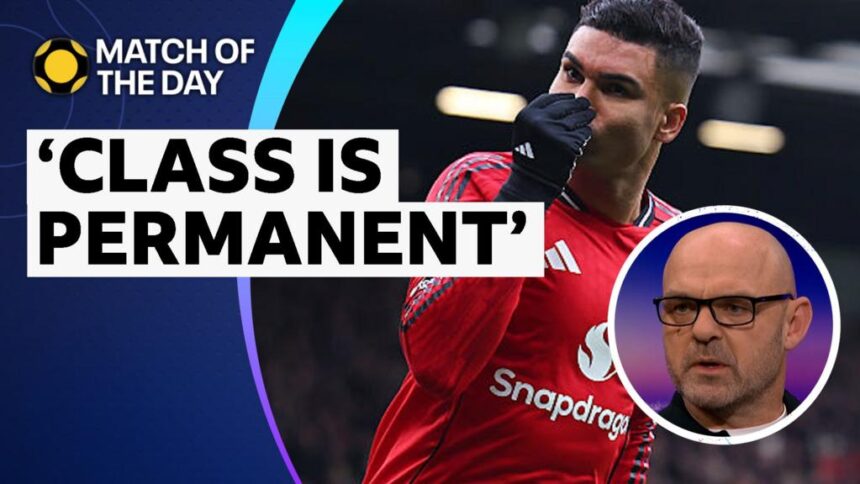
Will Manchester United Miss Casemiro’s Calming Influence?
The final whistle at Craven Cottage had blown, the three points were secured, but the narrative had already shifted. In the aftermath of Manchester United’s dramatic 3-2 victory over Fulham, the discourse wasn’t solely about a vital win. Instead, the spotlight turned to a departing legend, with Match of the Day pundits Danny Murphy and Troy Deeney dissecting a pressing question now echoing across the Stretford End: Will Manchester United desperately miss Casemiro? The Brazilian’s masterful, controlling performance in what appears to be his final act for the club served as a potent reminder of his unique qualities, leaving fans and analysts to ponder the looming void in the heart of midfield.
A Farewell Masterclass in Game Management
Casemiro’s performance against Fulham was a textbook demonstration of the subtle arts that define elite defensive midfielders. On the scoresheet with a crucial goal, his true impact was woven into the fabric of the match’s tempo. As Fulham pressed and United’s lead looked perpetually fragile, Casemiro was the metronome. He consistently provided an outlet, broke lines with intelligent forward passing, and, most importantly, made the correct decision under pressure time and again.
This “intelligence and calmness,” as highlighted by the pundits, is a non-negotiable asset in high-stakes matches. It’s the antithesis of panic. Where younger players might rush, Casemiro slows the game to his pace. Where others might launch a hopeful ball, he chooses a penetrative pass. This was not just about tackles and interceptions—though those were present—but about psychological control of a football match. He provided the stability that allowed United’s more attacking players the freedom to express themselves, knowing a world-class safety net was in place.
The Incoming Void: More Than Just a Position
Replacing Casemiro is not a simple like-for-like transaction. His departure leaves a multidimensional hole that transcends the “number six” role on a team sheet. United must now contend with the loss of several irreplaceable assets simultaneously:
- Trophy-Winning Pedigree: Five Champions League medals. Casemiro operated with a baseline expectation of success forged at Real Madrid. That mentality is contagious and vital in a rebuilding squad.
- Big-Moment Experience: His game intelligence shines brightest when the pressure is at its peak. He knows when to commit a tactical foul, when to hold position, and when to drive forward—decisions born from thousands of elite minutes.
- Leadership and Standards: While not the captain, he was a de facto leader on the pitch, organizing, demanding, and setting a professional standard in training and matches.
- Defensive Positioning: His ability to read the game and snuff out danger before it fully materializes is a pre-emptive defensive tool that United’s other midfield options lack.
Without him, the burden on the back four increases exponentially. The centre-backs will receive the ball in more pressured situations, and the attacking transition will lack that first, incisive pass from deep that turns defence into attack in an instant.
The Candidates to Fill the Casemiro-Shaped Hole
Erik ten Hag now faces his most significant midfield puzzle. The options within the current squad present a series of compromises, each with a notable trade-off against what Casemiro provided.
Kobbie Mainoo is the shining light, possessing composure and technical quality beyond his years. However, asking an 18-year-old—however talented—to shoulder the sole defensive midfield responsibility week-in, week-out is a monumental risk. His development is best served with protection, not by being thrown into the deepest fire.
Christian Eriksen offers the passing range and calmness but lacks the physicality and defensive ground coverage required for a lone pivot in a top Premier League side. Scott McTominay provides goal threat and engine room energy, but his game lacks the positional discipline and distributive control Casemiro exemplifies. This internal audit makes it clear: the transfer market is not an option but a necessity to properly address this deficit.
The Verdict: A Resounding Yes, But With a Caveat
So, will Manchester United miss Casemiro? The evidence points to a definitive yes. His Fulham swansong was a timely, almost cruel, reminder of the serene control he can impose. In the immediate term, his absence will be felt in games where game management is paramount—seeing out narrow leads, navigating frantic away fixtures, and providing a platform in major cup ties. There will be moments this season where United look disjointed in midfield, overrun in transitions, and lacking a cool head, and the ghost of Casemiro’s calming presence will haunt those performances.
However, football is a sport of cycles and evolution. Casemiro’s wages, age profile, and the need to reshape the squad for a new era made his departure inevitable. The question transforms from “Will they miss him?” to “How effectively and quickly can they evolve beyond him?“
The long-term success of this transition hinges on two critical factors: a strategic, successful signing of a younger, dynamic holding midfielder who can be a cornerstone for the next five years, and the careful management of Kobbie Mainoo’s integration. The future can be bright, but the present will involve growing pains.
Conclusion: An Era Ends, A New Challenge Begins
Casemiro’s two-season stint at Manchester United was a paradox—a period of individual brilliance that often highlighted systemic flaws. His farewell performance was a perfect microcosm: a display of sheer class that simultaneously underscored why the club must move on and the scale of the challenge in doing so. The intelligence and calmness praised by Murphy and Deeney are not easily replicated. They are the product of a career at the very pinnacle of the sport.
United will miss Casemiro. They will miss his aura, his big-game nous, and his ability to simplify the complex chaos of a football match. But his departure is also an opportunity—a forcing function to modernize the midfield and build a new, sustainable identity. The victory over Fulham, inspired by the Brazilian, was a fitting end to his chapter. Now, the hard work of writing the next one, without its recently departed protagonist, truly begins. The success of Erik ten Hag’s project may well depend on how swiftly the club finds an answer to the question his best player just posed on his way out the door.
Source: Based on news from BBC Sport.