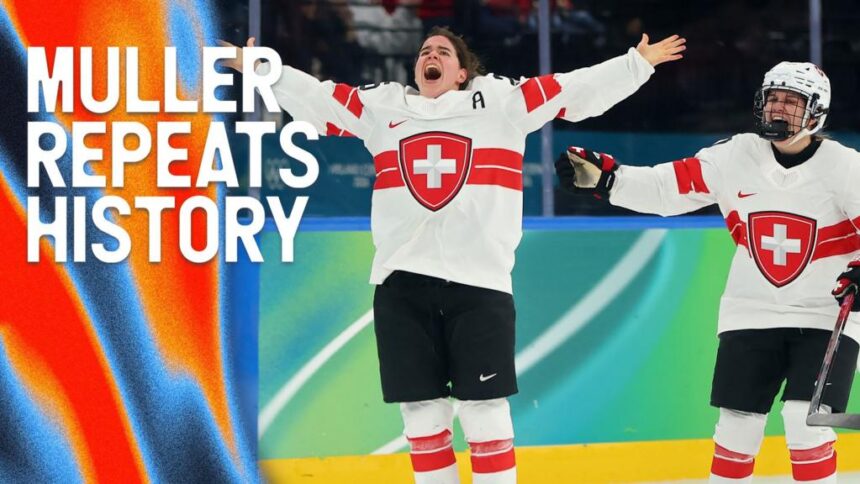
Deja Vu in Gold: Alina Müller’s Historic Double Bronze Cements Olympic Legacy
The rarest moments in sports are not always those of first-time triumph. Sometimes, they are echoes—powerful, resonant, and impossibly poetic repetitions of history that defy the relentless march of time. In the cauldron of Olympic pressure, where narratives are written and rewritten in an instant, Swiss ice hockey star Alina Müller authored a chapter for the ages. Twelve years after her childhood miracle, she did it again. Facing the same opponent, for the same medal, with the same ice in her veins, Müller scored an overtime winner to lift Switzerland to a 2-1 victory over Sweden, claiming bronze at the 2026 Winter Olympics. It was a moment of stunning symmetry, a career-spanning bookend that transforms a prodigy into a legend.
From Prodigy to Pioneer: The Sochi Spark
To understand the magnitude of the 2026 moment, one must rewind to Sochi 2014. The hockey world was introduced to a 15-year-old phenom named Alina Müller. She wasn’t just on the roster; she was a vital force. In the bronze medal game against Sweden, with the score tied 3-3 in overtime, the teenager found the puck on her stick. With a sniper’s calm, she unleashed the shot that would make history, securing Switzerland’s first-ever Olympic medal in women’s ice hockey. It was a Cinderella story, a glimpse of a dazzling future. Müller became the youngest player to score in an Olympic women’s hockey final, a record that stands. That goal wasn’t just a game-winner; it was the foundation stone upon which Swiss women’s hockey was built, inspiring a generation and announcing a new European power.
The 2026 Replay: Experience Meets Destiny
Fast forward to the 2026 Games. Müller, now a 27-year-old veteran and world-class star, had carried the hopes of her nation through multiple world championships and the heartbreak of PyeongChang 2018. The stage was set: Switzerland vs. Sweden, once again, with bronze on the line. The game was a tense, defensive masterpiece, tied 1-1 through regulation. As overtime began, the ghost of Sochi lingered in the air. Then, it happened. A broken play, a scramble in front, and there was Müller, positioned with the savvy of a player who had lived this exact dream. She buried her chance. The eruption from the Swiss bench was not just joy, but disbelief laced with profound respect. The same scorer. The same opponent. The same medal.
This goal, however, was different. It was not the spark of discovery, but the flame of sustained excellence. Key factors in this historic repeat include:
- Unflappable Clutch Gene: Müller possesses a rare psychological makeup for the biggest moments, a trait evident at 15 and refined at 27.
- Tactical Evolution: Her game grew from pure offensive talent to a complete, two-way force, making her impactful even when not scoring.
- Leadership Role: In 2026, she was the undisputed leader, shouldering the expectation and guiding a new wave of Swiss talent.
- Historic Olympic Symmetry: The repeat achievement is unprecedented in hockey, placing her in a unique pantheon of Olympic athletes.
Analysis: Cementing a Legacy Beyond the Medal
From an expert perspective, Alina Müller’s double bronze achievement transcends the hardware. It represents the complete arc of an athlete’s journey and the growth of an entire sport. In 2014, she was the thrilling exception. In 2026, she is the cornerstone. Her career bridges two eras for Swiss hockey: from plucky underdog to consistent podium threat. This victory solidifies Switzerland’s status as a permanent fixture in the women’s hockey elite, a status unimaginable before that first goal in Sochi.
Furthermore, the narrative deeply impacts the women’s game globally. It provides a powerful story of longevity and legacy outside the traditional North American rivalry. It shows young players worldwide that an Olympic moment can be more than a one-time peak; it can be a promise fulfilled years later. Müller’s story is one of remarkable consistency and mental fortitude, proving that the pressure of replicating past glory can be harnessed as fuel.
The Future: What’s Next for Müller and Swiss Hockey?
With this historic chapter closed, the question turns to the future. For Alina Müller, her legacy is secure as the greatest Swiss women’s hockey player of all time. Her focus will likely shift to the one prize that has eluded her: an Olympic or World Championship gold. Switzerland, with Müller as its veteran leader, is closer than ever. The 2030 Winter Olympics could see her chasing a third, different-colored medal, an astonishing quest for a player whose career is already defined by historic symmetry.
Predictions for the landscape post-2026:
- Swiss Program Stability: This bronze will ensure continued investment and inspire the next “Alina Müller,” creating a virtuous cycle of success.
- European Ascent: Alongside other improving nations, Switzerland’s success puts increasing pressure on the North American duopoly, promising more competitive Olympic tournaments.
- Müller’s Lasting Impact: Her story will be a cornerstone of Olympic lore, used for decades to illustrate poise, longevity, and the magical, repetitive possibilities of sport.
Conclusion: An Echo That Became a Roar
Alina Müller’s overtime winner in 2026 was more than a goal. It was a perfect echo, a circle closed, a promise kept. From the wide-eyed 15-year-old in Sochi to the composed legend over a decade later, she authored one of the most uniquely beautiful stories in Olympic history. She didn’t just win two bronze medals; she connected them across twelve years with a thread of unwavering excellence and icy calm. In a sports world often obsessed with “firsts,” Müller’s “second” stands as a towering testament to durability, destiny, and the incredible fact that sometimes, history doesn’t just rhyme—it repeats, down to the finest, most glorious detail. Her legacy is now bronze, twice forged, forever shining.
Source: Based on news from BBC Sport.