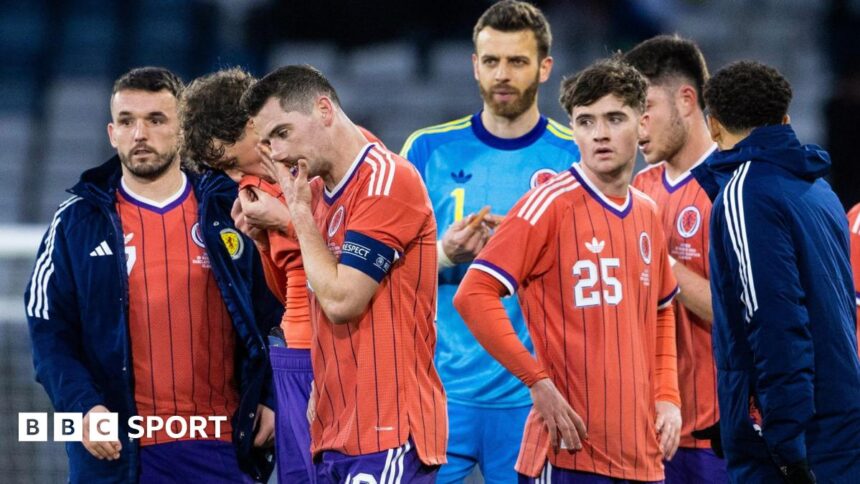
Scotland’s Hampden Warriors Retreat Into Their Shell in Japan Stalemate
The ghosts of Hampden Park are a demanding lot. They feed on chaos, on thunderous noise, on moments of unscripted brilliance that sear themselves into a nation’s memory. They are the echoes of Denis Law’s impudent backheel, the shimmering after-image of Archie Gemmill’s slaloming wonder, the primal roar that greeted James McFadden’s Parisian missile. On a quiet Friday night in Glasgow, those ghosts were left hungry, as Scotland’s warriors, so recently heroic, returned to their reserved selves in a subdued 0-0 draw with Japan.
The Hampden Paradox: From Copenhagen Ecstasy to Glasgow Ennui
To understand the flatness, you must first recall the zenith. Last November in Copenhagen, Scotland played with a swagger that felt revolutionary. Against a talented Denmark side, they were fearless, tactically astute, and clinical—a complete performance that secured Euro 2024 qualification in the most stylish manner imaginable. It was a benchmark, a promise of a new, assertive Scotland.
The return to a half-full Hampden for this friendly fixture was always going to struggle to match that voltage. Yet, the drop-off was stark. The creative spark that illuminated Denmark was absent. The midfield, usually so fluent, was functional. The attacking trio, Scotland’s celebrated “go-to men,” were peripheral, playing within themselves. This wasn’t a regression to the bad old days, but a puzzling step back into a familiar caution. The warrior spirit was sheathed, replaced by a polite, almost studious, approach.
As BBC Scotland currently runs a vote for the nation’s most iconic goal—pitting legends like Law and Dalglish against modern heroes like McFadden and McTominay—this match offered no new contender. No bicycle kick from the gods, no stunner from the halfway line. Not even a scruffy, deflected effort to debate. On a night crying out for a moment of ignition, the flint remained stubbornly dry.
Analysing the Flatline: Where Did the Intensity Go?
Several factors contributed to the performance lethargy. Friendlies, particularly at the end of a long season, are notorious for their lack of edge. For Japan, this was a crucial warm-up for major tournaments; for Scotland, with their Euros place secure, it carried less tangible weight. This disparity in urgency was palpable.
More concerning was the timidity among the established core. Key players who define Scotland’s intensity were noticeably subdued:
- Midfield Muted: The engine room lacked its usual ferocious press, allowing Japan comfortable possession in deep areas.
- Attack Isolated: The link between midfield and attack was sluggish, leaving forwards to feed on scraps and hopeful balls.
- Safe Passing: A preference for risk-averse, sideways distribution stifled any momentum, a stark contrast to the vertical, incisive play witnessed in qualifying.
This was not a tactical failure by Steve Clarke, but an apparent inability from the players to self-generate the emotional intensity that has become their trademark. They were, in a word, reserved. The Hampden crowd, often a ferocious 12th man, had little to rally behind, and a quiet, expectant atmosphere settled in, further dampening the spectacle.
Glimmers in the Gloom: Curtis and Conway Offer Hope
If the result and overall performance were forgettable, the night was not without its meaningful milestones. In the absence of roaring goals, personal moments provided the warmth.
The debut of Findlay Curtis was a bright spot. The young defender’s introduction was a nod to the future, and he looked composed and assured in his brief cameo. His inclusion signals a healthy look towards depth building ahead of the Euros.
More significantly, striker Tommy Conway earned his first start. The Middlesbrough forward, who has been prolific in the English Championship, led the line with intelligent movement and a commendable work rate. While service to him was limited, his mere presence from the start is a positive development. Scotland’s historical Achilles’ heel has been a reliable number nine. Conway’s emergence and integration offer a potential new solution, a fresh option beyond the established order. His development at club level will be one of the most intriguing subplots for Scotland heading to Germany.
The Road to Germany: Reading Between the Lines of a Friendly
So, what does this 0-0 draw truly tell us about Scotland’s Euro 2024 prospects? The expert view must be one of context. Friendly matches are diagnostic tools, not definitive judgments. This was a check-up, not the final exam.
The primary concern raised is one of mentality and consistency. Can this squad, so brilliant at summoning its best for competitive fixtures, develop a more ruthless, professional approach to every outing? The biggest challenge for Steve Clarke is not tactical, but psychological: instilling the belief that every time they wear the dark blue, they must be the aggressors, the protagonists, regardless of the occasion.
Predictions for the Euros must therefore be tempered but not downgraded. This performance is a reminder that the heights of Copenhagen are a standard, not a guarantee. Scotland’s success in Germany will hinge on:
- Rediscovering their defensive compactness and aggressive press from the first whistle.
- Unleashing their creative players (McGinn, McTominay) with greater freedom and intent.
- Integrating promising talents like Conway to provide a different attacking dimension.
Conclusion: A Wake-Up Call, Not a Setback
The final whistle at Hampden brought a sense of anti-climax, a feeling of opportunity missed to build momentum and connection with the fans. The warriors who conquered Denmark were, for one night, reserved. Yet, in the grand narrative, this may prove a valuable, if dull, chapter.
It serves as a potent reminder that legacy is not built in friendly matches in June. It is forged in the crucible of tournaments. The iconic goals being voted on by fans—from Law to McFadden—were almost all scored when it mattered most. Scotland’s current squad has already written one glorious qualifying chapter. The Japan game was a footnote, a pause.
The true test, and the chance to create new immortality, awaits in Germany. The hope must be that this quiet night at Hampden was merely the deep breath before the roar.
Source: Based on news from BBC Sport.