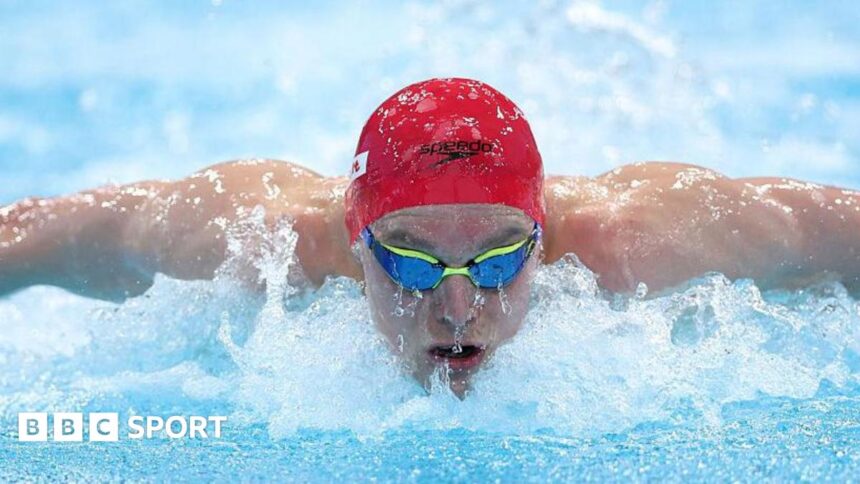
Duncan Scott Powers to Commanding 200m Medley Victory, Staking Paris Claim in London
The roar that greeted Duncan Scott’s final, furious freestyle surge at the London Aquatics Centre was more than just applause for a national championship win. It was a resonant acknowledgement of a champion reasserting his dominance. At the Aquatics GB Swimming Championships, Scott, the double Olympic champion, delivered a masterclass in the men’s 200m individual medley, winning in 1:56.08 and sending a crystal-clear message to his rivals just months before the Paris Olympics.
A Statement Swim: Scott’s London Masterclass
From the moment he launched off the blocks, Scott’s intent was palpable. His butterfly leg was strong and controlled, conserving energy without conceding ground. On the backstroke, he began to edge ahead, his technical precision turning the water into a propulsive highway. But it was on the breaststroke leg—often considered the make-or-break discipline in the medley—where Scott truly flexed his evolved prowess. Once a segment where he might merely hold on, he now powered through it, building a decisive lead.
By the time he pivoted into his signature freestyle, the race was effectively over. Scott’s closing 50 meters was a study in controlled power, churning through the water to touch in 1:56.08. He comfortably saw off the challenge of Evan Jones in second, with seasoned medley specialist Max Litchfield taking bronze. The time, while not a personal best, was a supremely confident season-opener, effortlessly securing his qualification for the European Aquatics Championships and, more importantly, solidifying his Olympic berth.
“It was pretty good, I think,” Scott remarked with characteristic understatement. For those watching, it was a performance that screamed far more than that. It was the swim of a man who has transformed the agony of consecutive Olympic silver medals in this event into a refined, relentless fuel.
Chasing History: The Path to Becoming Britain’s Greatest Olympian
This victory in London carries a significance that transcends the current Olympic cycle. With this win, Duncan Scott isn’t just building momentum for Paris; he is steadily climbing the pantheon of British Olympic greatness. The staggering fact is now well-known: Duncan Scott is tied with Sir Bradley Wiggins as the second most-decorated Olympian in British history, each possessing eight Olympic medals.
This shared podium sits just one step below the legendary cyclist, Sir Jason Kenny, who has nine. Scott’s haul—a gold from the 4x200m freestyle in Tokyo, three silvers, and four bronzes—is a testament to his staggering versatility and consistency across individual and relay events. Every race in Paris now carries the weight of potential history. A single medal of any color would see him draw level with Kenny; two would see him stand alone.
This historical context adds a fascinating layer to every stroke he takes. The 200m IM, in particular, represents unfinished business. Silver in Rio behind Michael Phelps, and silver again in Tokyo behind China’s Wang Shun, have left a palpable void in his individual Olympic resume. His London performance suggests he is crafting the perfect response.
Expert Analysis: The Evolution of a Medley Maestro
Scott’s development in the individual medley is a case study in athletic evolution. Earlier in his career, he was predominantly a freestyle force, with the medley as a demanding side project. Today, he is a complete medley threat. Analysts point to key improvements:
- Breaststroke Transformation: This was once a relative weakness. Now, through dedicated technical work, it has become a weapon he uses to break races open, as seen in London.
- Race Intelligence: Scott swims with a economist’s mind. He manages his energy distribution across all four strokes with cold efficiency, ensuring he has a devastating freestyle kick in reserve.
- Mental Fortitude: The experience of two Olympic near-misses has forged a competitor who understands pressure not as a burden, but as a catalyst. His calm demeanor belies a fierce competitive engine.
His main rivals for Paris—like the reigning champion Wang Shun, Japan’s Daiya Seto, and the USA’s Carson Foster—will have watched this swim closely. Scott’s time, while impressive, is still some way off his own British record and the world’s best. This suggests a carefully managed peak, with significant reserves of speed and endurance being honed for the exact moment they are needed most: the Olympic final in Paris.
Paris 2024: Predictions for the Olympic Showdown
The road from London to Paris is now clearly paved. Scott’s commanding win at the Aquatics GB Championships was the first and most critical step, proving his form and fitness. The upcoming European Championships will serve as a vital tactical dress rehearsal against continental competition.
For Paris, the predictions are inevitably bold. Scott enters as a co-favorite in a stacked 200m IM field. The event is arguably more open than in previous cycles, with no single dominant figure like Phelps. This parity plays to the strengths of a consistent, big-race performer like Scott.
We predict a monumental showdown in the Paris final. The narrative is almost too compelling: Britain’s most versatile swimmer, on the cusp of becoming its most decorated Olympian, seeking to finally convert Olympic silver into gold in his most poignant event. His performance in London demonstrated he has the race model, the technical skill, and the championship temperament to do it. The final piece will be the unforgiving taper and the unique adrenaline of the Olympic stage.
Conclusion: A Champion Poised for Destiny
Duncan Scott’s powerful medley win in London was far more than a routine qualification. It was the emphatic opening statement of an athlete entering his prime, acutely aware of the history within his grasp and fiercely motivated by past disappointments. He has systematically addressed the gaps in his medley arsenal, transforming himself into the complete package.
As the swimming world turns its gaze towards Paris, Scott finds himself in a rare and powerful position: chasing both personal redemption and national sporting immortality in the same lap. If his London display is a true indicator of his trajectory, then the waters of Paris may well witness the coronation of Britain’s greatest Olympian, finally crowned with that elusive individual gold. The chase is on, and Duncan Scott has never looked more powerful.
Source: Based on news from BBC Sport.