DK Metcalf Suspended: The NFL’s Unyielding Line Between Player and Fan
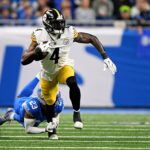
The NFL regular season for star wide receiver DK Metcalf is over. In a decision that underscores the league’s zero-tolerance policy regarding player-fan interaction, the NFL has suspended the Pittsburgh Steelers’ offensive weapon for two games following a physical altercation with a Detroit Lions fan. The incident, which occurred during the Steelers’ controversial Week 16 win, has ignited a firestorm of debate, pitting the league’s strict crowd-control mandates against the often-unseen provocation athletes face. While the suspension itself is clear-cut, the murky details and troubling context surrounding the confrontation reveal a far more complex and troubling story.
The Incident: A Camera Angle and a League Mandate
The initial CBS broadcast footage from Ford Field was jarring. It appeared to show DK Metcalf, after a heated on-field exchange with Lions defenders, suddenly lunging into the front row and throwing a punch at a fan. The visual alone was enough to trigger immediate condemnation. However, an alternate angle later surfaced, providing critical context. The video showed Metcalf grabbing the fan, later identified as Ryan Kennedy, by the shirt and pulling him forward, not throwing a punch. This distinction, however, proved immaterial to the NFL’s disciplinary process.
The league’s press release was unequivocal. It stated: “players may not enter the stands or otherwise confront fans at any time on game day.” The policy further clarifies that any “unnecessary physical contact with a fan” that presents crowd-control or injury risks will be met with accountability. For the NFL, the act of crossing that physical boundary—regardless of the degree of force or the provocation—is the violation. The suspension is not for *what* was done, but for the fact it was done at all. This absolutist stance is the league’s primary tool in maintaining the sacred, if sometimes tense, separation between the field of play and the paying public.
The Unseen Provocation: Allegations Beyond the Broadcast
While the NFL’s ruling is based on observable action, the catalyst for Metcalf’s reaction exists in the realm of reported verbal exchange. Metcalf himself has remained silent with the media, but significant figures have relayed his account. Former NFL star Chad Johnson stated on his Nightcap podcast that Metcalf told him the fan, Kennedy, used a racial slur and insulted his mother with derogatory language. NFL Network’s Tom Pelissero corroborated this, adding a crucial, damning piece of history: Metcalf had reportedly reported the same fan to stadium security for similar behavior last season when he played for the Seattle Seahawks.
Ryan Kennedy’s version, given to the Detroit Free Press, notably avoids denying any specific verbal taunts. He admitted to calling Metcalf by his full name—”DeKaylin Zecharius Metcalf”—and stated, “My words don’t matter because it was on camera.” The Lions organization, for its part, did not eject Kennedy from the stadium. This disparity in consequences—a two-game suspension for the player and no immediate ejection for the fan—lies at the heart of the controversy. It raises urgent questions about the enforcement of the Fan Code of Conduct and the mechanisms in place to protect players from what they allege to be hate speech and personal attacks.
- Player’s Allegation: Racial slur and derogatory comments about his mother; history with the same fan.
- Fan’s Statement: Acknowledged using Metcalf’s full name; deflected from the content of his words.
- Team Action: Lions did not eject the fan during or after the incident.
- League Priority: Action (physical contact) punished definitively; speech investigation less transparent.
Expert Analysis: The NFL’s Impossible Position and Its Ripple Effects
From a league operations standpoint, the suspension is a necessary, if cold, application of the rules. The NFL cannot, under any circumstances, be seen to condone players physically engaging with spectators. The potential for escalation, liability, and a breakdown of stadium security is too great. The policy is designed to be black-and-white to remove ambiguity in enforcement.
However, sports psychologists and veteran analysts point to the unsustainable pressure this creates. “You’re telling a hyper-competitive athlete in an emotionally charged, physically violent environment to be a passive receptacle for anything thrown at them from a protected space,” notes one former player turned analyst. “The league’s stance is legally prudent, but it psychologically ignores the human element.” The revelation that Metcalf had previously flagged this fan is particularly damaging. It suggests a systemic failure in the security apparatus meant to de-escalate such situations before they reach a boiling point.
For the Pittsburgh Steelers, the suspension is a significant blow to their faint playoff hopes. Metcalf, acquired to be a game-changing threat, was just finding his rhythm in the offense. His absence in two critical games removes their most dynamic perimeter weapon and makes an already struggling unit more predictable. The suspension also effectively ends Metcalf’s first regular season in Pittsburgh not with a stat line, but with a disciplinary footnote.
Predictions and Lasting Implications
Looking ahead, we can anticipate several outcomes from this incident. First, Metcalf’s appeal is unlikely to succeed. The NFL’s policy is too clearly defined, and the visual evidence of contact, however clarified, meets the threshold for violation. The league may acknowledge the provocation in its ruling but will stand firm on the suspension to deter future incidents.
Second, this event will likely accelerate behind-the-scenes discussions about enhancing stadium security protocols for player protection. This could include:
- Increased monitoring of known agitators in front-row seats.
- Quicker ejection powers for security based on player complaints.
- Enhanced audio monitoring technology in field-level seating areas.
Finally, the court of public opinion will remain divided. Some will see Metcalf as a professional who lost his composure and must face the consequences. Others will view him as a man repeatedly subjected to vile abuse who finally reacted, only to be punished by a system that failed to protect him. This divide highlights the core tension: the NFL’s need for absolute control over player conduct versus its moral and practical responsibility to ensure a minimally toxic environment for its employees.
Conclusion: A Line in the Turf That Needs Redrawing
The suspension of DK Metcalf is a definitive statement from the NFL: the line between player and fan is inviolable. The league has upheld its rule with decisive action. Yet, in doing so, it has exposed a glaring flaw in its own ecosystem. Punishing the physical reaction without a transparent, equally rigorous process for addressing the alleged cause—especially with a documented history—feels like addressing a symptom while ignoring the disease.
This incident is more than a two-game suspension. It is a case study in the modern athlete-fan dynamic, where social media bravado spills into stadiums and hate speech can be hurled from inches away. The NFL has successfully drawn its line in the turf regarding physical contact. The harder, and now unavoidable, task is to clearly define and enforce the boundaries of acceptable fan behavior with the same unwavering commitment. Until it does, players like DK Metcalf will be left in an impossible position, bearing the full weight of a system’s failure the moment their composure finally breaks.
Source: Based on news from Yahoo Sports.