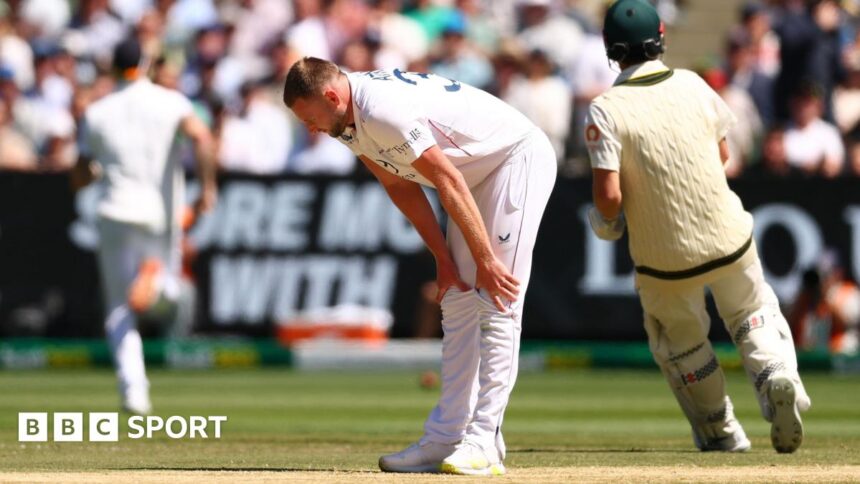
Seamer Gus Atkinson’s Hamstring Injury Deals ‘Serious Blow’ to England’s Ashes Hopes
The relentless physical toll of a modern Ashes series has claimed another victim. On the second morning of the pivotal fourth Test at the Melbourne Cricket Ground, England’s pace attack was dealt a potentially devastating setback as emerging seamer Gus Atkinson pulled up with a left hamstring injury. The sight of the 27-year-old leaving the field for assessment after just four overs cast a long shadow over England’s efforts to claw their way back into the series, adding a fresh layer of crisis to a tour already riddled with fitness concerns. This is more than a minor hiccup; it is a body blow that threatens to unravel England’s strategic plans and deplete their fighting resources at a critical juncture.
The Moment of Concern: A Series Hangs in the Balance
The incident occurred with ominous simplicity. After delivering the final ball of his fourth over, Atkinson, who had been generating decent pace and probing the Australian batters, immediately clutched the back of his left leg. His expression, a mix of pain and frustration, told the story before any official announcement was made. After a brief on-field conversation with captain Joe Root and the team medic, the Surrey paceman trudged slowly from the hallowed MCG turf. The England camp later described the issue as “soreness,” a deliberately cautious term that belies the potential severity of a soft-tissue injury for a fast bowler. The decision to take him off for assessment “over the next few hours” underscores the anxiety now gripping the touring party.
This development is a cruel twist for Atkinson, whose inclusion in this Test was seen as a proactive move to inject fresh energy into a weary bowling unit. His injury compounds an existing injury crisis that has seen England lose the services of Jofra Archer, Olly Stone, and Ben Stokes (as a bowler) for the entire series, while Stuart Broad and Mark Wood have been managed with extreme care. The depth of England’s pace reserves is now being tested to its absolute limit.
Expert Analysis: The Domino Effect of a Bowling Injury
From a tactical perspective, Atkinson’s departure fundamentally alters England’s approach for the remainder of this Test and potentially the series. His injury creates a domino effect that impacts multiple areas:
- Increased Workload for Key Bowlers: The immediate burden falls squarely on the shoulders of James Anderson, Ollie Robinson, and the lone remaining express option, Mark Wood. With a five-match series condensed into a short timeframe, the cumulative overs are taking a physical toll. Forcing this trio to bowl more spells risks their own fitness and reduces their potency.
- Strategic Imbalance: England selected Atkinson as a point of difference—a bowler capable of unsettling batters with pace from a relatively unfamiliar angle. Without him, the attack becomes more one-dimensional, allowing Australian batters like Marnus Labuschagne and Steve Smith to settle into familiar rhythms against less varied offerings.
- Captaincy Conundrum for Joe Root: Root’s already difficult task of managing his resources becomes a nightmare. He must now juggle his remaining frontliners without the luxury of a reliable fourth seamer to provide control or breakthrough overs. This could lead to defensive field settings and longer, more draining spells for his key men.
“This is the worst possible scenario for England,” remarked former Australian fast bowler Glenn McGrath in a commentary stint. “You build your attack around certain roles, and when one piece is ripped out so early in a must-perform Test, the whole structure becomes unstable. Root’s hand has been severely weakened.”
Predictions: Navigating the Immediate and Long-Term Fallout
The immediate future hinges on the results of Atkinson’s assessment. The spectrum of outcomes ranges from optimistic to catastrophic for England’s Ashes campaign.
Best-Case Scenario: The “soreness” is deemed minor, a tightness rather than a tear. Atkinson could potentially return to the field later in the match, albeit with his output severely limited. England would use him sparingly, but even a few overs of relief could be valuable. His participation in the crucial fifth Test in Hobart would likely be managed but possible.
Worst-Case Scenario: A confirmed hamstring strain, even a grade one, would almost certainly rule Atkinson out for the remainder of the series. The recovery timeline for a fast bowler is measured in weeks, not days. This would force England to look to their bench, where options like Craig Overton or the uncapped Saqib Mahmood wait. It would represent a definitive end to Atkinson’s first Ashes tour.
The Broader Series Impact: Beyond Melbourne, this injury intensifies the scrutiny on England’s much-discussed schedule and player management. The relentless cycle of international cricket, franchise leagues, and biosecure bubbles is being cited as a contributing factor to this epidemic of injuries. If England lose this Test and surrender the Ashes, the post-mortem will focus heavily on the physical preparedness and preservation of their premium fast-bowling assets.
A Test of Resilience and Resourcefulness
In adversity, character is revealed. England’s challenge is now twofold: they must find a way to compete in this Test with a hobbled attack, and they must plan for a future in this series without a key weapon. It will require exceptional skill from Anderson and Robinson, heroic efforts from Wood, and clever contributions from the spin of Jack Leach. More than ever, England’s batters must shoulder the responsibility by building monumental totals to give their bowlers something to defend and, crucially, time to rest.
The Melbourne Cricket Ground, a colosseum of sporting drama, has witnessed another pivotal moment in Ashes history. While the roar of the crowd may be for Australian boundaries, the quiet concern in the England dressing room is palpable. Gus Atkinson’s hamstring is more than a muscle; it has become the latest focal point in a series defined by physical attrition. England’s hopes of retaining the Ashes now depend not only on skill and heart but on the fragile biology of their remaining bowlers. How they respond to this “serious blow” will define their legacy from this tour—one of resilient fightback or tragic collapse under the weight of an ever-mounting injury list.
Source: Based on news from BBC Sport.