Senegal’s Defiant Display: Parading a Trophy, Challenging a Verdict
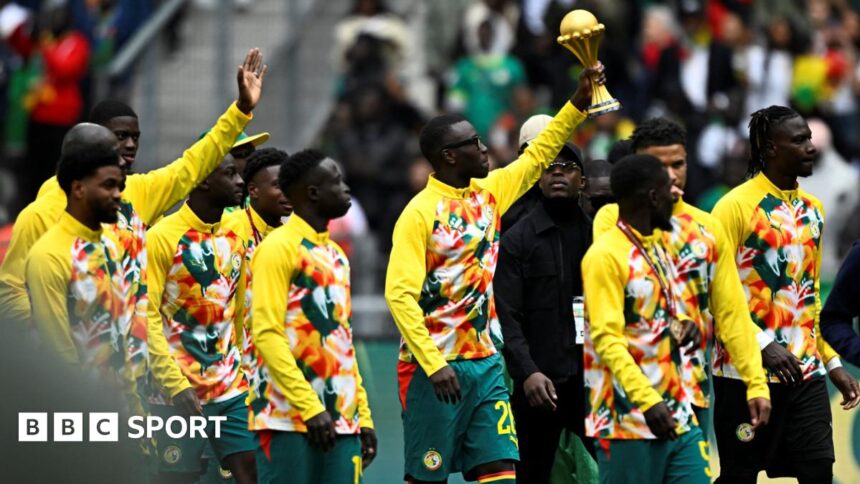
The air at the Stade de France crackled with defiance, not just friendly anticipation. This past Saturday, as Senegal prepared to face Peru, the world witnessed a stunning act of sporting protest. The Lions of Teranga took to the pitch for their warm-up, but they were not alone. Cradled in the hands of captain Kalidou Koulibaly, glinting under the Parisian lights, was the Africa Cup of Nations trophy. This was no celebratory relic from 2021; this was the contested prize from 2025, a title stripped from them by decree just weeks before. In a move that blurred the lines between ceremony and statement, Senegal paraded their disputed crown, turning a friendly match into a powerful tableau of their ongoing fight for footballing justice.
A Final Mired in Chaos and a Title Overturned
To understand the profound symbolism of that parade, one must revisit the chaotic, controversial night in January that precipitated this unprecedented crisis. The 2025 AFCON final in Rabat was a tense, goalless affair, pitting the defending champions, Senegal, against the passionate host nation, Morocco. As the clock ticked into stoppage time, a moment of high drama erupted. The referee pointed to the penalty spot, awarding Morocco a last-gasp spot-kick for a contested challenge.
What followed was a Senegal team protest of historic proportions. Feeling aggrieved by a decision they deemed catastrophic and unjust, the entire Senegalese squad, led by their coaching staff, made the extraordinary decision to leave the field of play. For approximately 17 minutes, the world watched a final in limbo, a tournament held hostage by fury and principle. When Senegal eventually returned, the footballing gods scripted a twist worthy of Greek tragedy: Morocco’s penalty was missed. Energized and perhaps feeling vindicated, Senegal then scored a stunning winner in extra time to seemingly retain their title.
However, the Confederation of African Football (CAF) saw the walk-off not as an act of protest but as a grave violation. After a disciplinary review, CAF’s decision was seismic: overturning the AFCON final result. Senegal was stripped of the title, Morocco was declared the 2025 champion, and Senegal faced additional sanctions. The sporting verdict was clear, but for Senegal, the moral battle had only just begun.
Parading Principle: More Than Just a Trophy
The pre-match display in Paris was a masterclass in symbolic communication. It was a calculated, dignified, and public rejection of CAF’s ruling. By parading the physical trophy, Senegal made their claim tangible and visible to a global audience. The message was multifaceted and potent:
- Assertion of Moral Victory: The players and federation presented themselves not as disgraced champions, but as wronged warriors who had won the contest on the grass, if not in the boardroom.
- Unifying a Nation: The act served as a powerful rallying cry for the Senegalese people, transforming a bureaucratic decision into a shared point of national pride and grievance.
- Applying Public Pressure: This was a move designed for the court of public opinion, keeping the controversy in the international spotlight as their formal appeal process unfolds.
This was far from a petulant gesture. It was a strategic escalation, demonstrating that the Senegal FA appeal to CAS (the Court of Arbitration for Sport) is not merely a procedural step, but the legal front of a deeply felt campaign for what they believe is their rightful legacy.
The Legal Labyrinth: Senegal’s Appeal and Its Implications
With the formal appeal now lodged in Lausanne, the football world turns its gaze to the intricacies of sports law. Senegal’s case at CAS will likely hinge on several critical arguments, challenging both the process and the proportionality of CAF’s punishment.
Key arguments in Senegal’s favor may include:
- The extreme nature of the sanction: Is stripping a title, won after returning to the field and scoring in open play, a proportionate response to a walk-off?
- Precedent and consistency: Have similar team protests in high-stakes matches resulted in the overturning of a match result, particularly after the game was completed?
- Match official’s role: Will the controversy surrounding the penalty decision itself form part of the context, even if CAS typically avoids re-refereeing matches?
CAF’s position will be rooted in: the absolute authority of the referee, the imperative to maintain discipline, and the need to deter any future teams from abandoning a match. They will argue that the integrity of the competition’s regulations must be upheld above the dramatic narrative of the match itself.
The outcome is wildly uncertain. CAS could uphold CAF’s decision, reduce the sanctions, or, in a monumental ruling, reinstate Senegal as champions. The ramifications extend far beyond this trophy. A precedent will be set, defining the limits of team protest and the ultimate power of governing bodies in African football.
Predictions and the Lasting Shadow on African Football
This controversy has cast a long shadow that will not quickly recede. Looking ahead, several scenarios and consequences seem probable.
Immediate Fallout: The CAS process will be lengthy and intensely scrutinized. Regardless of the verdict, one nation will feel eternally aggrieved. The Morocco AFCON championship, though official, may forever carry an asterisk in the eyes of many, while Senegal’s generation of stars risks being defined by a title they feel was stolen.
Broader Impact on CAF: This crisis represents a significant test of CAF’s governance and crisis management. The perception of heavy-handedness, especially against a reigning champion, could fuel existing tensions between member associations and the continental body. The event has already sparked fierce debate about the need for technological intervention (like VAR, which was not in use) in all major finals and clearer protocols for extreme on-field situations.
Prediction on the Appeal: In a cautious forecast, it seems likely CAS may seek a middle path. Upholding some form of punishment for the walk-off (a significant fine, stadium bans) but reversing the title-stripping sanction as disproportionate punishment. This would allow CAF to save face on enforcing discipline but return the trophy to Senegal, deeming the sporting result on the pitch as ultimately sacrosanct.
Conclusion: A Battle for Legacy Beyond the Pitch
The image of Kalidou Koulibaly holding the AFCON trophy aloft in Paris is now etched into African football history. It symbolizes a conflict that transcends a single penalty decision. This is a battle about agency, about the right to contest perceived injustice, and about what truly defines a champion. Is it the final whistle on the pitch, or the subsequent decree in a disciplinary chamber?
Senegal’s parade was not an act of delusion; it was a declaration of belief. Their appeal to CAS is the logical extension of that belief into the realm of law. While Morocco holds the official title, the legitimacy of the 2025 AFCON crown remains fiercely contested. The final whistle on this saga has not been blown. The Lions of Teranga have not left the field this time; they have entered a different arena, fighting not with footballs, but with principle, precedent, and an unwavering conviction that their victory was, and remains, real.
Source: Based on news from BBC Sport.